☄️ Composition & OrbitHubble expansion rate ~67–73 km/s per megaparsec • Accelerated by dark energy
⚡ Cosmic SparkStretches empty space like rising raisin bread, shifting ancient starlight from blue to red!
🤯 Mind-Blowing Fact • Grade 1
Right while you read this sentence, distant galaxies millions of light-years away just drifted thousands of miles farther apart!
✨ Word Sparks (Grade 1 Glossary)
Tap 🔊 to hear
expand
To stretch out and grow much larger
redshift
Stretching of light waves toward red colors
universe
All of space, stars, galaxies, and everything
🪝
Did you know the whole universe is stretching bigger right this very second?
1
Baking Raisin Bread!
Picture raisins sitting inside warm bread dough in the oven. As the dough puffs up, every raisin moves farther from all the others! Galaxies in space do the exact same thing.
2
Stretching Light Red
As space stretches wider, starlight traveling across space gets stretched out too! Stretched light turns redder—a neat clue scientists call .
3
Safe Together at Home
Do NOT worry—Earth, our Solar System, and our Milky Way stay cozy together!
1. In the rising raisin-bread picture of the universe, what do the raisins stand for?
2. What happens to waves of starlight when expanding space stretches them longer?
🤯 Mind-Blowing Fact • Grade 2
One nearby neighbor—the Andromeda Galaxy—actually shows a 'blueshift' instead of a redshift because local gravity is pulling it toward our Milky Way!
✨ Word Sparks (Grade 2 Glossary)
Tap 🔊 to hear
blueshift
Squishing light waves shorter toward blue colors
Edwin Hubble
Astronomer who proved distant galaxies move apart
wave
Repeating up-and-down ripple carrying light or sound
🪝
How does a passing ambulance siren help explain how astronomers discovered the universe is growing?
1
Sirens and Stretched Waves
Listen to a fire truck zoom past on the street: its siren sounds high-pitched coming toward you and drops lower as it drives away! Sound stretch longer behind a moving truck. Light travels in waves too—short waves look blue or violet, while longer waves look orange and red.
2
Edwin Hubble's Big Discovery
Nearly a hundred years ago, astronomers Vesto Slipher, Georges Lemaître, and split galaxy light into rainbows. Almost every distant galaxy's light was shifted toward red—and the farther away a galaxy sat, the faster space carried it away!
3
Why You Aren't Stretching
Local gravity easily holds planets, stars, and our Milky Way together while empty deep space expands between galaxy groups.
1. Which color of visible light has LONGER waves than blue light?
2. Why does the nearby Andromeda Galaxy show a 'blueshift' instead of a redshift?
🤯 Mind-Blowing Fact • Grade 3
James Webb's giant gold-coated mirror uses real gold precisely because gold reflects redshifted infrared light better than silver or aluminum!
✨ Word Sparks (Grade 3 Glossary)
Tap 🔊 to hear
Big Bang
Hot dense beginning of our expanding universe
dark energy
Mysterious force speeding up the universe's expansion
barcode lines
Dark element stripes inside a rainbow spectrum
🪝
Why does NASA's James Webb Space Telescope need infrared 'heat eyes' to see the earliest blue stars in the universe?
1
Reading Cosmic Barcodes
Every chemical element, like hydrogen or oxygen, stamps dark at exact places across a rainbow spectrum. In the 1910s and 1920s, Vesto Slipher, Georges Lemaître, and Edwin Hubble noticed those barcode lines in distant galaxies slid steadily toward the red end! Rewinding that expansion backward like a movie led Lemaître to propose the universe began from a tiny hot start—what we now call the .
2
Space Itself Stretches
Galaxies aren't firing rocket engines to fly through motionless space. Instead, the fabric of space between galaxy clusters expands! Draw dots on an uninflated party balloon and blow it up: every dot sees every other dot move away, with no single 'center' dot on the balloon's skin.
3
Why James Webb Uses Infrared
Light from the very first galaxies has traveled over 13 billion years through expanding space. Those ancient ultraviolet and blue waves stretched ten times longer—all the way past red into invisible infrared light! That is why NASA built the golden James Webb Space Telescope with giant infrared sensors.
4
Speeding Up!
In 1998, astronomers discovered a shock: mysterious '' is making cosmic expansion speed up!
1. Why did engineers give the James Webb Space Telescope infrared detectors and gold mirrors?
2. What shocking discovery did astronomers make in 1998 about the expanding universe?
🤯 Mind-Blowing Fact • Grade 4
Albert Einstein originally added a fudge factor to his equations to force the universe to stand still—later calling his doubt about an expanding universe a historic missed opportunity after visiting Edwin Hubble!
Pulsating star whose rhythm reveals true brightness
megaparsec
Cosmic distance unit equal to 3.26 million light-years
🪝
How can two galaxies move apart faster than the speed of light without breaking Albert Einstein's cosmic speed limit?
1
Slipher, Leavitt, Lemaître, and Hubble
Unraveling cosmic expansion took a brilliant relay team! Vesto Slipher first clocked huge galaxy redshifts at Lowell Observatory starting in 1912. Using Henrietta Swan Leavitt's star distance rule, Belgian physicist Georges Lemaître derived an expanding-universe equation from Einstein's general relativity in 1927, and Edwin Hubble cemented the linear velocity-distance law atop Mount Wilson in 1929—today honored together as the .
2
Cosmological vs. Doppler Redshift
Although ambulance sirens illustrate Doppler shifts from objects moving through air, cosmological redshift works differently: photons stretch while in flight as the metric scale of space itself expands! Astronomers label redshift with the letter $z$: at $z = 1$, a photon's wavelength has doubled since emission, meaning the universe was half its present size when that star shone.
3
Outrunning Light Without Breaking Physics
Einstein's special relativity forbids any rocket or light beam from traveling through local space faster than $300,000 \text{ km/s}$. Yet no speed limit restricts how fast empty space itself expands across billions of light-years! Galaxies beyond ~14 billion light-years recede faster than light relative to us while sitting peacefully in their own local neighborhoods.
4
JWST Pushes Past Redshift Fourteen
In 2024, JWST confirmed galaxy JADES-GS-z14-0 at redshift $z = 14.32$—shining when the universe was just 290 million years old, stretched more than fifteenfold!
1. If astronomers measure a distant galaxy at redshift z = 1, how big was the universe when that light left?
2. Why doesn't a very distant galaxy receding faster than light violate Einstein's speed limit?
🤯 Mind-Blowing Fact • Grade 5
Even though the universe is 13.8 billion years old, metric expansion while light was traveling stretches the observable universe's current diameter to roughly 93 billion light-years across!
✨ Word Sparks (Grade 5 Glossary)
Tap 🔊 to hear
scale factor
Number tracking relative cosmic size over time
Hubble tension
Mismatch between early and modern expansion rates
isotropic
Looking uniform in every direction across space
🪝
Why are modern cosmologists locked in a thrilling mystery called the 'Hubble Tension'—where early and late universe measurements disagree?
1
Friedmann-Lemaître-Robertson-Walker Metric
Soon after Albert Einstein published general relativity in 1915, Russian mathematician Alexander Friedmann (1922) and Belgian physicist Georges Lemaître (1927) proved a homogeneous, cosmos naturally expands or contracts, characterized by a time-dependent $a(t)$. Cosmological redshift $z$ directly records how much space stretched between emission ($t_e$) and observation ($t_0$): $1 + z = \lambda_{\text{obs}} / \lambda_{\text{emit}} = a(t_0) / a(t_e)$.
2
Calibrating the Cosmic Distance Ladder
Via the Hubble-Lemaître relation ($v = H_0 d$), recession velocity rises linearly with distance $d$. Measuring the Hubble constant $H_0$ locally climbs a multi-rung distance ladder: Gaia geometric parallaxes calibrate Henrietta Leavitt's Cepheid period-luminosity relation, which in turn calibrates Type Ia supernovae out into the smooth Hubble flow—yielding $H_0 \approx 73 \text{ km/s/Mpc}$ from the SH0ES team using Hubble and JWST.
3
Dark Energy and Cosmic Acceleration
In 1998, two rival teams led by Saul Perlmutter, Brian Schmidt, and Adam Riess found high-redshift Type Ia supernovae ~25% dimmer than a decelerating universe predicted—proving repulsive dark energy ($\approx 68\%$ of cosmic energy density) began accelerating cosmic expansion roughly five billion years ago!
4
The Hubble Tension Puzzle
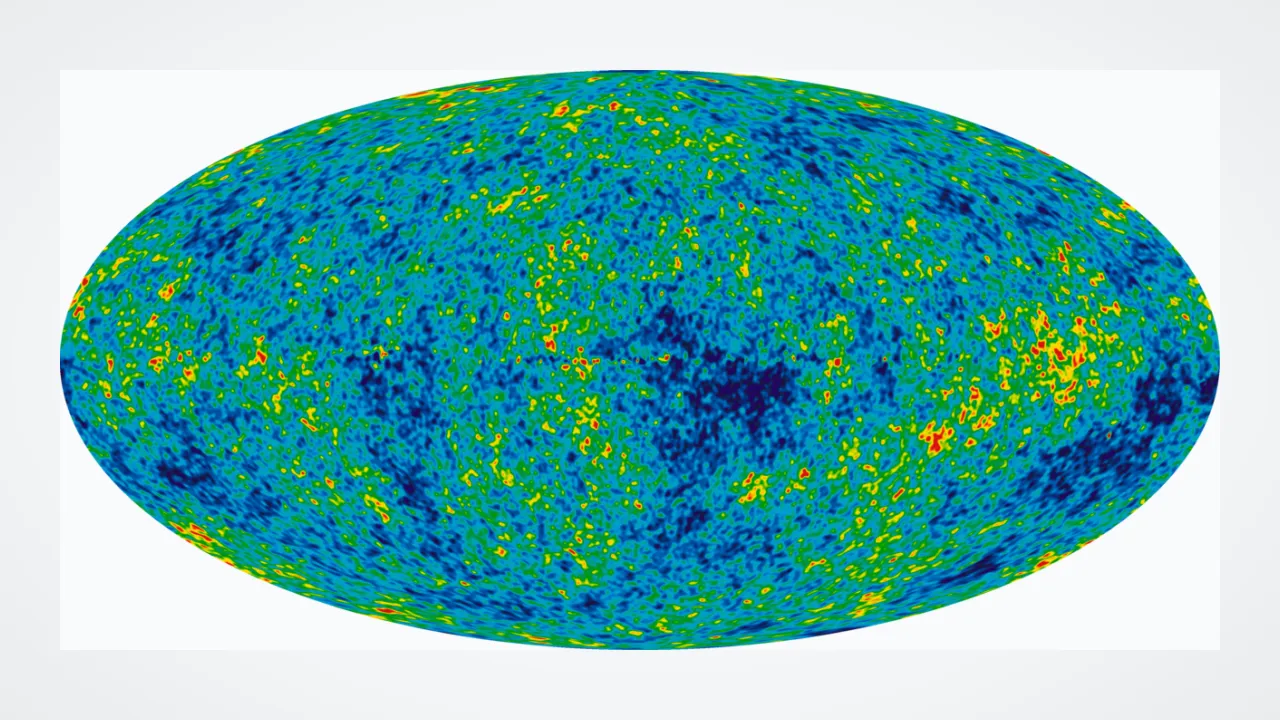
Extrapolating forward from European Space Agency Planck satellite maps of the early Cosmic Microwave Background under the standard $\Lambda$CDM cosmological model predicts a present-day expansion rate of $H_0 \approx 67.4 \pm 0.5 \text{ km/s/Mpc}$. Yet local Cepheid-supernova distance ladders measured independently by Hubble and cross-checked with JWST infrared photometry yield $73.0 \pm 1.0 \text{ km/s/Mpc}$—a stubborn $>5\sigma$ discrepancy pointing toward possible early dark energy, interacting neutrinos, or evolving cosmic geometry!
5
DESI Maps Dynamic Dark Energy
Using 5,000 robotic fiber-optic positioners atop Kitt Peak in Arizona, the Dark Energy Spectroscopic Instrument (DESI) has already measured 3D redshifts of tens of millions of galaxies and quasars across 11 billion years of cosmic history—tracking subtle 'baryon acoustic oscillation' rulers to test whether dark energy stays constant or slowly weakens over eons.