1. Why does a red giant shine orange-red instead of yellow-white?
2. Roughly how long from now will our Sun turn into a red giant?
🤯 Mind-Blowing Fact • Grade 2
Even though a red giant is huge, its puffed-up outer layers are thinner than the air inside a vacuum cleaner bag!
✨ Word Sparks (Grade 2 Glossary)
Tap 🔊 to hear
hydrogen
Lightest gas and main fuel inside stars
helium
Light gas made when stars fuse hydrogen
shell
A hollow layer wrapping around a center
🪝
Why does running OUT of fuel in the middle make a star grow a hundred times bigger?
1
Running Low on Hydrogen
For billions of years, a star like our Sun squeezes atoms together in its center to make and bright sunshine. Eventually, the very center runs out of hydrogen fuel! Gravity squeezes that core tighter and hotter, lighting up a roaring ring of fresh hydrogen around the outside of the core.
2
Puffing Outward
That new burns so fiercely that it pushes the star's outer gas layers outward millions of miles! Stretched thin, the surface cools and turns glowing orange-red while shining hundreds of times brighter overall.
3
Swallowing Close Planets
When a red giant swells, inner rocky planets like Mercury and Venus get gobbled right up inside the giant star's outer clouds!
1. What triggers a Sun-like star to start swelling into a red giant?
2. How thick is the puffed-up outer gas of a giant red giant star?
🤯 Mind-Blowing Fact • Grade 3
Astronomers caught a real red giant star named ZTF SLRN-2020 flashing 100 times brighter as it swallowed a Jupiter-sized planet 12,000 light-years away!
✨ Word Sparks (Grade 3 Glossary)
Tap 🔊 to hear
main sequence
Long steady middle life of hydrogen-fusing stars
fusion
Smashing small atoms together to release energy
habitable zone
Orbit distance mild enough for liquid water
🪝
Could frozen icy moons around Jupiter and Saturn warm up into ocean worlds when our Sun becomes a red giant?
1
Leaving the Main Sequence
Astronomers call steady, middle-aged hydrogen-burning stars 'main-sequence' stars. When a star weighing between half and eight times our Sun's mass uses up its core hydrogen, that peaceful balance ends. Gravity crushes the helium core smaller and hotter, sparking furious in a surrounding hydrogen shell that inflates the star 100 to 200 times wider!
2
Cooler Surface, Bigger Glow
Its surface cools down to around 5,000 to 8,000 degrees Fahrenheit, shifting its color to ruby or tangerine. Yet because its glowing surface area is now gigantic, a red giant shines hundreds or thousands of times brighter than before!
3
Forging Carbon for Life
Deep inside the squeezed core, temperatures hit 180 million degrees Fahrenheit! Helium atoms slam together to forge carbon and oxygen—the exact atoms that build plants, oceans, and people.
4
Shifting the Habitable Zone
When our Sun swells in five billion years, scorching inner worlds, icy moons like Europa and Titan far out in the Solar System may thaw into warm ocean worlds!
1. How can a red giant shine thousands of times brighter than our Sun if its surface is actually cooler?
2. Which two life-building elements are forged when a red giant fuses helium in its super-hot core?
🤯 Mind-Blowing Fact • Grade 4
Red giant Mira sheds so much gas as it plows through space that NASA's GALEX ultraviolet telescope discovered a comet-like tail of star-stuff stretching 13 light-years behind it!
✨ Word Sparks (Grade 4 Glossary)
Tap 🔊 to hear
radiation pressure
Outward push exerted by intense starlight
helium flash
Sudden runaway ignition of helium in cores
planetary nebula
Glowing gas shell shed by dying giants
🪝
What happens during a 'helium flash' when a red giant's core unleashes as much power as an entire galaxy for a few seconds?
1
The Mirror Principle Inside Stars
Astrophysicists often describe evolved stars using the 'mirror principle': whenever a star's core contracts, its outer envelope expands! Once core hydrogen turns entirely to helium ash, fusion halts at the center. Gravity crushes the core down toward Earth's size, superheating a surrounding hydrogen shell whose intense bloats the outer atmosphere across Earth-orbit scales.
2
The Runaway Helium Flash
In low-to-medium-mass stars like our Sun, electrons inside that crushed helium core pack so tightly they become 'degenerate'—behaving like a rigid quantum solid rather than normal gas. When core temperatures reach 100 million kelvins, helium fusion ignites all at once in a runaway ''! For a few seconds, the core generates power rivaling the entire Milky Way—yet every bit gets absorbed expanding the core without blowing the star apart.
3
Mira Variables and Stellar Winds
Later, during the asymptotic giant branch (AGB) phase, stars like Mira ('The Wonderful') pulsate rhythmically over hundreds of days, swelling and dimming while gentle stellar winds shed carbon-rich stardust into space.
4
Blossoming Into a Planetary Nebula
Finally, the red giant exhales its outer layers as a glowing butterfly-shaped , leaving its hot white dwarf heart behind.
1. Why doesn't the enormous 'helium flash' blow a red giant star to pieces?
2. What remains after a Sun-like red giant gently sheds its outer layers as a planetary nebula?
🤯 Mind-Blowing Fact • Grade 5
Half of all elements heavier than iron—including the barium in medical X-rays and lead in pencils' history—are cooked slowly inside pulsing asymptotic giant branch red giants!
✨ Word Sparks (Grade 5 Glossary)
Tap 🔊 to hear
triple-alpha process
Fusion of three helium nuclei into carbon
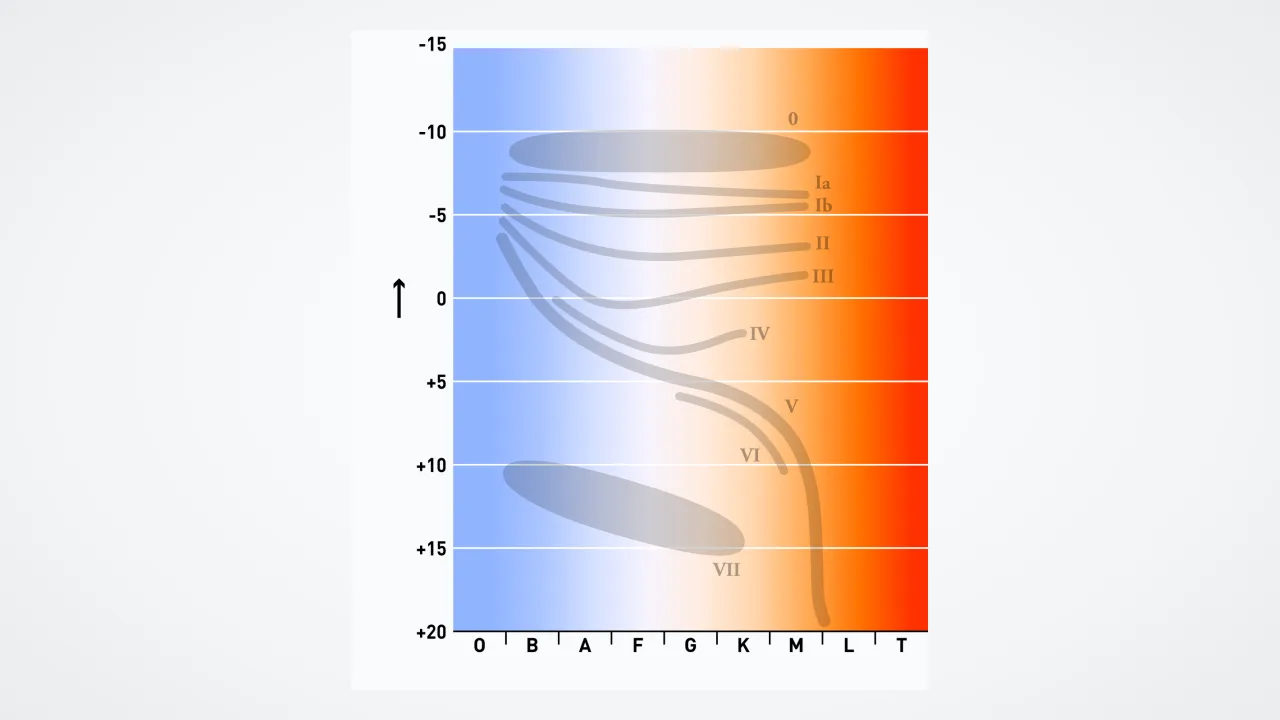
H-R diagram
Chart comparing star brightness against surface temperature
asteroseismology
Studying star interiors through brightness sound ripples
🪝
How did Fred Hoyle predict an exact quantum resonance inside carbon atoms just by realizing red giants had to forge the elements of life?
1
Climbing the Hertzsprung-Russell Diagram
When Ejnar Hertzsprung and Henry Norris Russell plotted stellar luminosity against surface temperature in the early twentieth century, they noticed cool K- and M-type stars split into two dramatic groups: dim main-sequence dwarfs and luminous giants shining 100 to 10,000 times brighter than the Sun. Applying the Stefan-Boltzmann law ($L = 4\pi R^2 \sigma T^4$), cool ~3,500 K temperatures paired with immense luminosity proved these stars possessed radii spanning up to 1 astronomical unit!
2
Hoyle's Triple-Alpha Breakthrough
Turning helium-4 nuclei into carbon-12 puzzled nuclear physicists because two helium nuclei form unstable beryllium-8 that decays in $10^{-16}$ seconds. In 1953, Fred Hoyle reasoned that since carbon-based life exists, carbon-12 MUST possess an excited quantum resonance at 7.65 MeV allowing a third helium nucleus to fuse inside red giant cores at $10^8$ K—a prediction laboratory physicists verified within days!
3
Distinguishing Red Giants From Red Supergiants
Stellar mass draws a sharp evolutionary dividing line across the upper right of the . Intermediate-mass stars ($0.5$ to $8 M_\odot$) ascend the red giant branch and subsequent asymptotic giant branch (AGB), undergoing thermal helium-shell pulses before gently expelling glowing planetary nebulae. Massive stars ($>8 M_\odot$) such as Betelgeuse and Antares instead swell into colossal red supergiants up to 800 solar radii wide, fusing heavier elements all the way to iron before detonating as core-collapse supernovae.
4
Asteroseismology and Dredge-Ups
Deep convective 'dredge-up' currents scoop freshly forged carbon, nitrogen, and slow-neutron-capture ($s$-process) heavy elements like barium, strontium, and zirconium up to the visible photosphere. Meanwhile, ultra-precise Kepler and TESS space-based tracks mixed gravity-acoustic oscillation waves rippling deep inside red giant cores, cleanly distinguishing hydrogen-shell-burning ascenders from older helium-core-burning 'red clump' stars.
5
Earth's Ultimate Orbital Fate
Roughly 7.5 billion years from now, steady solar wind mass loss will weaken the Sun's gravitational grip enough to let planetary orbits spiral slightly outward—saving Mars and the outer worlds, while tidal bulges raised on the bloated solar chromosphere will likely drag Mercury, Venus, and Earth inward to vaporize.