💡 INVENTIONS
⚙️ c. 1873 CE • Mechanical Typewriter Layout
VA Science, Engineering & History SOL
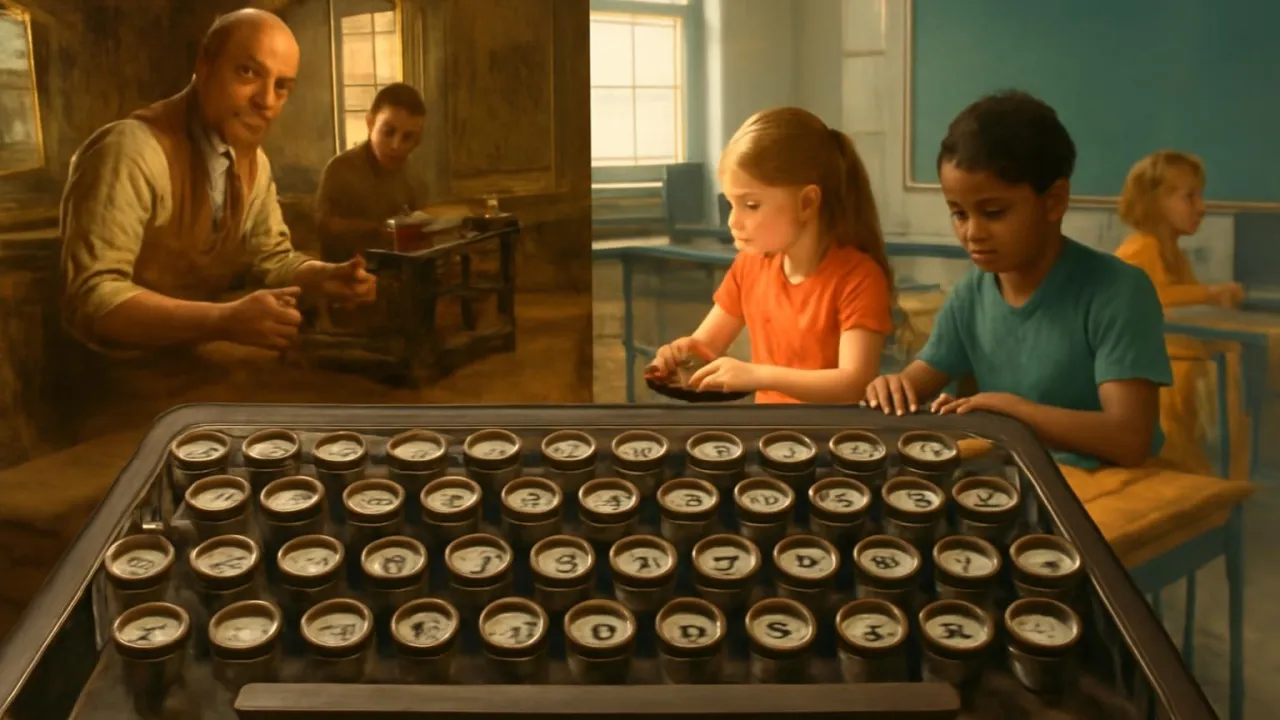
QWERTY Keyboard
The Click-Clack Code That Changed Writing
Grade 5 • Advanced • 333 words
🧑🔬 Inventor & OriginChristopher Latham Sholes • Milwaukee, USA
⏳ Year Invented1873 CE (19th Century)
⚙️ How It WorksKeys are pressed to make letters appear on paper or a screen
⚡ World-Changing SparkMade fast, organized typing possible worldwide
🤯 Mind-Blowing Fact • Grade 1
The QWERTY pattern is on almost every computer and phone in the world!
✨ Word Sparks (Grade 1 Glossary)
Tap 🔊 to hear
keyboard
A board with many letter keys
type
To press keys to write words
screen
A flat part that shows words
🪝
What sound do you hear when fingers tap keys fast?
1
Tap, Tap, Tap!
Fingers tap keys in a line. Each key makes a little click. Letters pop up on a . Words appear fast and neat.
2
A Secret Code
The keys are in a special order. Q, W, E, R, T, and Y are at the top. It helps people quickly.
3
Everywhere You Look
="button" class="ca-inline-spark" onclick="pulseWordSpark(1, 0)" title="Tap to highlight Word Spark">Keyboards are in schools and homes. People use them to write and play. You can find them on computers and tablets!
The first QWERTY keyboard was made for a typewriter in 1873!
✨ Word Sparks (Grade 2 Glossary)
Tap 🔊 to hear
pattern
A special order of things
inventor
A person who creates something new
typewriter
A machine that types letters on paper
🪝
Have you ever wondered why keyboards look the way they do?
1
A Busy Row of Keys
When you press the keys, you hear clicking sounds and see words appear. The keys are not in ABC order, but in a special . This pattern is called QWERTY, named after the first six letters on the top row.
2
Why QWERTY?
Long ago, jammed if people typed too fast. The , Christopher Sholes, made the QWERTY layout to slow down jams and help people type better. Now, almost every computer and phone uses this .
3
Typing All Around Us
People use QWERTY keyboards to write stories, search online, and play games. You can find them in classrooms, offices, and even on tablets. Typing helps people share ideas quickly and easily.
The word 'typewriter' can be typed using only the top row of a QWERTY keyboard!
✨ Word Sparks (Grade 3 Glossary)
Tap 🔊 to hear
layout
How things are arranged or set up
vibration
A shaking or moving back and forth
efficient
Doing something in the best way
🪝
What if every keyboard looked different—would typing be slower or faster?
1
The Puzzle of the Keys
When you press a key, you hear a click and see a letter on the screen. The QWERTY keyboard looks like a puzzle because the letters are not in alphabetical order. This special helps people type quickly and avoid jams on old typewriters.
2
Inventing a New Way to Write
Christopher Latham Sholes invented the QWERTY in 1873 for the first successful typewriter. He arranged the keys so that common letter pairs, like TH or ER, were far apart. This design reduced the and jamming of typewriter arms when people typed fast.
3
From Typewriters to Tablets
Even though computers and phones do not jam, the QWERTY pattern stayed popular. People learned to type so fast that the pattern became the standard for almost every device. Today, QWERTY keyboards are used by billions of people to write, search, and play games.
4
How Does It Work?
When you press a key, a signal tells the computer which letter to show. The QWERTY groups certain letters together, making typing more . This arrangement is called a layout, and it helps your fingers move smoothly across the keyboard.
There are more than 2 billion QWERTY keyboards in use worldwide today!
✨ Word Sparks (Grade 4 Glossary)
Tap 🔊 to hear
resonance
A strong, repeating vibration or sound
efficient
Getting things done with less effort
adapted
Changed to fit a new use
🪝
Imagine typing a story if the keys were in a different order—how would that feel?
1
A Clever Solution for a Mechanical Problem
In the late 1800s, typewriters often jammed when people typed quickly, because their metal arms would collide. Christopher Latham Sholes and his team designed the QWERTY keyboard layout to space out commonly used letter pairs, reducing mechanical jams. This clever arrangement allowed typists to work faster without causing the typewriter to break down. The QWERTY system soon became the standard for typewriters everywhere.
2
The Science Behind the Layout
The QWERTY layout is not random; it is based on how often certain letters and letter pairs are used in English. By separating frequent pairs, Sholes minimized the and vibration that led to jams. This layout also encouraged typists to use both hands, balancing the work between left and right. The design made typing more , even though it was not in alphabetical order.
3
From Paper to Pixels
When computers replaced typewriters, the QWERTY layout was kept because millions of people already knew how to use it. Today, QWERTY is found on laptops, tablets, and smartphones, connecting the past to the present. Even though technology changed, the familiar key pattern stayed the same. This shows how one invention can shape how we work for generations.
4
A Global Impact
The QWERTY keyboard helped people write faster, share ideas, and connect across the world. It made it possible to send letters, write books, and even code computers. As new devices appeared, the QWERTY layout was for touchscreens and other languages. Its influence can be seen in almost every country, making it one of the most important inventions for communication.
The longest word you can type using only the left hand on a QWERTY keyboard is 'stewardesses.'
✨ Word Sparks (Grade 5 Glossary)
Tap 🔊 to hear
digraph
Two letters that make one sound together
technological inertia
When old designs stay because people are used to them
ergonomic
Designed to be comfortable and efficient for people
🪝
If you could redesign the keyboard, what would you change to make typing even faster?
1
The Engineering Challenge of Early Typewriters
In the 19th century, inventors raced to create machines that could print letters faster than handwriting. Christopher Latham Sholes, along with his colleagues Carlos Glidden and Samuel Soulé, faced a major engineering problem: early typewriters jammed when neighboring typebars struck the paper in quick succession. To solve this, Sholes developed the QWERTY layout in 1873, intentionally spacing out commonly paired letters to minimize mechanical collisions and improve reliability.
2
Designing for Efficiency and Mechanical Limits
The QWERTY arrangement was not random; it was engineered based on letter frequency and common English like 'TH' and 'ER.' By separating these pairs, Sholes reduced resonance and allowed the typewriter's mechanical arms to reset smoothly. The design also balanced finger movement between both hands, promoting efficiency. This layout was patented and quickly adopted by Remington, the leading typewriter manufacturer of the era.
3
From Metal Arms to Digital Signals
With the advent of computers, the mechanical problems of typewriters disappeared, but the QWERTY layout remained. Modern keyboards use electrical circuits instead of metal arms, translating each key press into a digital signal that appears instantly on a screen. Despite technological advances, the familiar QWERTY pattern endures because millions of people are trained to use it, making it a powerful example of .
4
Global Spread and Cultural Impact
The QWERTY keyboard has become a global standard, adapted for dozens of languages and alphabets. Its influence extends to smartphones, tablets, and even assistive technology for people with disabilities. The layout has shaped how people communicate, learn, and work, enabling rapid information sharing across continents. Some alternative layouts, like Dvorak or AZERTY, exist, but QWERTY remains the most widely used due to its historical momentum.
5
The Legacy of QWERTY and Future Innovations
Today, over two billion QWERTY keyboards are in daily use worldwide, from classrooms to coding labs. The design’s legacy is seen in everything from computer science to social media, demonstrating the lasting impact of a well-engineered solution. As technology evolves, new input methods like voice recognition and touchscreens may challenge QWERTY’s dominance, but its story shows how engineering, history, and human habits shape the tools we use every day.