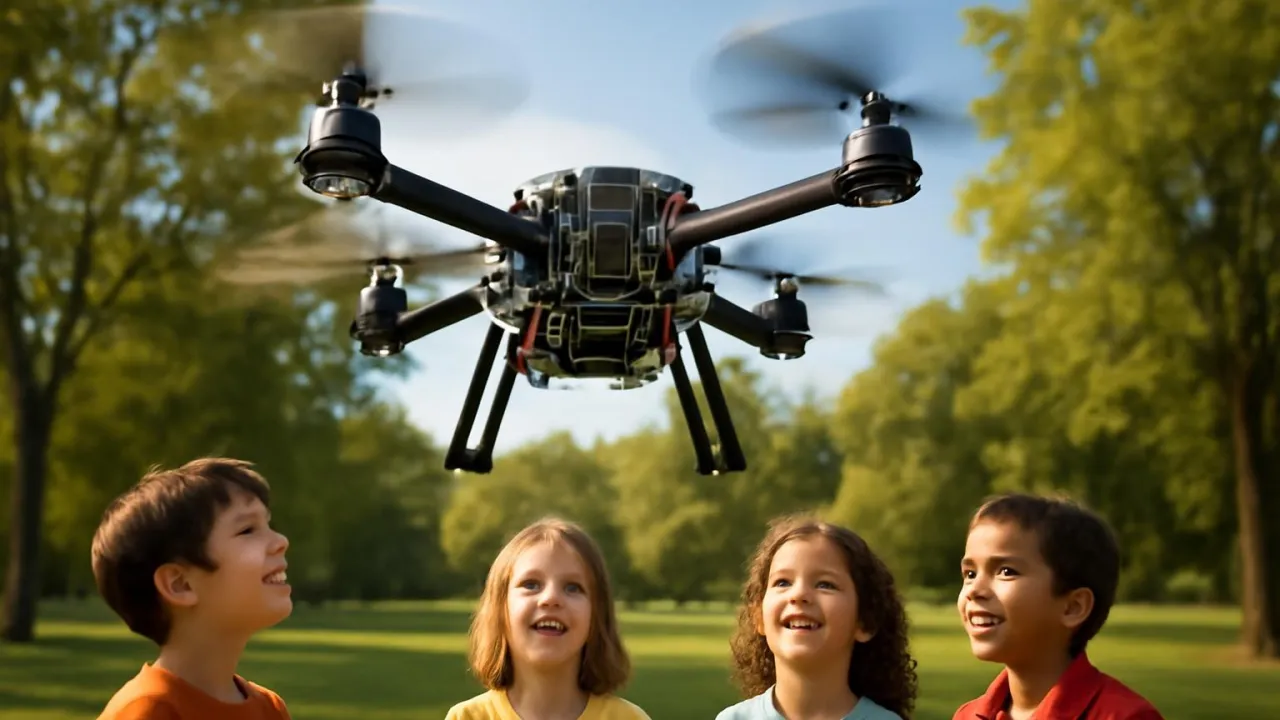
The world’s smallest drone is smaller than a tennis ball!
✨ Word Sparks (Grade 2 Glossary)
Tap 🔊 to hear
signal
A message sent to control something
zoom
Move very fast
competition
A fun race or contest
🪝
Have you ever heard a drone’s buzzing wings and wondered how it flies?
1
Flying with Four Blades
Quadcopter drones use four spinning blades to lift into the air. Each blade moves quickly, making a buzzing sound as the drone rises. People use controllers to steer the drone left, right, up, or down. Drones can fly over parks, houses, and even rivers.
2
What Makes It Move?
The spinning blades push air down, which lifts the drone up. The controller sends to the drone, telling it how to turn or stop. Some drones even have cameras to take pictures from above. Drones can hover in one place or around very fast.
3
Cool Things Drones Can Do
Drones help people take amazing photos and videos from the sky. They can find lost animals or help firefighters see hard-to-reach places. Some kids race drones in fun . Drones let us explore places we cannot go ourselves.
Some quadcopters can fly over 100 miles per hour in races!
✨ Word Sparks (Grade 3 Glossary)
Tap 🔊 to hear
rotor
A spinning blade that lifts the drone
torque
A turning force that spins things
prototype
A first test version of an invention
🪝
Imagine hearing a sharp buzzing above and looking up to spot a tiny flying robot—what keeps it in the air?
1
The Four-Rotor Wonder
Quadcopter drones are named for their four spinning , or blades. Each rotor vibrates as it spins, creating lift that pushes the drone skyward. The rotors are arranged in a square, with two spinning clockwise and two spinning counterclockwise. This special design keeps the drone balanced and steady in the air.
2
How Drones Fly and Turn
A quadcopter’s electronic controller sends signals to each , changing their speed. When the rotors spin faster, the drone rises higher, and when they slow down, it lowers. To turn or tilt, the controller makes some rotors spin faster than others, using the principle of . This lets the drone hover, zoom, or even flip.
3
Amazing Uses for Quadcopters
Quadcopter drones can carry small cameras to record videos and take photos from above. Scientists use drones to study forests, animals, and even volcanoes without getting too close. Some drones help deliver packages or search for lost hikers. Racing drones are built for speed and can twist through obstacle courses.
4
From Toy to Tool
The first quadcopter appeared in the early 2000s, using lightweight materials and smart electronics. Engineers earned patents for their clever designs, making drones safer and easier to fly. Today, quadcopters are used by kids, scientists, and rescue teams all over the world. Their ability to hover and move in any direction makes them powerful flying tools.
1. Why do quadcopters have two rotors spinning each way?
2. What is a common use for drone cameras?
🤯 Mind-Blowing Fact • Grade 4
Some modern quadcopters can carry over 20 pounds of supplies for rescue missions.
✨ Word Sparks (Grade 4 Glossary)
Tap 🔊 to hear
aerodynamic
Shaped to move easily through air
microprocessor
A tiny computer that controls things
erosion
When wind or water wears away land
🪝
What if you could see your neighborhood from a bird’s-eye view using a high-tech flying machine?
1
The Science of Four Rotors
Quadcopter drones rely on four precisely arranged rotors, each powered by its own electric motor. The rotors’ rapid spinning creates upward thrust by forcing air downward, a principle called lift. Two rotors spin clockwise and two spin counterclockwise, which helps cancel out unwanted spinning, or yaw, and keeps the drone stable. The electronic controller adjusts each rotor’s speed to steer, hover, or perform flips.
2
From Early Experiments to Modern Marvels
The idea of multi-rotor flight dates back to early 20th-century prototypes, but true quadcopters emerged in the early 2000s. Inventors like Louis Le Masne and Jordi Muñoz combined lightweight frames with advanced sensors and , allowing drones to react instantly to wind and movement. Their patents and innovations made drones reliable for both fun and important jobs.
3
How Drones Are Changing Our World
Today, quadcopters are used in many fields, from delivering medicine to filming movies and monitoring wildlife. Scientists use drones to study , map forests, and track endangered animals in remote places. Emergency teams fly drones to survey disaster areas quickly and safely, while hobbyists race drones through challenging courses for sport.
4
The Future of Aerial Robotics
As technology improves, drones are becoming smarter, faster, and more energy efficient every year. Engineers are developing advanced sensors and artificial intelligence to help drones avoid obstacles and fly longer distances. With new uses appearing all the time, quadcopters are reshaping how we explore, learn, and solve problems from the sky.
The world’s largest quadcopter drone can lift over 200 pounds and fly for more than an hour.
✨ Word Sparks (Grade 5 Glossary)
Tap 🔊 to hear
gyroscope
A spinning sensor that helps balance things
vector thrust
Changing direction by aiming force
autonomous
Able to work or fly by itself
🪝
If you could design a flying robot, how would you make it balance, steer, and see the world below?
1
Engineering the Quadcopter’s Flight
Quadcopter drones achieve flight by precisely controlling four rotors, each powered by a high-speed electric motor. The rotors are arranged in a square, with adjacent pairs spinning in opposite directions to counteract torque and maintain yaw stability. By varying the speed of each rotor, the drone can ascend, descend, tilt, or rotate in place, using the principles of aerodynamic lift and . Electronic speed controllers and gyroscopic sensors constantly adjust the motors to respond to wind, movement, or commands from the pilot. This sophisticated system allows quadcopters to hover, maneuver with agility, and even perform complex aerial tricks.
2
From Early Concepts to Modern Robotics
While early multi-rotor flying machines were tested as far back as the early 1900s, practical quadcopters became possible only with the invention of lightweight materials and microprocessors in the 21st century. Pioneers like Louis Le Masne and Jordi Muñoz developed the first consumer-friendly drones in 2006, integrating accelerometers, GPS, and wireless communication for precise control. Their patented designs sparked a revolution, making unmanned aerial vehicles accessible to hobbyists, filmmakers, and scientists worldwide. Today’s quadcopters range from palm-sized toys to professional models capable of carrying heavy payloads.
3
Physics and Mathematics in Action
Quadcopters rely on Newton’s Third Law of Motion: for every action, there is an equal and opposite reaction. As each rotor blade spins, it pushes air downward, creating lift that counters gravity and raises the drone. The drone’s onboard computer calculates and adjusts power to each rotor hundreds of times per second, using feedback from and accelerometers. This real-time data processing enables precise stabilization, rapid turns, and recovery from turbulence. The mathematical algorithms behind these adjustments are essential for safe, smooth flight.
4
Global Impact and Real-World Applications
Quadcopter drones have transformed industries ranging from filmmaking and agriculture to emergency response and environmental science. Farmers use drones to monitor crops and spray fertilizers efficiently, while rescue teams deploy them to deliver medical supplies or survey disaster zones. In conservation, drones track animal migrations and document erosion in fragile ecosystems. Their ability to access dangerous or remote areas has saved lives and provided valuable data for researchers.
5
The Future of Aerial Innovation
As battery technology, artificial intelligence, and sensor systems continue to advance, quadcopters are expected to become even more and versatile. Engineers are developing drones that can navigate complex environments, avoid obstacles, and collaborate in swarms for large-scale mapping or delivery missions. With new regulations and ethical considerations emerging, the future of quadcopter drones promises safer skies, smarter machines, and endless possibilities for exploration and discovery.