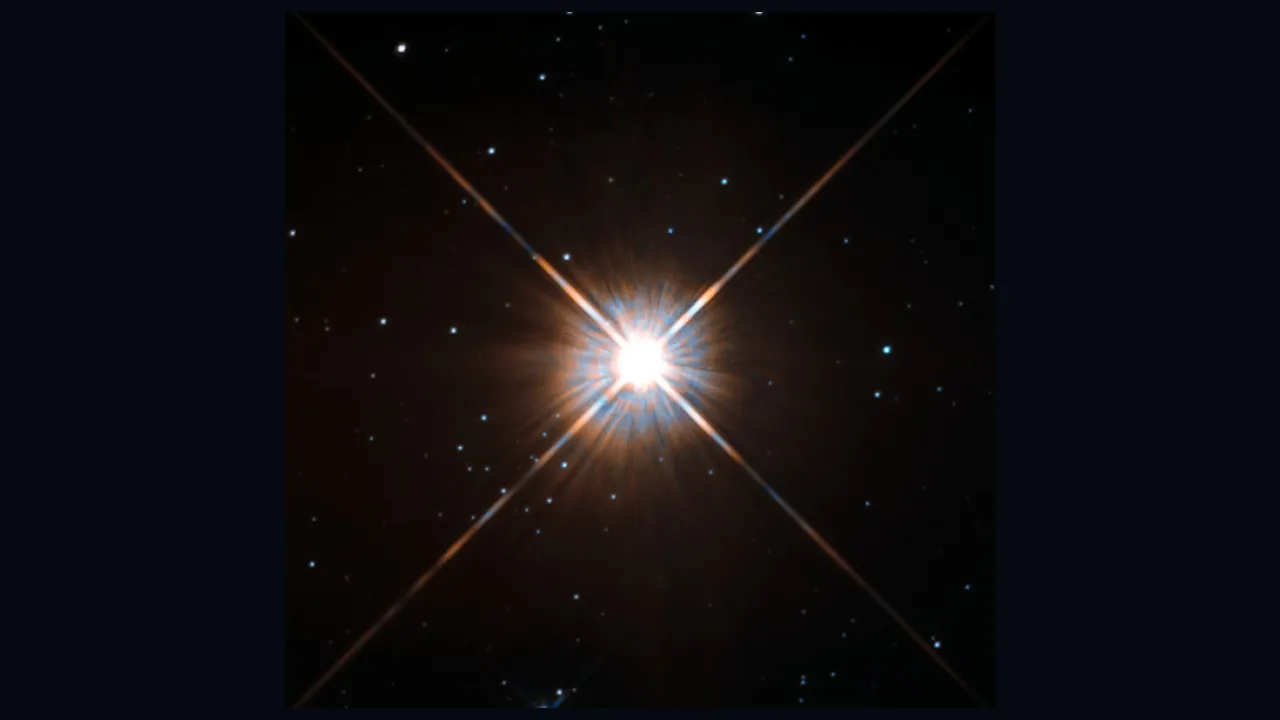
🪐 Scale / Diameter133,000 mi (214,000 km) diameter • 0.122 solar masses (1.5× Jupiter's width)
☄️ Composition & OrbitSlow-fusing convective hydrogen core • Orbits Alpha Centauri AB every ~550,000 years
⚡ Cosmic SparkClosest star beyond our Sun, hosting an Earth-sized rocky world and burning fuel for trillions of years
🤯 Mind-Blowing Fact • Grade 1
Even though Proxima Centauri is the closest star beyond our Sun, a jet airliner flying nonstop would take almost five million years to get there!
✨ Word Sparks (Grade 1 Glossary)
Tap 🔊 to hear
red dwarf
A small, cool star that glows dim red
neighbor
Someone or something living very close nearby
dim
Shining softly instead of super bright
🪝
Why can't you see our Sun's very closest neighbor star without a telescope?
1
Right Next Door in Space
After our bright daytime Sun, what star sits closest to Planet Earth? Say hello to Proxima Centauri! Even though it is our nearest star , it hides completely from your eyes at night.
2
Small, Cool, and Red
Why is it so hard to spot? This little star is barely wider than Giant Planet Jupiter and shines with a ruby glow!
3
A Rocky Planet Nearby
Best of all, an Earth-sized rocky planet circles close around this cozy red ember!
1. Why can't we see Proxima Centauri with just our eyes at night?
2. What exciting object orbits close around Proxima Centauri?
🤯 Mind-Blowing Fact • Grade 2
Because Proxima Centauri sips its fuel so gently, it will keep shining for about four trillion years—hundreds of times longer than our Sun will live!
✨ Word Sparks (Grade 2 Glossary)
Tap 🔊 to hear
exoplanet
A planet orbiting a star beyond our Sun
stellar flare
Sudden bright burst of energy from a star
proxima
A Latin word that means nearest or closest
🪝
What would the sky look like from a planet whose year lasts only eleven Earth days?
1
Named for Being 'Nearest'
In Latin, the word '' means 'nearest'—the perfect name for a star sitting 4.25 light-years from Earth in the southern constellation Centaurus! Scottish astronomer Robert Innes spotted it in 1915 by comparing star photos taken years apart and noticing one faint red dot creeping across the sky.
2
A Pint-Sized Star With Giant Flares
Measuring only one-seventh as wide as our Sun, this cool red dwarf sips its hydrogen fuel super slowly. Yet don't let its tiny size fool you: twisted magnetic storms often blast huge, bright off its surface!
3
World of the Eleven-Day Year
Orbiting snug beside it is Centauri b, a rocky that finishes a full trip around its star in just 11.2 days!
Why does our Sun's closest star neighbor have both a cozy habitable zone and fierce space weather?
1
Third Member of a Triple Star Family
Floating 25 trillion miles (4.246 light-years) away in Centaurus, Proxima Centauri is actually Alpha Centauri C—the smallest, outermost member of a triple star system! It loops lazily around the brighter twin stars Alpha Centauri A and B once every 550,000 years.
2
Barely Bigger Than Jupiter
Although Proxima Centauri weighs about 12 percent of our Sun's mass—roughly 129 Jupiters—gravity squeezes that gas down to a ball just 133,000 miles (214,000 km) wide. Its 5,000-degree-Fahrenheit surface shines with less than two-thousandths of our Sun's total brightness.
3
Discovering Proxima Centauri b
In 2016, European astronomers detected a tiny back-and-forth wobble in Proxima's starlight caused by an Earth-mass planet! Named Proxima Centauri b, it orbits inside the where temperatures could allow liquid water.
4
Superflare Challenge
There is one big catch: as an active flare star, Proxima Centauri sometimes brightens dozens of times in minutes, showering nearby planets with X-rays and light!
Postage-stamp-sized ultra-light robotic space probe
🪝
Why will tiny Proxima Centauri outlive every brilliant blue and yellow star shining in tonight's sky?
1
Fully Convective Fuel Saver
Inside a mid-sized star like our Sun, helium 'ash' builds up in a quiet central core where outer hydrogen fuel can never reach it, ending our Sun's main life after ten billion years. Proxima Centauri works completely differently! Weighing just 0.122 solar masses, this M5.5 red dwarf bubbles like a pot of simmering soup from center to surface. Full mixes every drop of hydrogen through its nuclear core, allowing it to shine steadily for roughly four trillion years—nearly 300 times the current age of our universe!
2
Magnetic Dynamo and the 2019 Extreme Superflare
That churning interior also twists powerful magnetic fields across its surface—over 600 times stronger on average than our Sun's! In May 2019, nine telescopes in space and on Earth watched Proxima Centauri unleash its biggest recorded superflare, brightening 14,000 times in ultraviolet light over just seven seconds.
3
A Multi-Planet Neighborhood
Radial-velocity instruments in Chile haven't stopped at one world. Alongside habitable-zone Earth-twin candidate Proxima b (1.07 Earth masses, 11.2-day orbit), astronomers uncovered tiny sub-Earth Proxima d—just a quarter of Earth's mass—skimming around the star every five days!
4
Target Number One for Interstellar Probes
Because Proxima Centauri sits 'only' 25 trillion miles away, futuristic laser-pushed concepts aim to zip past Proxima b within twenty years of launch and beam back humanity's first close-up exoplanet photos.
1. Why does full convection allow Proxima Centauri to shine for trillions of years?
2. Besides habitable-zone Proxima b, what inner planet was found orbiting every five days?
🤯 Mind-Blowing Fact • Grade 5
Because low-mass Proxima Centauri will never grow hot enough to fuse helium into carbon, trillions of years from now it will briefly turn into a rare 'blue dwarf' before cooling into a pure helium white dwarf—a stellar stage our 13.8-billion-year-old universe is still far too young to have produced even once!
✨ Word Sparks (Grade 5 Glossary)
Tap 🔊 to hear
proper motion
Apparent drift of nearby stars across Earth's sky
tidal locking
Gravity keeping one planet side always facing star
parsec
Astronomical distance unit equal to 3.26 light-years
🪝
How did blink-comparator glass plates, 40-centimeter-per-second Doppler spectroscopy, and convective magnetohydrodynamics make an 11th-magnitude red dwarf astronomy's premier exoplanet laboratory?
1
Blink-Plate Discovery and Bound Triple Dynamics
In 1915, Union Observatory director Robert Innes in Johannesburg examined photographic plates taken five years apart near Alpha Centauri and spotted a faint 11.1-magnitude red star sharing the bright pair's rapid across Centaurus. Two years later, Dutch astronomer Joan Voûte measured its trigonometric parallax, confirming it lay slightly closer than Alpha Centauri AB. Precision radial-velocity measurements with ESO's HARPS spectrograph in 2016 finally proved that Proxima Centauri (Alpha Centauri C) is gravitationally bound to AB in a vast, eccentric 550,000-year orbit, currently passing near apastron at 4.2465 light-years (1.302 ) from our Sun.
2
Interior Physics of a Fully Convective M5.5 Dwarf
Interferometric angular-diameter measurements with the Very Large Telescope peg Proxima's radius at 0.154 solar radii (~214,000 km) and its mass at 0.122 solar masses, yielding a mean density over forty times water's! Below ~0.35 solar masses, stellar interiors lack a radiative zone; full interior convection slowly fuses protons via the proton-proton chain at a bolometric luminosity of just 0.155% solar, preventing core helium stratification and extending Proxima's main-sequence lifespan to roughly four trillion years before it quietly becomes a helium white dwarf.
3
Doppler Precision: Proxima b and Sub-Earth Proxima d
In August 2016, the Pale Red Dot campaign detected a 1.4-meter-per-second Doppler reflex revealing Proxima Centauri b: a minimum-1.07-Earth-mass world orbiting at 0.0485 AU (7.25 million km) every 11.186 days inside the temperate liquid-water zone. Follow-up ESPRESSO observations on the VLT pushed radial-velocity precision to 40 centimeters per second—slower than a crawling baby—uncovering inner sub-Earth Proxima d (~0.26 Earth masses, 5.12-day period).
4
Space Weather Versus Planetary Habitability
Because Proxima b orbits twenty times closer to its star than Earth orbits the Sun, tidal forces likely lock one hemisphere in permanent ruby twilight while intense magnetic reconnection unleashes frequent X-ray and extreme-ultraviolet superflares—such as the May 2019 ALMA/Hubble event—posing a rigorous test for atmospheric retention on M-dwarf worlds across the galaxy.
5
Future Cosmic Encounters
Streaming subtly toward our Solar System, Proxima Centauri will make its closest approach ~27,000 years from now at roughly 3.0 light-years before continuing its grand galactic trek.