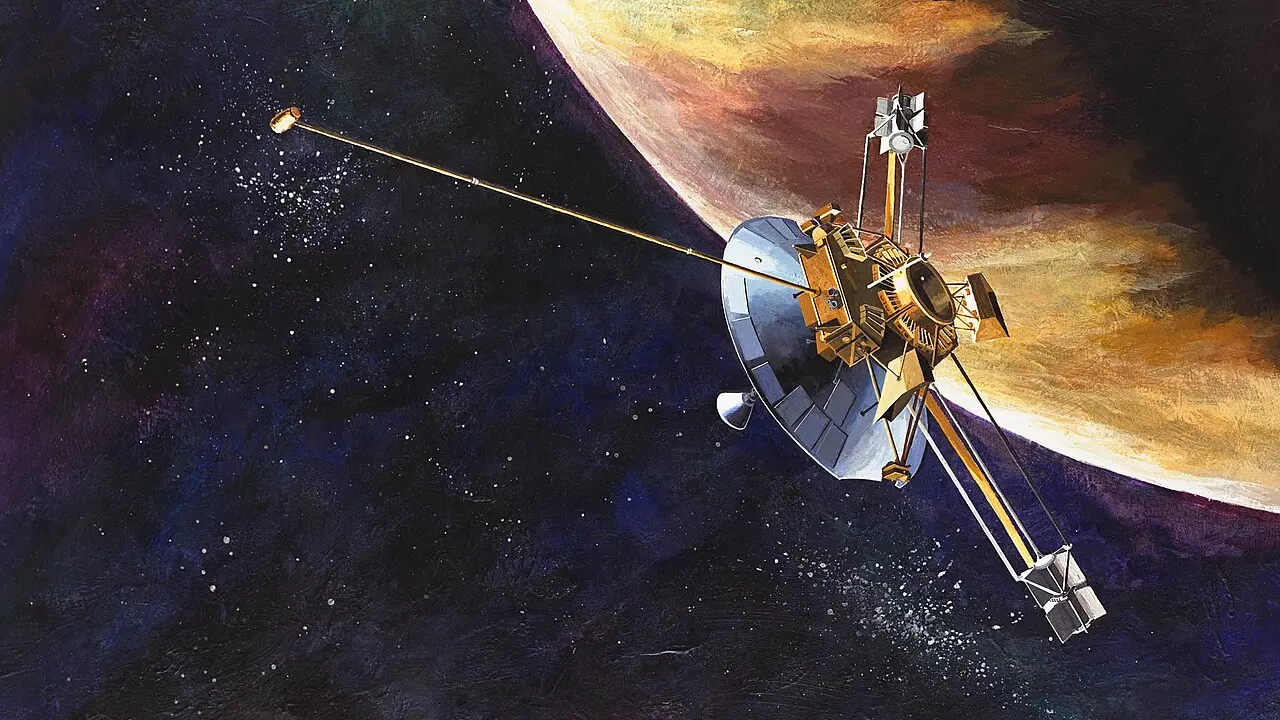
1. Which giant planet did Pioneer 10 visit up close for the very first time in history?
2. What is drawn on the shiny gold plaque attached to Pioneer 10?
🤯 Mind-Blowing Fact • Grade 2
Designed for a 21-month mission, tough little Pioneer 10 kept sending radio beeps back to Earth for more than thirty years until 2003!
✨ Word Sparks (Grade 2 Glossary)
Tap 🔊 to hear
radiation
fast invisible energy particles in space
Great Red Spot
giant swirling storm on planet Jupiter
escape path
route fast enough to leave Sun
🪝
Were space rocks packed like bumper cars beyond Mars, or could a spacecraft zip right through?
1
Testing an Unknown Highway
Before 1972, no spacecraft had ever ventured past Mars! Some scientists worried the Asteroid Belt might be choked with dusty boulders that would smash any probe to bits. Pioneer 10 bravely flew in first—and coasted across the 170-million-mile belt without a scratch!
2
Surviving Jupiter's Zapping Belts
In December 1973, Pioneer 10 skimmed just 81,000 miles above Jupiter's colorful swirling clouds and . Jupiter's fierce belts nearly fried its electronics, yet the tough little probe beamed back hundreds of dazzling measurements!
3
Sailing Toward a Red Star
Jupiter's giant gravity flung Pioneer 10 onto an out of our Solar System, heading toward the bright orange-red star Aldebaran!
1. What big worry did Pioneer 10 put to rest when it crossed the Asteroid Belt in 1972?
2. How long did Pioneer 10 keep talking to Earth compared to its planned 21-month mission?
🤯 Mind-Blowing Fact • Grade 3
Pioneer 10 didn't snap square TV pictures—instead, the whole spacecraft spun five times a minute so a narrow light sensor scanned Jupiter strip by strip like a paintbrush!
✨ Word Sparks (Grade 3 Glossary)
Tap 🔊 to hear
Van Allen belts
zones of radiation trapped around Earth
magnetosphere
protective magnetic bubble surrounding a planet
anodized
coated with protective metal layer
🪝
Why did later Voyager probes owe their survival at Jupiter to Pioneer 10's daring close brush?
1
First Nuclear-Powered Deep Space Probe
Picture blazing a trail where sunlight drops twenty-seven times weaker than at Earth! Launched on March 2, 1972 by NASA's Ames Research Center, lightweight Pioneer 10 became the first spacecraft powered completely by four plutonium-238 radioisotope generators mounted on booms.
2
Braving 10,000-Times Stronger Radiation
After proving the Asteroid Belt was spacious and safe, Pioneer 10 dove deep inside Jupiter's magnetic bubble in December 1973. Trapped electrons and protons blasted the probe with radiation ten thousand times stronger than Earth's ! Several false commands triggered and glass lenses darkened, yet Pioneer 10 survived—teaching engineers exactly how to radiation-harden Voyager and Galileo!
3
Beyond Neptune's Orbit
In June 1983, Pioneer 10 passed beyond the orbit of Neptune—then the farthest planet from the Sun—becoming the first craft to leave the planetary neighborhood behind.
4
Carl Sagan's Cosmic Map
Its 6-by-9-inch gold- aluminum plaque, designed by Carl Sagan, Frank Drake, and artist Linda Salzman Sagan, maps our Sun's address using fourteen pulsing stars!
1. How did Pioneer 10's scary brush with Jupiter's radiation help later missions like Voyager?
2. How did spinning Pioneer 10 build up its famous close-up images of Jupiter?
🤯 Mind-Blowing Fact • Grade 4
Pioneer 10 passed the Moon's distance in just 11 hours after liftoff—nearly seven times faster than the Apollo Moon missions!
✨ Word Sparks (Grade 4 Glossary)
Tap 🔊 to hear
liquid metallic hydrogen
crushed hydrogen acting like conducting metal
micrometeoroid
sand-sized speck of speeding space rock
photon
single tiny packet of light or heat
🪝
What mysterious tiny push slowed Pioneer 10 in deep space and stumped physicists for nearly twenty years?
1
Record-Shattering Departure
Climbing atop a three-stage Atlas-Centaur rocket with an extra solid-fuel kick motor on March 2, 1972, the 258-kilogram Pioneer 10 hurtled away at 32,400 miles per hour—passing the Moon's orbit in just eleven hours, compared to three days for Apollo astronauts! Over seven months inside the Asteroid Belt, panels filled with pressurized gas cells recorded surprisingly sparse dust impacts, clearing the path for outer-planet exploration.
2
Unlocking Jovian Interior Physics
During its December 3, 1973 periapsis 130,000 kilometers above Jupiter's cloud tops, Pioneer 10 measured Jupiter's immense magnetosphere, discovered that Jupiter radiates more heat from internal contraction than it absorbs from the Sun, and confirmed from gravity data that Jupiter lacks a solid surface beneath its churning hydrogen atmosphere—transitioning instead into a vast ocean of !
3
Decoding the Pioneer Plaque
Crafted in just three weeks before launch, the Pioneer Plaque uses a universal cosmic ruler: the 21-centimeter wavelength of a neutral hydrogen atom's spin flip! Radial lines give binary pulse rates and distances to fourteen Milky Way pulsars, pinpointing both Earth's location and the 1972 launch epoch.
4
Solving the 'Pioneer Anomaly'
Decades later, Doppler tracking showed Pioneer 10 slowing slightly more than solar gravity predicted! In 2012, Slava Turyshev's team solved this famous 'Pioneer Anomaly': uneven infrared heat radiating off the warm plutonium generators bounced backward off the big dish antenna, acting like a tiny brake!
1. What finally explained the mysterious 'Pioneer Anomaly' that gently slowed Pioneer 10 in deep space?
2. What universal measurement unit did Carl Sagan and Frank Drake etch onto the Pioneer Plaque so aliens could read sizes and distances?
🤯 Mind-Blowing Fact • Grade 5
In about two million years, silent Pioneer 10 will pass the bright orange bull's-eye star Aldebaran in the constellation Taurus—a journey more than six times longer than modern humans have existed on Earth!
✨ Word Sparks (Grade 5 Glossary)
Tap 🔊 to hear
spin-stabilized
kept pointing steady by gyroscopic rotation
synchrotron radiation
intense energy from electrons spiraling magnets
anisotropic
stronger in one direction than others
🪝
How did a modest 258-kilogram spin-stabilized scout prove outer-planet exploration was possible and test Einsteinian gravity at 80 AU?
1
Spin-Stabilized Engineering for Uncharted Space
Managed by NASA's Ames Research Center and built by TRW, Pioneer 10 pioneered ultra-reliable deep-space minimalism. Instead of complex three-axis reaction wheels and computer-steered camera platforms, the 258-kilogram spacecraft spun steadily at 4.8 revolutions per minute around the axis of its 2.74-meter parabolic high-gain antenna, keeping its radio beam locked onto Earth while four SNAP-19 plutonium-238 radioisotope thermoelectric generators delivered 155 watts at launch.
2
Surviving Jovian Synchrotron Belts
Crossing the main Asteroid Belt between July 1972 and February 1973, Pioneer 10's optical asteroid-meteoroid telescope and pressurized argon-nitrogen penetration cells overturned worst-case debris models. Diving within 2.86 Jovian radii on December 3, 1973, the probe endured electron fluxes a thousandfold above lethal human doses inside Jupiter's belts—mapping a colossal magnetotail stretching toward Saturn's orbit, measuring helium abundance via infrared radiometry, and imaging Galilean moons Ganymede and Europa alongside Jupiter's banded cloud decks.
3
Hyperbolic Escape and Heliospheric Science
Accelerated by Jupiter's gravitational slingshot past solar escape velocity, Pioneer 10 crossed beyond Pluto's and Neptune's orbits in June 1983—since Pluto then swung inside Neptune—and continued monitoring solar wind cosmic-ray modulation across seven solar cycles until its final faint telemetry arrived from 82.19 astronomical units on January 23, 2003.
4
Thermal Recoil and the Pioneer Anomaly
Precise S-band Doppler tracking of Pioneer 10 and twin Pioneer 11 uncovered a persistent sunward deceleration of 8.74 times 10 to the minus 10 meters per second squared beyond 20 AU. After recovering vintage 1970s telemetry tapes and building finite-element thermal models, researchers proved in 2012 that thermal radiation from the RTGs and instrument compartment accounted for 100 percent of the drift—confirming General Relativity across the outer Solar System.
5
Bound for Aldebaran
Coasting silently at 11.9 kilometers per second with its pulsar-mapped gold-anodized plaque intact, Pioneer 10 will glide past the orange giant star Aldebaran—65 light-years away in Taurus—roughly two million years from today.