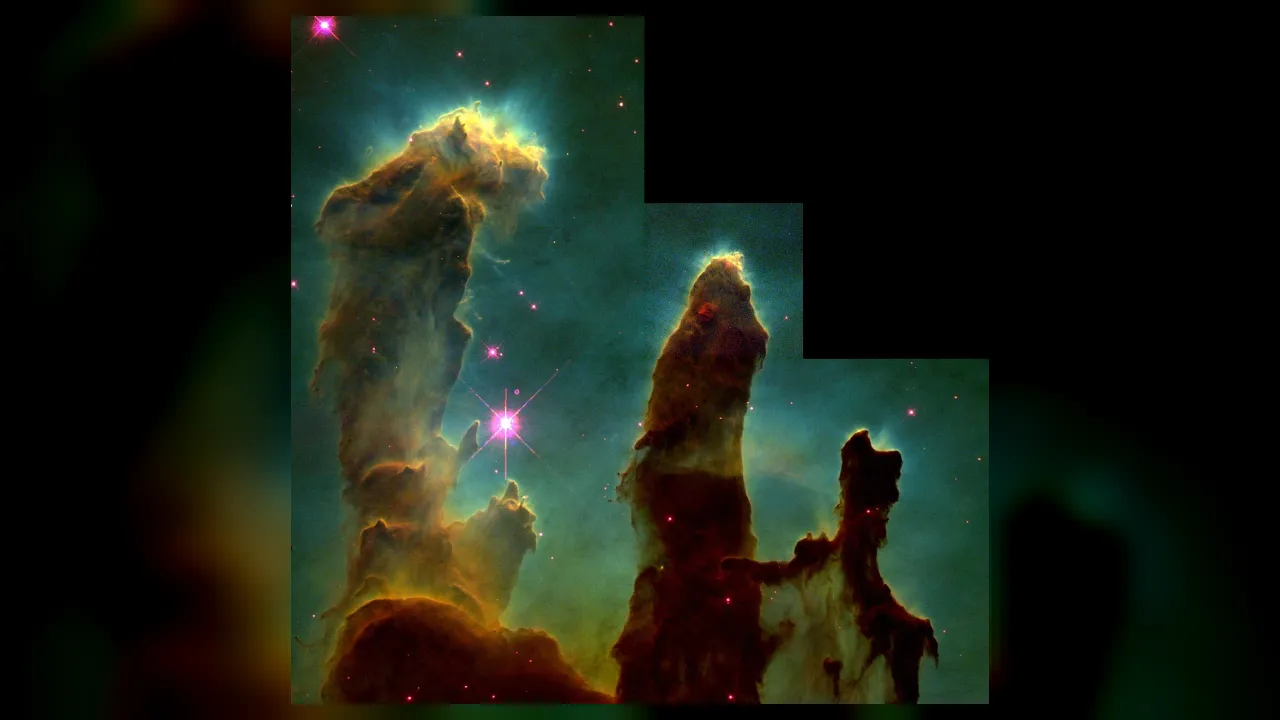
1. What is forming deep inside the Pillars of Creation?
2. Inside which larger nebula do the Pillars of Creation stand?
🤯 Mind-Blowing Fact • Grade 2
A beam of light racing at 186,000 miles per second still takes almost five full years to travel from the bottom of the tallest pillar to its top!
✨ Word Sparks (Grade 2 Glossary)
Tap 🔊 to hear
ultraviolet
Energetic invisible light from hot stars
cluster
Group of young stars shining close together
column
Tall upright tower of rock or gas
🪝
How did one space telescope picture make three clouds of dust world-famous?
1
Hubble's Most Famous Photo
In 1995, NASA's Hubble Space Telescope zoomed into the Eagle Nebula, 6,500 light-years away. It snapped a breathtaking photo of three golden-brown of gas and dust rising like desert canyons. People everywhere fell in love with the Pillars of Creation!
2
Carved by Starlight
Just above the pillars shines a of hot, massive young stars. Their fierce light and roaring winds blow loose gas away, carving the denser clouds into tall elephant-trunk shapes.
3
X-Ray Vision with Webb
Thick dust hides baby stars in ordinary light. When the James Webb Space Telescope looked in infrared light, the pillars turned see-through—revealing sparkling red newborn stars!
1. What carves the Pillars of Creation into their tall tower shapes?
2. How did the James Webb Space Telescope peer right through the thick brown dust of the pillars?
🤯 Mind-Blowing Fact • Grade 3
Astronomers gave those star-forming bumps at the pillar tips the nickname 'EGGs'—short for Evaporating Gaseous Globules!
✨ Word Sparks (Grade 3 Glossary)
Tap 🔊 to hear
photoevaporation
Starlight boiling gas off a cloud
protostar
Baby star still gathering gas and dust
globule
Compact dark pocket of star-forming gas
🪝
Why are the Pillars of Creation both building new stars and slowly melting away at the same time?
1
Heart of Messier 16
Point a telescope toward the constellation Serpens on a summer night to find Messier 16, famously called the Eagle Nebula. About 6,500 light-years away at its glowing core stand three dramatic columns of cold hydrogen gas and microscopic dust stretching nearly five light-years tall.
2
Cosmic Sandbars in a Storm
Think of how hard pebbles on a sandy beach block rushing waves, leaving neat ridges of sand tucked behind them. Dense knots of gas at the pillar tips shield the cool columns underneath while blazing young stars overhead boil away surrounding gas—a process called .
3
Finger-Shaped Star Eggs
Sticking out from the tops of the pillars are tiny finger-like bumps called Evaporating Gaseous , or EGGs! Each fingertip-sized bump is wider than our Solar System and shelters an embryonic star.
4
Crimson Jets in Webb's View
In 2022, the James Webb Space Telescope spotted wavy red glows along the pillar edges—supersonic jets shot out by newborn stars only a few hundred thousand years old!
1. What do astronomers call the dense, star-forming bumps at the tips of the Pillars of Creation?
2. What causes the wavy crimson-red glow along the pillar edges in James Webb Space Telescope images?
🤯 Mind-Blowing Fact • Grade 4
Even though the Pillars of Creation look dense like thunderheads, their gas is actually a better vacuum than almost any chamber scientists can pump out on Earth—it only looks thick because it spans trillions of miles!
✨ Word Sparks (Grade 4 Glossary)
Tap 🔊 to hear
molecular hydrogen
Cold paired hydrogen atoms forming stars
opaque
Blocking visible light from passing through
silhouette
Dark outline seen against bright background
🪝
How do ultraviolet radiation and gravity battle each other across five light-years of glowing nebula?
1
Sculpted by NGC 6611
Deep inside the Eagle Nebula (Messier 16) in the constellation Serpens, a brilliant open cluster of newborn O- and B-type stars known as NGC 6611 floods space with blistering ultraviolet light. Directly beneath those powerhouse stars stand the Pillars of Creation—three elephant-trunk columns of cold and silicate-carbon dust rising up to five light-years (nearly 30 trillion miles) long.
2
The Physics of Photoevaporation
When ultraviolet photons slam into the outer skin of the pillars, they heat and ionize hydrogen, sulfur, and oxygen atoms, causing ghostly blue-green wisps of gas to steam away into space. Dense pockets at the column summits act as cosmic umbrellas, shielding the cold shadow zones below so gravity can keep collapsing gas into protostars.
3
Comparing Hubble and JWST
Hubble's iconic 1995 and 2014 visible-light portraits showcase , silhouetted dust walls bathed in glowing ionized oxygen and hydrogen. In contrast, JWST's 2022 Near-Infrared Camera (NIRCam) and Mid-Infrared Instrument (MIRI) pierced straight through micron-sized dust grains, uncovering dozens of ruby-red protostars still wrapped in dusty cocoons along with wavy crimson shockwaves from supersonic newborn jets.
4
Ephemeral Cosmic Monuments
Because intense ultraviolet radiation erodes the pillars atom by atom every day, astronomers calculate these majestic towers are temporary sculptures that will completely evaporate over the next one to three million years, leaving behind a glittering open cluster of sibling stars.
1. Why do the Pillars of Creation look solid in photos even though their gas is thinner than a laboratory vacuum?
2. What will eventually happen to the Pillars of Creation over the next few million years?
🤯 Mind-Blowing Fact • Grade 5
Comparing Hubble's 1995 and 2014 portraits directly caught a narrow protostellar jet inside the Pillars stretching an extra 60 billion miles across space in just nineteen years!
✨ Word Sparks (Grade 5 Glossary)
Tap 🔊 to hear
stellar feedback
How young stars reshape birth clouds
narrowband
Filter isolating light from specific atoms
bipolar jet
Twin gas beams blasted from protostars
🪝
What do multi-wavelength observations from Hubble, Chandra, and Webb reveal about how massive stars regulate galactic star birth?
1
Icon of Modern Astrophysics
Situated roughly 1,700 to 2,000 parsecs (about 6,500 light-years) away inside the Sagittarius-Carina spiral arm of our Milky Way, Messier 16—the Eagle Nebula—harbors a brilliant two-million-year-old open cluster cataloged as NGC 6611. In April 1995, astronomers Jeff Hester and Paul Scowen used Hubble's Wide Field and Planetary Camera 2 to map optical emission from ionized hydrogen, singly ionized sulfur, and doubly ionized oxygen, unveiling the towering elephant-trunk columns immortalized worldwide as the Pillars of Creation.
2
Radiative Feedback: Triggering and Quenching
Spanning roughly four to five light-years along its tallest left trunk, this molecular complex illustrates 's fascinating dual role. Extreme ultraviolet radiation pouring from NGC 6611's massive O-type stars drives an ionization shock front into frigid molecular hydrogen (10–30 kelvins), compressing boundary layers to trigger gravitational collapse while simultaneously boiling away outer envelopes—capping the final masses of Evaporating Gaseous Globules (EGGs) before embedded protostars can accrete further.
3
JWST's Near- and Mid-Infrared Dissection
In late 2022, the James Webb Space Telescope combined NIRCam and MIRI imaging to separate dust grain populations from newborn stars. NIRCam resolved bright crimson lava-like knots along pillar edges where supersonic from Class 0 and Class I protostars—barely 100,000 to 300,000 years old—excite molecular hydrogen shocks, while MIRI highlighted ghostly gray-blue sheets of cool polycyclic aromatic hydrocarbons and silicate dust.
4
Testing the Supernova Shock Debate
In 2007, warm dust emission mapped by Spitzer sparked lively debate over whether a nearby supernova shockwave might have toppled the pillars 6,000 years ago—its light still en route to Earth. Subsequent Chandra X-ray surveys and 3D integral-field spectroscopy with ESO's MUSE instrument ruled out an imminent blast wave, confirming steady photoevaporative erosion over one to three million years.
5
Mirror of Our Own Sun's Birthplace
Short-lived radioactive isotopes preserved inside ancient Solar System meteorites prove our own Sun formed near massive O-type stars inside an energetic, turbulent nursery remarkably similar to Messier 16 some 4.57 billion years ago.