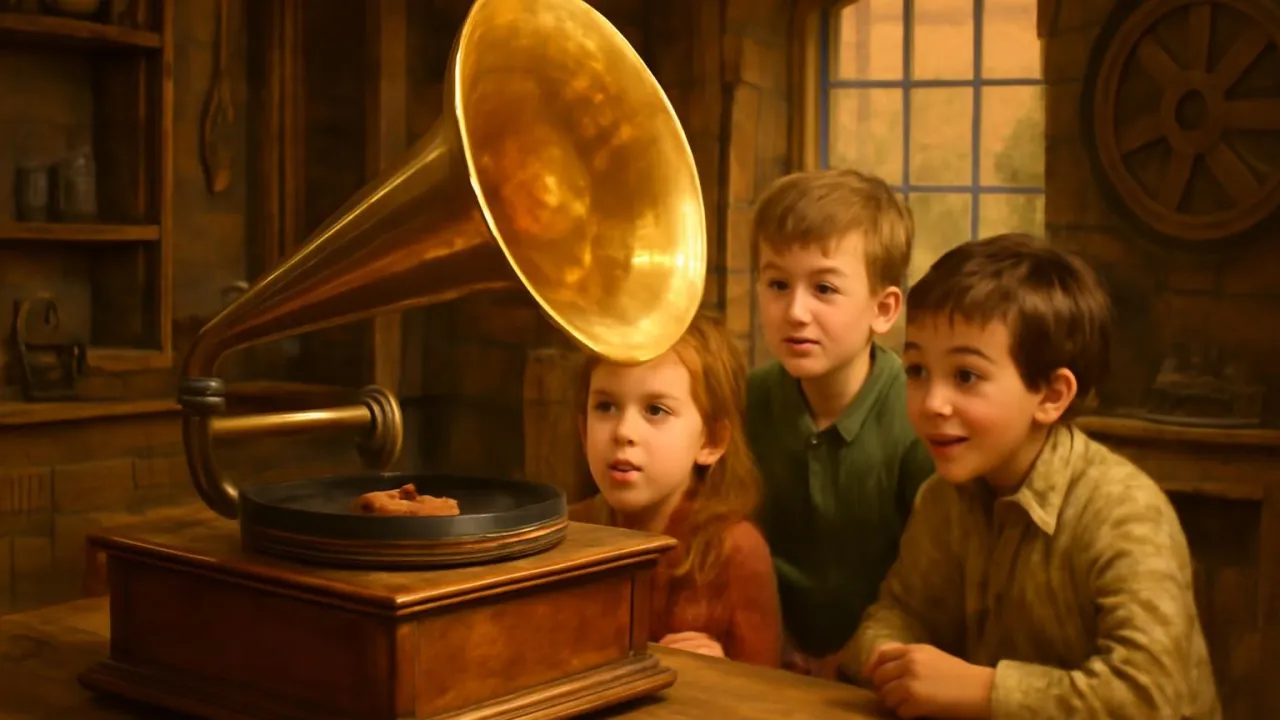
Early phonographs could record and play back voices, not just music!
✨ Word Sparks (Grade 2 Glossary)
Tap 🔊 to hear
groove
A tiny line in the record
invent
To make something new
spin
To turn around and around
🪝
Can you imagine hearing your favorite song spin from a shiny disc?
1
Music from a Machine
The phonograph has a shiny horn and a spinning disc. When you turn the handle, the disc and a needle moves. The needle follows tiny lines on the disc, making music play. Families loved listening to music together at home.
2
How Sound Travels
The disc has that wiggle as it . The needle rides in the grooves, and the horn makes the sound louder. People could play music or even record their own voices. It was like magic for everyone to hear.
3
A Special Invention
Thomas Edison invented the first phonograph in 1877. Before this, music could not be saved or replayed. The phonograph changed how people enjoyed music forever. It made sharing music fun and easy.
The very first song ever recorded was 'Mary Had a Little Lamb'—by Thomas Edison himself!
✨ Word Sparks (Grade 3 Glossary)
Tap 🔊 to hear
vibration
Fast shaking that makes sound
stylus
A needle that follows the grooves
amplify
To make sound louder
🪝
What would it feel like to hear your own voice coming from a spinning record?
1
The Magic of Recorded Sound
Imagine a time when music could only be heard live. The phonograph changed everything by letting people record and replay sound. Its large brass horn and spinning disc became symbols of early music technology. Families gathered around to listen to music and voices from the past.
2
How the Phonograph Works
A phonograph uses a needle, called a , to trace grooves on a record. These grooves are tiny wavy lines that represent sound . As the record spins, the stylus vibrates and creates sound waves. The horn amplifies these waves, making the music or speech loud enough to hear.
3
Inventing the Sound Machine
Thomas Edison invented the first phonograph in 1877, using a cylinder instead of a flat disc. Later, inventors improved it with flat records that were easier to use. The phonograph was the first invention to capture and replay sound, making it a true breakthrough.
4
Changing the World of Music
Before the phonograph, music could not be saved or shared. The phonograph allowed people to listen to music anytime, anywhere. It started a new era of recorded music and inspired many future inventions. Today, record players are still loved by music fans around the world.
2. Why was the phonograph a breakthrough invention?
🤯 Mind-Blowing Fact • Grade 4
Some early phonograph records could only play for two minutes before needing to be changed!
✨ Word Sparks (Grade 4 Glossary)
Tap 🔊 to hear
groove
A spiral path cut into a record
resonance
When something vibrates with strong sound
acoustic
Related to sound and hearing
🪝
What secrets are hidden in the tiny grooves of a spinning record?
1
A Revolution in Sound
Before the phonograph, music vanished as soon as it was played. In 1877, Thomas Edison invented the phonograph, a machine that could record and replay sound. Its brass horn, spinning disc, and moving needle brought music and voices back to life. This invention sparked a revolution in how people experienced sound.
2
The Science Behind the Music
The phonograph works by turning sound waves into physical on a record. As the record spins, a stylus rides along the grooves, vibrating with every bump and dip. These vibrations travel through the tonearm to the horn, where they are amplified into music or speech. The process is a brilliant example of mechanical and engineering.
3
From Cylinders to Discs
Edison's first phonograph used tinfoil cylinders, but later inventors like Emile Berliner improved the design with flat discs. Discs were easier to produce, store, and play, making music more accessible to everyone. The phonograph's design inspired future inventions like the gramophone and modern record players.
4
A Lasting Cultural Impact
The phonograph changed how people shared music, stories, and news across the world. It made it possible to preserve famous speeches and performances for future generations. Even today, vinyl records and turntables remain popular, showing the lasting influence of Edison's invention.
1. How does the phonograph turn grooves into sound?
2. Why did flat discs become more popular than cylinders?
🤯 Mind-Blowing Fact • Grade 5
In 1927, a phonograph record sent to space aboard Voyager 1 became Earth's message to the stars!
✨ Word Sparks (Grade 5 Glossary)
Tap 🔊 to hear
stylus
A fine-tipped needle that reads grooves
resonator
A part that makes sound bigger
analog
A way to store sound as wavy lines
🪝
What if you could see invisible sound waves captured forever in a spiral groove?
1
The Birth of Sound Recording
In the late 19th century, the world was transformed by a machine that could capture and replay sound. Thomas Edison invented the phonograph in 1877, using a rotating cylinder covered in tinfoil to record vibrations from voices and music. When someone spoke into the mouthpiece, a etched the sound waves as tiny grooves onto the cylinder’s surface. Later, playing the cylinder back made the stylus vibrate in the same pattern, recreating the original sounds through a large horn.
2
Engineering the Phonograph: Mechanics and Acoustics
The phonograph’s operation is based on the physics of vibration and acoustic amplification. As the cylinder or disc rotates at a constant speed, the traces the groove, which contains microscopic variations corresponding to the original sound waves. These vibrations travel through the tonearm and are mechanically amplified by the horn, which acts as a to boost volume without electricity. This mechanical process relies on precise engineering, as even tiny imperfections in the groove can distort the sound.
3
From Cylinders to Flat Discs: Evolution and Global Spread
While Edison’s original design used cylinders, Emile Berliner revolutionized the industry by inventing the flat disc record in the 1890s. Discs were easier to mass-produce, store, and ship, leading to the worldwide popularity of record players. By the early 20th century, phonographs were found in homes, concert halls, and radio stations across the globe. The technology evolved further with electric amplification, but the basic principle of a vibrating tracing a groove remained the same.
4
Quantitative Specs and Enduring Legacy
Early phonograph cylinders rotated at about 120 revolutions per minute and could record for up to two minutes. Later, standard 78 RPM records held about three to five minutes of audio per side, while LP (long play) records introduced in the 1940s could hold over 20 minutes. The phonograph made possible the global music industry, preserved historic speeches, and inspired countless innovations in audio technology. Even today, vinyl records are prized for their warm sound quality.
5
The Phonograph’s Cultural and Scientific Impact
The invention of the phonograph marked the beginning of the modern era of recorded media. It allowed people to experience music, stories, and voices from distant places and times, fundamentally changing how culture and knowledge were shared. The phonograph’s principles of mechanical sound reproduction laid the groundwork for radio, magnetic tape, and digital audio. Its enduring popularity among collectors and musicians shows the lasting fascination with the science and artistry of recorded sound.