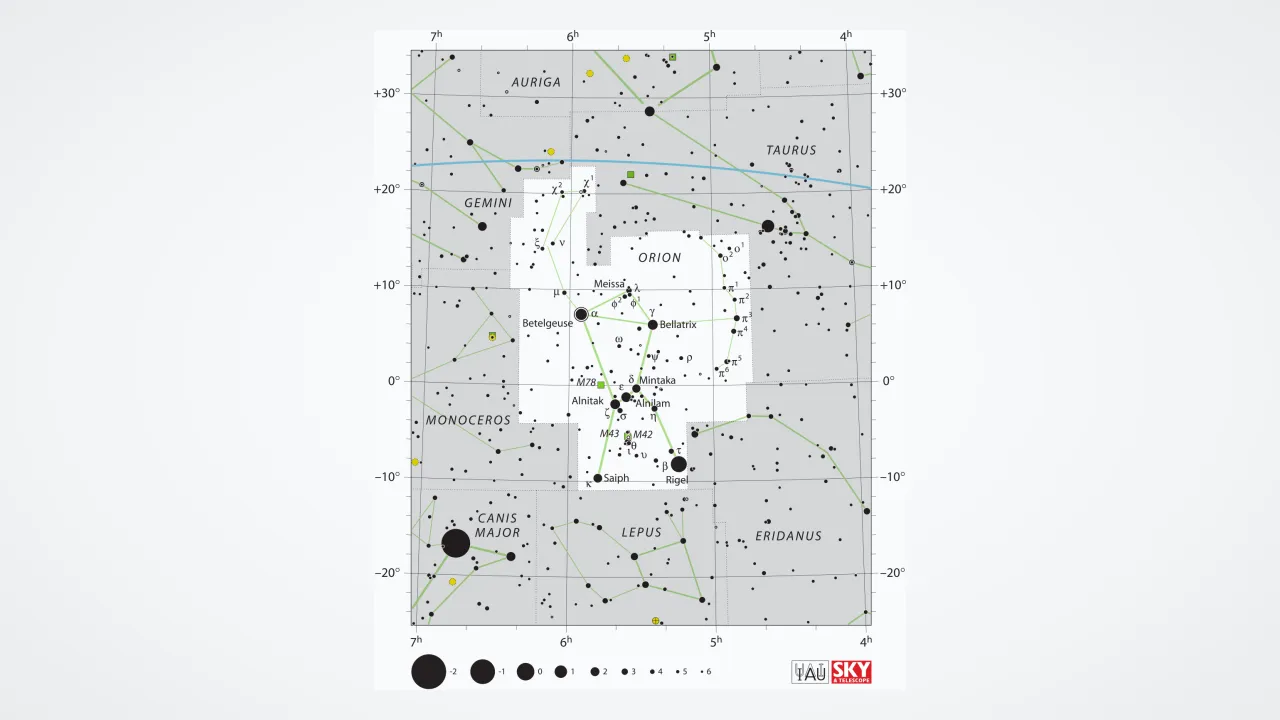
1. How many bright stars line up in a neat row to make Orion's Belt?
2. What color does the giant shoulder star Betelgeuse glow in the night sky?
🤯 Mind-Blowing Fact • Grade 2
Betelgeuse is so gigantic that if you placed it where our Sun sits, its outer edge would swallow Mercury, Venus, Earth, Mars, and reach toward Jupiter!
✨ Word Sparks (Grade 2 Glossary)
Tap 🔊 to hear
equator
imaginary middle line dividing north and south
temperature
how hot or cold something measures
light-year
distance light travels in one whole year
🪝
Why do two stars in the same constellation glow completely different colors?
1
A Giant Hourglass in the Sky
Gaze up on a clear January evening, and a giant hourglass of dazzling stars commands the sky! Ancient storytellers around the world saw a brave hunter, a canoe, or a butterfly in Orion's bright stars.
2
Star Colors Tell Temperatures
Orion is a living science lesson in star colors! Cool stars glow orange-red like campfire embers—that is Betelgeuse on Orion's shoulder. Much hotter stars blaze blue-white like a blowtorch—that is Rigel down at Orion's foot!
3
The Glowing Orion Nebula
Look just below the three belt stars to spot a misty patch with your own eyes. That is the Orion Nebula, a huge cosmic nursery 1,344 away!
1. Which star in Orion is hotter: orange-red Betelgeuse or blue-white Rigel?
2. What is the fuzzy glowing patch hanging below Orion's Belt?
🤯 Mind-Blowing Fact • Grade 3
Nearby Alnitak on the left end of Orion's Belt illuminates the famous dark Horsehead Nebula, sculpted from thick interstellar dust!
✨ Word Sparks (Grade 3 Glossary)
Tap 🔊 to hear
asterism
easy-to-spot star shape inside a constellation
ultraviolet
energetic invisible light beyond violet
stardust
tiny mineral grains blown out by stars
🪝
Why do Orion's stars look flat on the dome of night when they actually sit hundreds of light-years apart in 3D space?
1
An Illusion of Depth
Connect the dots of Orion on a star chart and the Hunter looks flat like a sticker on a ceiling. Yet fly outward in a spaceship and you would discover a deep 3D surprise! Bellatrix on one shoulder sits about 250 light-years from Earth, Betelgeuse sits around 550 light-years away, Rigel shines from 860 light-years out, and middle belt star Alnilam blazes nearly 2,000 light-years away!
2
Signpost to Neighbors
Stargazers use Orion's Belt—Alnitak, Alnilam, and Mintaka—as a cosmic signpost. Follow the belt downward to find Sirius, the brightest star in the entire night sky, or follow it upward to reach orange Aldebaran and the Pleiades star cluster.
3
Inside Orion's Sword
Hanging beneath the belt is Messier 42, the Great Orion Nebula. Spanning 24 light-years wide, this hydrogen cloud glows pink and green as four fierce newborn stars called the Trapezium blast it with energy.
4
Betelgeuse's Great Dimming
Late in 2019, astronomers watched Betelgeuse suddenly dim by more than half after coughing out a titanic cloud of cooling !
1. What caused red supergiant Betelgeuse to noticeably dim in late 2019 and early 2020?
2. If you draw a straight line down to the left along Orion's Belt, what famous star do you hit?
🤯 Mind-Blowing Fact • Grade 4
Curving across the whole constellation like a giant backwards comma glows Barnard's Loop—the 300-light-year shockwave shell blown outward by ancient supernovae in Orion two million years ago!
✨ Word Sparks (Grade 4 Glossary)
Tap 🔊 to hear
proplyd
planet-forming dust disk inside a bright nebula
supernova
titanic explosion ending a massive star's life
ionized
energized gas stripped of outer electrons
🪝
How is one constellation showing us the birth, dazzling youth, and explosive finale of massive stars all at once?
1
A Complete Stellar Life Cycle
Sweep a pair of binoculars across the Orion Constellation and you witness the entire dramatic biography of massive stars playing out across one patch of sky! Straddling the celestial equator across 594 square degrees, Orion belongs to the Orion Molecular Cloud Complex—a sprawling turbulent reservoir of hydrogen gas and dust spanning hundreds of light-years from 1,000 to 1,400 light-years away.
2
Birth in the Trapezium Nursery
Inside Orion's Sword glows Messier 42, the Orion Nebula. When the Hubble and James Webb Space Telescopes peered inside this glowing blister of gas, they photographed ''—teardrop-shaped protoplanetary disks around infant stars less than a million years old, sculpted by fierce stellar winds from the central Trapezium cluster.
3
Fierce Blue Youth vs. Aging Red Giant
Orion's brightest jewel isn't Alpha Orionis (Betelgeuse), but Beta Orionis—dazzling Rigel! Burning at 12,100 kelvins and shining over 120,000 times brighter than our Sun, blue-white Rigel plus the three O-type supergiants of Orion's Belt live fast and fierce. Across the constellation, bloated red supergiant Betelgeuse has already exhausted its core hydrogen and fuses heavier elements at a cooler 3,600 kelvins.
4
Future Supernova Fireworks
Sometime within the next 100,000 years, Betelgeuse's iron core will collapse and explode as a Type II —shining as brightly as a full Moon from 550 light-years away while remaining completely safe for Earth!
1. Which star is actually the brightest star in Orion most of the time?
2. What will happen to Earth when Betelgeuse eventually explodes as a supernova?
🤯 Mind-Blowing Fact • Grade 5
Three 'runaway stars' now scattered across three completely different constellations were traced backward like rewinding a movie to a single gravitational collision inside the Orion Nebula 2.5 million years ago!
✨ Word Sparks (Grade 5 Glossary)
Tap 🔊 to hear
OB association
loose group of young, hot, massive stars
declination
celestial latitude north or south of sky equator
runaway star
star flung at high speed from birthplace
🪝
Why do astrophysicists treat the Orion Molecular Cloud Complex as our galaxy's Rosetta Stone for massive star formation?
1
Crossroads of Celestial Cultures and Geometry
Bisected almost symmetrically by the celestial equator—with star Mintaka (Delta Orionis) sitting within a quarter-degree of zero —Orion rises visibly from every inhabited continent on Earth. Recognized for millennia as Osiris to ancient Egyptians, Mul.Sipa.Zi.An.Na ('True Shepherd of Anu') in Babylonian tablets, Three Marys or a celestial canoe in Southern Hemisphere traditions, and the Hunter in Greek star lore, Orion unites cultural astronomy with extraordinary astrophysical wealth inside our Milky Way's Local Arm.
2
OB Associations and Runaway Stars
Nearly all of Orion's hot blue-white luminaries—Alnitak, Alnilam, Mintaka, Saiph, and Bellatrix—belong to the Orion OB1 Association, sibling cohorts of massive O- and B-type stars born sequentially over the past twelve million years. Gravitational slingshots inside dense young clusters occasionally hurl massive stars outward like cosmic cannonballs: astronomers traced three famous ''—AE Aurigae, Mu Columbae, and 53 Arietis—streaking away in opposite directions at over 100 kilometers per second right back to a violent stellar close encounter inside the Orion Nebula cluster 2.5 million years ago!
3
Inside the Orion Molecular Cloud Complex
Spanning more than twenty degrees from Orion's head down past its knees lies a vast reservoir of cold molecular hydrogen, dust, and magnetic filaments. Messier 42 (the Orion Nebula) is merely a sunlit blister carved into the near face of the giant dark cloud OMC-1 by intense Lyman-continuum radiation from Theta-1 Orionis C—a 40-solar-mass O-type powerhouse in the Trapezium shining 200,000 times brighter than our Sun. Behind M42, infrared eyes like JWST penetrate dust to reveal the Becklin-Neugebauer Object, infrared protostars, and silhouette Horsehead pillars.
4
Contrasting Supergiant Endpoints
Comparing Rigel (spectral class B8Ia, 860 light-years distant) with pulsating convective red supergiant Betelgeuse (M1–M2Ia, ~550 light-years distant, radius ~700–900 solar radii) illustrates how rapid nuclear burning swells short-lived massive stars across the Hertzsprung-Russell diagram.
5
Enriching Future Worlds
Through Barnard's Loop shockwaves and future core-collapse supernovae, Orion demonstrates how massive stars forge oxygen, silicon, and iron while compressing neighboring gas to trigger the next generation of Sun-like stars.
1. Which star inside Orion's Belt lies almost directly on the celestial equator (zero degrees declination), rising due east and setting due west worldwide?
2. What actually lights up the glowing pink and green gases of the Orion Nebula (Messier 42)?