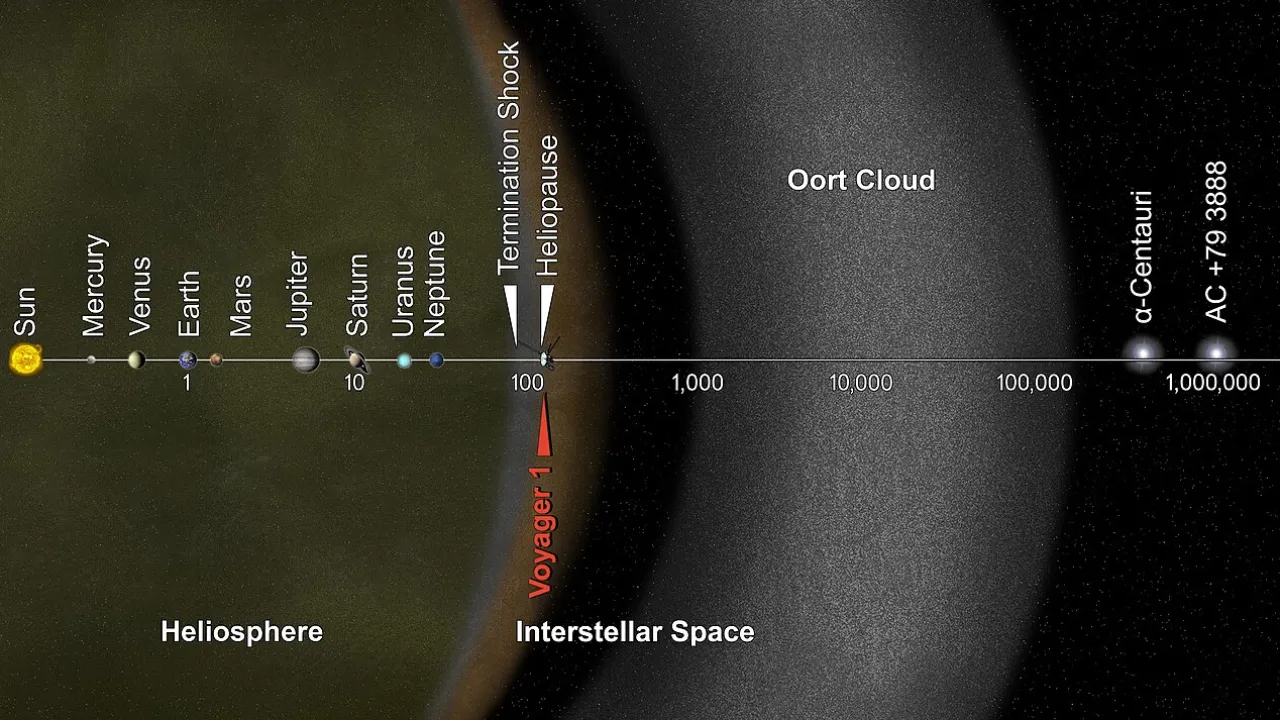
1. What shape does the Oort Cloud make around our Solar System?
2. What fills the Oort Cloud?
🤯 Mind-Blowing Fact • Grade 2
Once Voyager 1 enters the Oort Cloud, it will take roughly 30,000 years to fly all the way through to the other side!
✨ Word Sparks (Grade 2 Glossary)
Tap 🔊 to hear
shell
A hollow round layer wrapping around the center
clue
A helpful fact that solves a mystery
direction
The path or angle something comes from
🪝
How can astronomers know the Oort Cloud is real if no telescope has ever photographed it directly?
1
Clues from Surprise Visitors
Imagine standing in a snowy yard while snowballs fly in from overhead, sideways, and behind you! Astronomers noticed bright comets diving toward the Sun from every in the sky, taking thousands of years per trip.
2
Jan Oort's Big Idea
In 1950, Dutch astronomer Jan Oort figured out where those comets hide. Far beyond the flat Kuiper Belt, our Sun's gravity holds a giant round of trillions of icy bodies—now called the Oort Cloud!
3
Halfway to the Next Star
Individual Oort Cloud chunks are too tiny and dim for telescopes to spot out there. Its outer edge stretches nearly halfway to the nearest star system, Alpha Centauri!
1. How do scientists know the Oort Cloud surrounds us like a sphere?
2. How far out does the outer edge of the Oort Cloud reach?
🤯 Mind-Blowing Fact • Grade 3
Light from our Sun races at 186,000 miles per second—taking eight minutes to reach Earth—yet it takes over a full year to reach the outer edge of the Oort Cloud!
✨ Word Sparks (Grade 3 Glossary)
Tap 🔊 to hear
slingshot
Using strong gravity to fling an object fast
galactic tide
Gentle gravity pull from the Milky Way galaxy
long-period
Taking more than two hundred years per orbit
🪝
How did icy rocks born near Jupiter end up exiled trillions of miles away in the Oort Cloud?
1
Scattered by Giant Planets
Rewind the clock 4.6 billion years to our young Solar System! Countless icy chunks formed near Jupiter, Saturn, Uranus, and Neptune. As those giant planets grew, their powerful gravity acted like cosmic , flinging trillions of icy leftovers deep into outer space.
2
Two Layers in the Deep Dark
Astronomers Ernst Öpik and Jan Oort calculated that the Sun's weak distant gravity caught many of those flung snowballs before they escaped forever. Today the region has two parts: a doughnut-like inner Hills Cloud starting around 2,000 astronomical units, and a vast outer sphere reaching 100,000 astronomical units!
3
Nudged by Galactic Tides
At the outer edge, the Sun's hold is super gentle. Passing neighbor stars and the gentle gravitational pull of the Milky Way galaxy—called the —twist these icy orbits into a round shell.
4
Visitors Once in Millennia
When a galactic nudge sends an Oort Cloud snowball falling sunward, it blazes across Earth's sky as a spectacular comet like Hale-Bopp!
1. Where did the trillions of icy bodies in the Oort Cloud originally form?
2. What nudges Oort Cloud comets out of their distant orbits and sends them toward the Sun?
🤯 Mind-Blowing Fact • Grade 4
Orbiting near the outer edge of the Oort Cloud, an icy comet nucleus moves slower than a highway car on Earth and takes millions of years to circle the Sun once!
✨ Word Sparks (Grade 4 Glossary)
Tap 🔊 to hear
paradox
A puzzle that seems impossible until explained
heliopause
Boundary where the Sun's wind meets star space
interstellar
Located or traveling in space between stars
🪝
Why wouldn't our Solar System have any bright long-period comets left today without the Oort Cloud?
1
Solving Jan Oort's Comet Paradox
Every time a comet swings close to the hot Sun, solar heat boils away tons of its ice, or Jupiter's gravity flings it right out of the Solar System. In 1950, Dutch astronomer Jan Oort realized that if comets had orbited near the planets for 4.6 billion years, every single one would have burned out or vanished eons ago! Building on earlier work by Estonian astronomer Ernst Öpik, Oort deduced that a colossal fresh freezer must resupply long-period comets from afar.
2
Inner Hills Cloud to Outer Sphere
Modern orbital math maps this reservoir from roughly 2,000 astronomical units out to more than 100,000 astronomical units—about 1.5 light-years from the Sun. Its inner disk, the Hills Cloud, aligns somewhat with the planets, while outside gravitational tugs scramble the outer cloud into a true three-dimensional sphere.
3
Where the Sun's Grip Fades
Long past the —where the solar wind surrenders to gas—Oort Cloud nuclei creep along at walking speeds of just a few hundred feet per second. Subtle tugs from passing stars, giant molecular clouds, and the Milky Way's disk easily tip their aphelia.
4
Interstellar Cousins
Billions of comets were pushed completely free during our Solar System's youth, meaning other star systems shed comets too—explaining visitors like Borisov!
1. What puzzle convinced Jan Oort that a distant reservoir of comets must exist?
2. How fast does an icy body move near the outer boundary of the Oort Cloud?
🤯 Mind-Blowing Fact • Grade 5
Roughly 70,000 years ago, a dim red-dwarf pair called Scholz's Star actually flew right through our outer Oort Cloud at less than one light-year from the Sun!
✨ Word Sparks (Grade 5 Glossary)
Tap 🔊 to hear
isotropic
Spread evenly across every direction in space
occultation
Brief blocking of starlight by a passing object
semi-major axis
Half the longest width of an oval orbit
🪝
How did a tightly clustered spike in ancient comet orbits unveil a trillion-body sphere spanning three light-years?
1
The Statistical Signature in Semi-Major Axes
In 1950, Leiden Observatory director Jan Oort carefully analyzed the precise orbits of nineteen well-measured long-period comets. Plotting the reciprocals of their original semi-major axes—before planetary tugs altered their paths—Oort uncovered a striking spike corresponding to aphelia clustered between 20,000 and 100,000 astronomical units, arriving isotropically from every celestial latitude. Extending Ernst Öpik's 1932 insight, Oort demonstrated that our Solar System sits encased inside an immense cometary halo containing trillions of kilometer-scale nuclei totaling several Earth masses.
2
Two-Step Assembly: Scattering and Circularization
How did icy planetesimals condense near the giant planets at 5 to 30 AU yet wind up parked halfway to Alpha Centauri? Dynamical simulations reveal a two-stage dance. First, Jupiter, Saturn, Uranus, and Neptune gravitationally scattered leftover volatiles onto razor-stretched eccentric orbits. Before those bodies could fall back to be ejected completely, galactic tides from the Milky Way's disk and close stellar encounters lifted their perihelia safely clear of the planets, isotropizing their inclinations into a spherical cloud.
3
Architecture of the Hills and Outer Oort Zones
Astronomer Jack Hills proposed in 1981 that a denser, flatter inner torus—now termed the Hills Cloud—spans roughly 2,000 to 20,000 AU. Because inner-cloud comets lie more tightly bound to the Sun, they endure passing stars that strip the outer sphere, acting as a deep backup bank that steadily replenishes the outer Oort Cloud over billions of years.
4
Close Stellar Encounters Like Scholz's Star
Seventy thousand years ago, a dim binary system named Scholz's Star grazed directly through the outer Oort Cloud at roughly 52,000 AU! Perturbed comets from such stellar flybys take up to two million years to plunge into the inner Solar System.
5
Searching for Occultations in the Dark
Although individual Oort Cloud bodies reflect far too little sunlight for direct imaging, rapid-cadence star-monitoring arrays hunt for split-second stellar —tiny winks when an unseen distant comet slips directly across a background star.