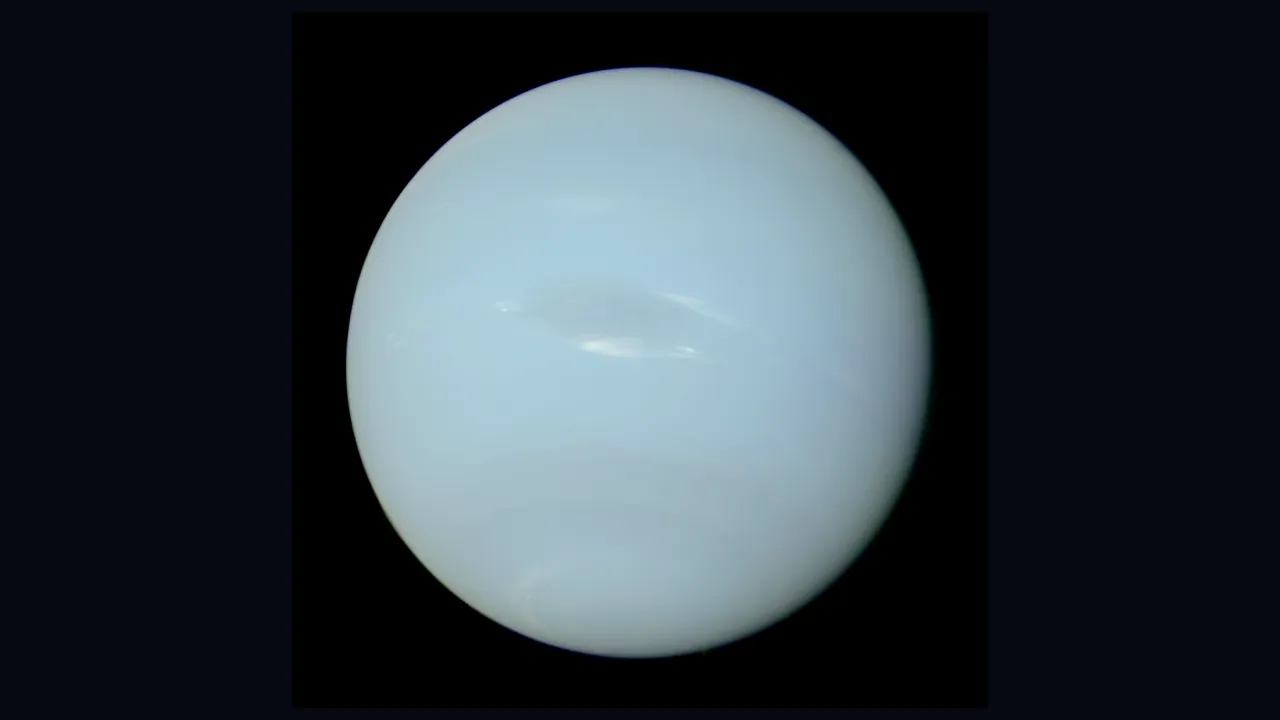
1. Which planet orbits eighth and farthest from the Sun?
2. What weather record does Neptune hold in our Solar System?
🤯 Mind-Blowing Fact • Grade 2
Sunlight at Neptune is 900 times dimmer than on Earth—high noon on Neptune looks like cozy twilight after sunset here!
✨ Word Sparks (Grade 2 Glossary)
Tap 🔊 to hear
Predict
To figure out where something is using clues.
Gravity tug
Invisible pull one giant world puts on another.
Twilight
Soft dim light right after the Sun sets.
🪝
How did scientists find Neptune using pencils and math paper before ever looking in a telescope?
1
Found With Math!
In the 1840s, astronomers noticed Uranus speeding up and slowing down strangely along its orbit. Mathematicians figured an unseen giant planet farther out must be tugging on it! In 1846, Johann Galle pointed his telescope right where math said to look—and spotted Neptune on the very first night!
2
Giant Dark Storms
Four times wider than Earth, Neptune swirls with white methane clouds and dark oval hurricanes as wide as our whole planet.
3
One Birthday Since 1846
Because one Neptune year lasts nearly 165 Earth years, Neptune finally finished its first full lap since discovery in 2011!
1. How did scientists figure out where to point their telescope to discover Neptune in 1846?
2. How many full orbits around the Sun has Neptune completed since humans discovered it in 1846?
🤯 Mind-Blowing Fact • Grade 3
Photos reprocessed in 2024 proved Neptune isn't dark royal blue—it is actually a soft greenish-blue very close to Uranus's color!
✨ Word Sparks (Grade 3 Glossary)
Tap 🔊 to hear
Internal heat
Warmth rising outward from deep inside a planet.
Ring arc
A thicker, brighter curved clump inside a faint ring.
Azure
A clear sky-blue color tinted by methane gas.
🪝
If sunlight is tiny and weak out at Neptune, what powers its 1,200-mile-per-hour winds?
1
Heavier Than Larger Uranus
Here is a neat space riddle: Uranus is slightly wider than Neptune, yet Neptune is heavier! Packed with seventeen times Earth's mass in a dense ocean-like mantle of water, ammonia, and methane ices, Neptune is the densest giant planet in our Solar System.
2
Powered From Within
Unlike sleepy Uranus, Neptune radiates more than twice as much heat from its hot interior as it gets from the distant Sun! Rising internal warmth stirs supersonic jet streams and bright white methane-ice clouds.
3
Vanishing Great Dark Spots
Voyager 2 spotted a Great Dark Spot as big as Earth in 1989, along with a fast white cloud nicknamed Scooter. Five years later, Hubble looked back and that storm had vanished—while brand-new dark storms popped up elsewhere!
4
Clumpy Dusty Rings
Five faint, dark rings circle Neptune. Its outermost Adams Ring holds bright clumpy arcs named Liberty, Equality, and Fraternity!
1. How does Neptune compare in width and mass to its neighbor Uranus?
2. What happened to the Great Dark Spot seen by Voyager 2 in 1989?
🤯 Mind-Blowing Fact • Grade 4
Galileo Galilei actually sketched Neptune in his notebook in December 1612—234 years before its official discovery—when it passed right beside Jupiter, mistaking the slow-moving planet for a background star!
✨ Word Sparks (Grade 4 Glossary)
Tap 🔊 to hear
Turbulence
Choppy, swirling air currents that slow smooth winds.
Vortex
A giant spinning whirlpool of high-pressure wind.
Ionic water
Hot squeezed water molecules split into charged particles.
🪝
Why can winds blow faster on freezing Neptune than on planets much closer to the Sun?
1
Low Turbulence Unlocks Supersonic Speed
Racing westward against Neptune's 16-hour spin at up to 2,100 kilometers per hour (1,300 mph), Neptune's equatorial winds break the local sound barrier! Paradoxically, weak sunlight helps them go faster: on Earth or Jupiter, intense solar heating creates choppy vertical that acts like brakes on wind. On frigid Neptune, internal heat rises smoothly with minimal friction, letting jet streams accelerate unchecked!
2
True Colors Revealed in 2024
For decades, textbooks showed Neptune as deep cobalt blue next to pale cyan Uranus because Voyager 2 scientists stretched contrast in 1989 to highlight faint clouds. Modern recalibration by Oxford astronomers in 2024 showed both ice giants share a gentle greenish-blue hue—with Neptune appearing only a touch bluer because vigorous winds thin out its white atmospheric haze!
3
Tilted, Off-Center Magnetosphere
Just like Uranus, Neptune generates its magnetic field inside a mid-depth shell of electrically conductive rather than its rocky core. Tilted 47 degrees from the spin axis and offset more than half a radius from center, its magnetosphere wobbles wildly with every rotation.
4
Shepherding Clumpy Ring Arcs
Why don't the dusty arcs in Neptune's Adams Ring spread out evenly? Tiny inner moon Galatea tugs them into stable gravitational pockets via a 42:43 orbital resonance!
1. Why did early 1989 pictures make Neptune look much darker blue than it really is?
2. How can weak sunlight actually help Neptune's winds reach 1,300 miles per hour?
🤯 Mind-Blowing Fact • Grade 5
Because Neptune's magnetic poles are tilted 47 degrees off-center, its glowing auroras shine halfway down near its middle latitudes instead of at its north and south poles—like Northern Lights glowing over South America!
✨ Word Sparks (Grade 5 Glossary)
Tap 🔊 to hear
Perturbation
Slight orbital detour caused by another planet's gravity.
Pyrolysis
Breaking molecules apart using intense deep heat and pressure.
Planetesimal
An icy or rocky building block of early planets.
🪝
How did celestial mechanics find Neptune in 1846—and how did Neptune's migration sculpt the entire outer Solar System?
1
Triumph of Newtonian Perturbation Theory
By the 1840s, Uranus had strayed wildly from ephemeris tables assuming only seven planets. Working independently with pencil and paper, French mathematician Urbain Le Verrier and English astronomer John Couch Adams inverted Newton's law of universal gravitation to solve for the mass and orbit of a perturbing eighth planet. Within an hour of opening Le Verrier's letter on September 23, 1846, Johann Gottfried Galle and Heinrich d'Arrest identified Neptune less than one degree from the predicted coordinates!
2
Internal Energetics and Diamond Precipitation
Orbiting at 30.07 astronomical units with a bulk density of 1.638 grams per cubic centimeter—highest of the four giant planets—Neptune emits 2.61 times more infrared energy than it absorbs from solar insolation. Beneath its hydrogen-helium-methane envelope, pressures reaching millions of bars inside the hot water-ammonia-methane mantle split hydrocarbons via , precipitating solid diamond crystals downward that release gravitational heat.
3
James Webb Infrared Ring and Aurora Breakthroughs
In 2022, JWST's Near-Infrared Camera delivered the crispest view of Neptune's dusty Le Verrier, Galle, Lassell, Arago, and Adams rings since Voyager 2's 1989 encounter, while subsequent JWST spectroscopy in 2025 detected trihydrogen cations ($H_3^+$) powering glowing infrared auroras tilted awkwardly near mid-latitudes due to Neptune's 47-degree offset magnetic dipole!
4
Planetary Migration and Kuiper Belt Sculpting
In the Nice model of Solar System evolution, Neptune formed closer to the Sun (around 15 to 20 AU) before gravitational scattering of icy drove it outward to 30 AU—sweeping Pluto and fellow plutinos into a protective 3:2 mean-motion resonance!
5
Capturing Triton and Reshaping Its Moons
That outward march also enabled Neptune to gravitationally capture giant retrograde Triton, disrupting its original satellite family into rubble that reassembled into moons like Proteus and Nereid.