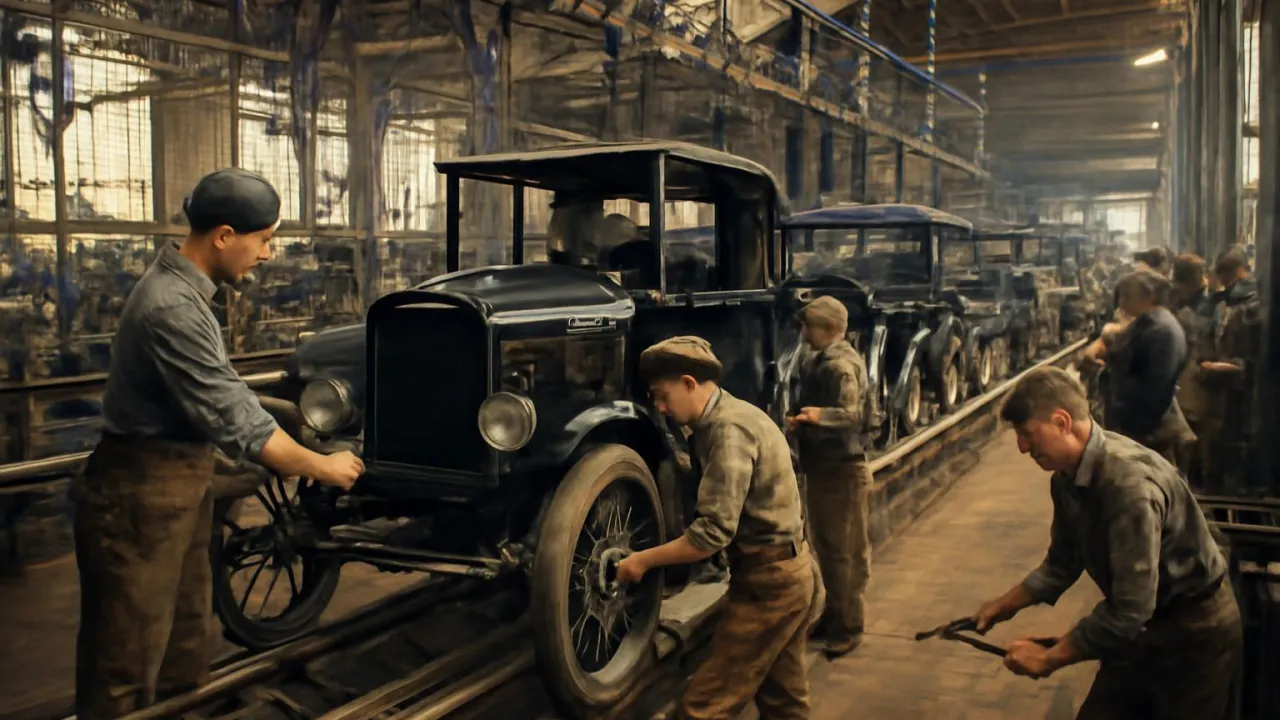
The first moving line cut car-building time from 12 hours to just 93 minutes!
✨ Word Sparks (Grade 2 Glossary)
Tap 🔊 to hear
assembly
Putting parts together to make something
conveyor
A moving belt that carries things
teamwork
Working together to finish a job
🪝
What if building a car was like passing a toy down a line?
1
A Line That Moves
In a busy factory, workers stand beside a long moving belt. Car parts travel past each worker, and each person adds a special piece. The line keeps moving, so everyone works together quickly.
2
Building Cars Faster
Before the moving line, cars took many hours to make. With the new line, workers finished a car in less than two hours. This made cars much cheaper for families.
3
Changing the World
The moving line helped people buy cars and travel far. It also changed how toys, bikes, and even food are made today.
Ford’s assembly line could build more than 200 cars in a single day!
✨ Word Sparks (Grade 3 Glossary)
Tap 🔊 to hear
conveyor
A moving belt that carries things
prototype
A first model of something new
mass production
Making many things quickly
🪝
Imagine hearing hundreds of tools tapping as cars come to life, one step at a time.
1
A New Way to Build
In 1913, Henry Ford’s factory was filled with the sounds of clanking metal and humming machines. Workers stood along a moving belt, each adding a part to a car as it passed by. This new invention was called the moving assembly line. It changed the way people built things forever.
2
How the Line Works
The moving assembly line uses a to carry car frames past workers. Each worker repeats a single task, like attaching wheels or doors, making the process efficient. This method is called because many cars are made quickly. The assembly line uses mechanical power to keep everything moving at the right speed.
3
A Big Impact
Before the assembly line, building a car took over twelve hours. With Ford’s invention, a car could be built in just ninety-three minutes. This made cars much cheaper, so more families could own one. The moving assembly line also inspired factories for toys, bicycles, and even food.
4
Words to Know
A is a first model of something new. A patent is a special right for inventors to protect their ideas. means making lots of the same thing quickly and efficiently.
Ford’s moving assembly line cut car prices by more than half in just a few years!
✨ Word Sparks (Grade 4 Glossary)
Tap 🔊 to hear
division of labor
Each person does one special job
patent
A special right for inventors
efficiency
Doing a job quickly and well
🪝
What if you could build a car in just over an hour, using teamwork and moving machines?
1
Birth of the Moving Assembly Line
In 1913, Henry Ford and his team revolutionized car-making at their Detroit factory by introducing a moving assembly line. Instead of workers moving around a car, the car itself traveled along a conveyor past each worker’s station. This system used carefully timed mechanical power to keep the line moving at a steady pace, allowing each worker to focus on a single task.
2
How It Works: Mechanical Magic
The moving assembly line relies on a conveyor belt powered by motors and pulleys. As the car chassis moves along the line, each worker adds or assembles a specific part, such as wheels, doors, or the engine. This method is called mass production, and it uses the principle of to increase and reduce mistakes.
3
A World Transformed
Before Ford’s invention, building a car took more than twelve hours and required skilled workers for every step. After the moving assembly line, a car could be built in just ninety-three minutes, making cars affordable for many families. The assembly line idea soon spread to other industries, changing how everything from bicycles to breakfast cereal was made.
4
The Legacy of Innovation
The moving assembly line is a landmark in industrial engineering and remains a key part of modern manufacturing. It introduced concepts like the prototype, where new models are tested, and the , which protects inventors’ ideas. Today, assembly lines use robots and computers, but the basic idea remains the same: teamwork, , and innovation.
1. How did the moving assembly line change factories?
2. What is a prototype used for?
🤯 Mind-Blowing Fact • Grade 5
By 1927, Ford’s assembly lines had produced more than 15 million Model T cars worldwide!
✨ Word Sparks (Grade 5 Glossary)
Tap 🔊 to hear
division of labor
Splitting big jobs into smaller, easy steps
conveyor
A moving belt that carries parts
innovation
A new idea that changes things
🪝
Can you picture a river of car parts gliding past hundreds of skilled hands, each adding a piece to history’s most famous automobile?
1
The Dawn of Industrial Mass Production
In the early 20th century, the Ford Motor Company’s Highland Park plant in Detroit echoed with the rhythmic sounds of clattering parts and humming motors. Henry Ford and his engineers introduced the moving assembly line in 1913, transforming car manufacturing from a slow, craft-based process into a marvel of industrial mass production. Instead of a team building one car at a time, the assembly line allowed unfinished cars to travel on a continuous , passing each worker who performed a single, specialized task.
2
Engineering Principles and Mechanical Innovation
The moving assembly line operates on the principle of , where complex tasks are broken into simple, repeatable steps performed by individual workers. Mechanical powered by electric motors and pulley systems precisely regulated the speed of production, ensuring each car frame advanced at a steady pace. This synchronized movement reduced downtime, minimized errors, and allowed unskilled workers to master specific assembly tasks, drastically increasing output.
3
Quantitative Impact: Time, Cost, and Scale
Before the assembly line, building a Model T required up to 12.5 labor hours per vehicle. After Ford’s , assembly time dropped to just 93 minutes per car—a nearly eightfold improvement. This efficiency slashed the price of a Model T from $850 in 1908 to under $300 by 1925, making car ownership possible for millions more families. By 1927, Ford factories had produced over 15 million Model Ts, forever changing global transportation.
4
Evolution and Global Influence
The moving assembly line’s success sparked a worldwide revolution in manufacturing, inspiring industries from appliances to electronics to adopt similar methods. Concepts like the prototype, used for testing new designs, and the patent, which protects inventors’ , became central to industrial progress. Today, modern assembly lines use advanced robotics, computer controls, and even artificial intelligence, but the core principle of efficient, step-by-step teamwork remains unchanged.
5
Cultural and Environmental Legacy
Ford’s moving assembly line not only made cars affordable but also shaped cities, economies, and even daily life. Suburbs grew as people could travel farther for work and leisure, and the demand for roads, gas stations, and auto repair shops soared. However, mass production also raised new challenges, such as worker fatigue, repetitive motion injuries, and environmental impacts from increased car use. The story of the moving assembly line is a powerful example of how one invention can accelerate progress and inspire future .