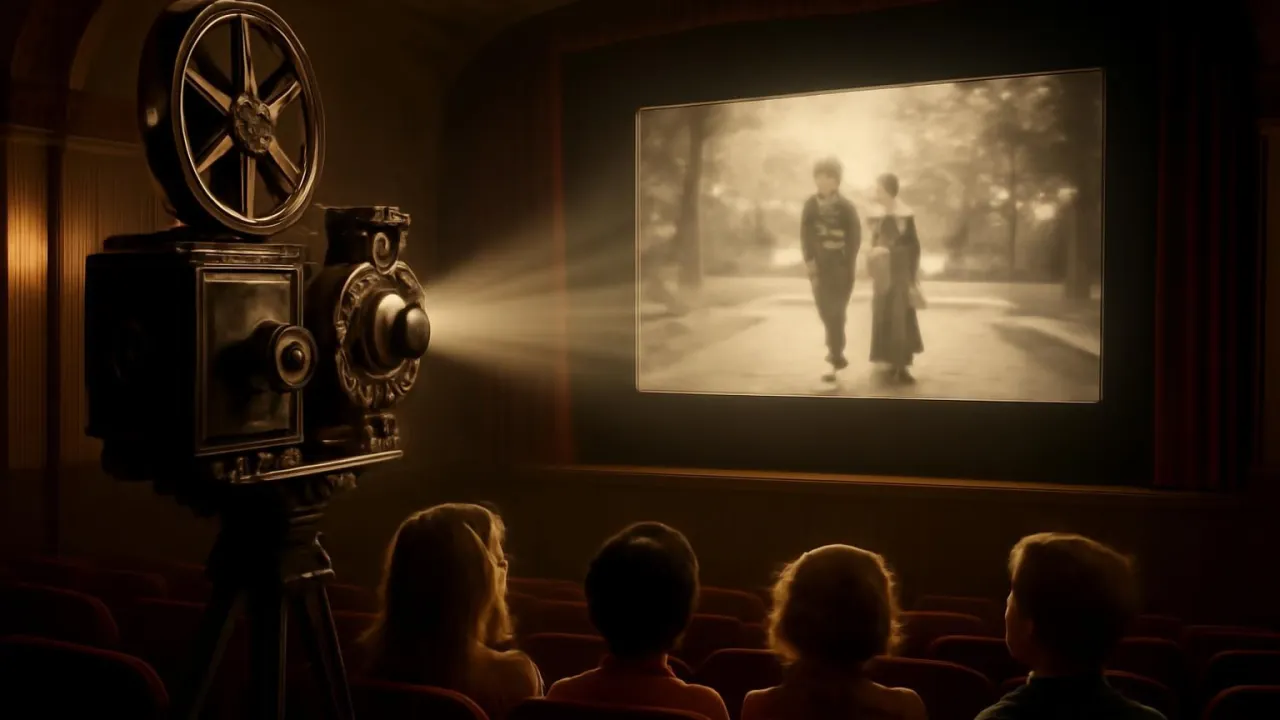
2. What do people do when watching movies together?
🤯 Mind-Blowing Fact • Grade 2
The first projectors could show movies to hundreds of people at once!
✨ Word Sparks (Grade 2 Glossary)
Tap 🔊 to hear
beam
A strong line of light
theater
A place to watch movies
whir
A soft spinning sound
🪝
Have you ever wondered how movies appear on a giant screen?
1
A Room Full of Wonder
When the lights go out, the projector starts to and shine. A strip of film moves quickly inside the machine, showing picture after picture. The bright makes the images huge on the wall.
2
How Movie Pictures Move
The film has many tiny photos, each a little different. The projector flashes light through each one, so fast our eyes see movement. This trick makes stories come alive for everyone watching.
3
Sharing Stories Together
Families and friends gather in to watch movies together. They laugh, gasp, and sometimes even cry at the stories. The projector helps people feel like they are part of the adventure.
The Lumière brothers’ first public film show amazed people in Paris in 1895.
✨ Word Sparks (Grade 3 Glossary)
Tap 🔊 to hear
frame
One picture on a film strip
lens
A glass part that focuses light
illusion
Something that tricks your eyes
🪝
Can you imagine the surprise when people first saw pictures moving on a wall?
1
The Flickering Invention
In a darkened room, a machine whirs and a bright beam of light bursts out. This is the motion picture projector, invented by the Lumière brothers in France in 1895. It uses a strip of film with many still images, each just a little different. When the film moves quickly, the pictures seem to come alive.
2
How the Projector Works
The projector shines light through the film, which is made of transparent material. As the film rapidly advances, each is lit up for a split second. Our eyes and brains blend these flashes together, creating the of smooth movement. This clever trick is called persistence of vision.
3
From Small Rooms to Big Theaters
Early projectors were shown in small halls, but soon theaters grew much larger. The projector’s powerful lamp and made it possible to cast images across wide screens. Audiences could now experience stories, travel, and adventure without leaving their seats.
4
A World of Moving Stories
The motion picture projector changed entertainment everywhere. It let people see news, cartoons, and even faraway places. Today, digital projectors use computers instead of film, but the magic of moving pictures remains the same.
1. What is the main trick that makes pictures look like they move?
2. Who invented the first famous motion picture projector?
🤯 Mind-Blowing Fact • Grade 4
Modern digital projectors can display over two million pixels in every single frame!
✨ Word Sparks (Grade 4 Glossary)
Tap 🔊 to hear
celluloid
A thin, clear plastic for film
project
To shine or throw an image
reel
A round spool that holds film
🪝
What secrets hide inside the whirring box that brought the world’s first movies to life?
1
A Dazzling Leap in Storytelling
When the Lumière brothers unveiled their motion picture projector in 1895, crowds gasped as still images flickered into moving scenes. Their invention used a strip of film with hundreds of tiny frames, each capturing a split-second of action. As the film advanced rapidly, a powerful lamp and a glass lens projected the images onto a large screen. The result was a magical illusion—pictures that seemed to move and breathe.
2
The Science of Moving Images
The projector works by shining intense light through the film, which is made from transparent . Each frame pauses briefly in front of the lamp, and the lens focuses the image onto the screen. Because the frames switch so quickly—usually 24 every second—our brains blend them into smooth motion. This phenomenon, called persistence of vision, is the key to movie magic.
3
Changing Entertainment Forever
Before projectors, people only saw stories in books or live theater. The motion picture projector allowed everyone to experience news, comedy, and adventure together in darkened theaters. Over time, projectors grew more advanced, using stronger lamps, sharper lenses, and even adding sound to the images.
4
From Film to Digital Wonders
Today, many projectors use digital technology instead of film . However, the basic principle—flashing images quickly to create movement—remains the same. The motion picture projector opened a new era of global storytelling, connecting millions of people through shared sights and sounds.
1. Why do our brains see smooth movement in movies?
2. What did projectors add to movies after pictures?
🤯 Mind-Blowing Fact • Grade 5
The largest digital cinema projectors can project images over 100 feet wide, using lamps brighter than 30,000 lumens.
✨ Word Sparks (Grade 5 Glossary)
Tap 🔊 to hear
sprocket
A toothed wheel that moves film forward
shutter
A device that quickly blocks light between frames
lumens
A measure of how bright a light is
🪝
Imagine you’re sitting in a silent, darkened theater—suddenly, a beam of light bursts forth, and still images leap into motion before your eyes. How does this remarkable transformation happen?
1
The Birth of Cinematic Projection
In 1895, French inventors Auguste and Louis Lumière unveiled the Cinématographe, a revolutionary device that could record, develop, and project moving images. Their invention marked a turning point in visual storytelling, allowing large audiences to witness lifelike motion on a grand scale. The earliest public screenings astonished viewers, who had never before seen photographs spring into action. The Cinématographe’s compact design combined a hand-cranked film advance, a powerful arc lamp, and a precision lens system, setting the standard for future projectors.
2
Optical and Mechanical Principles
A motion picture projector operates by advancing a strip of celluloid film, perforated with holes, through a complex mechanical gate. Each frame pauses momentarily in front of an intense light source, typically an incandescent or xenon lamp, while a lens system projects the magnified image onto a distant screen. The mechanism rapidly interrupts the light between frames, preventing blurring and creating the illusion of continuous movement—a phenomenon known as persistence of vision. Most classic projectors operate at 24 frames per second, a rate that balances smooth motion with efficient film usage.
3
Engineering Evolution and Technical Specifications
Early projectors required careful hand-cranking to maintain a steady frame rate, but later models used electric motors for precise control. Advances in lamp technology increased brightness, enabling projection onto screens over 30 feet wide in large auditoriums. Sound-on-film systems, introduced in the late 1920s, synchronized audio with the moving images using optical or magnetic tracks. Modern digital projectors employ high-resolution DLP or LCD chips, capable of displaying over two million pixels per frame and projecting images at up to 60 frames per second for ultra-smooth video.
4
Cultural Impact and Global Reach
The motion picture projector transformed entertainment, education, and news by making visual stories accessible to people worldwide. Movie theaters became social hubs, and films influenced fashion, language, and even politics across continents. Educational films brought science and history to classrooms, while documentaries connected audiences to distant cultures and events. The spread of projection technology fostered a shared global culture, bridging gaps between nations and generations.
5
From Analog Film to Digital Frontiers
While celluloid film dominated the 20th century, the 21st century ushered in digital cinema, eliminating the need for physical reels. Digital projectors use lasers or LEDs as light sources, offering greater color accuracy and reliability. Yet, the core principle remains unchanged: rapid projection of sequential images creates the illusion of motion. The legacy of the motion picture projector endures, inspiring future innovations in virtual reality, immersive media, and global communication.