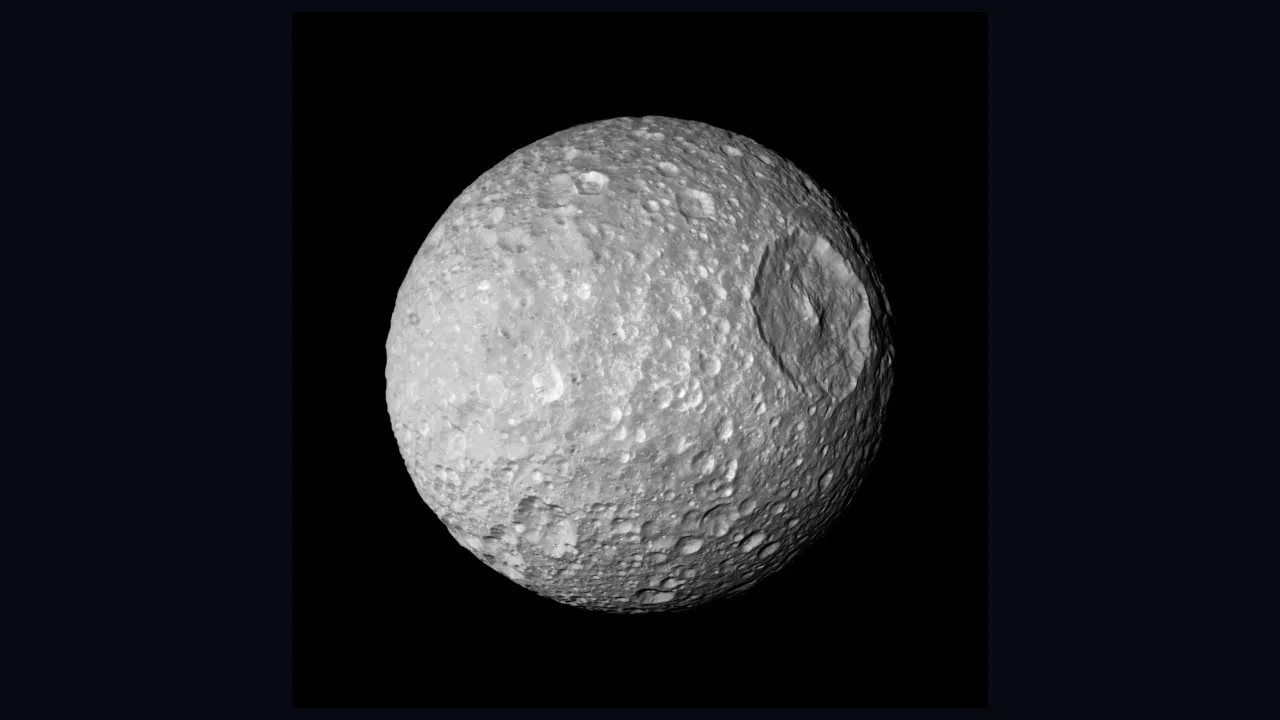
1. What makes Mimas so easy to recognize in photos?
2. What is Mimas mostly made of?
🤯 Mind-Blowing Fact • Grade 2
Saturn looms so huge in Mimas's sky that it would look thirty times wider than the full Moon looks from Earth!
✨ Word Sparks (Grade 2 Glossary)
Tap 🔊 to hear
Division
A wide open gap between planetary ring bands.
Shatter
To break suddenly into many small flying pieces.
Lumpy
Bumpy and uneven instead of smooth and round.
🪝
How close did one ancient crash come to smashing Mimas into smithereens?
1
Meet Herschel Crater
Speeding around Saturn in less than twenty-three hours, Mimas measures only 246 miles across. Long ago, an icy space rock slammed into Mimas and carved Herschel Crater—an 81-mile-wide bowl with walls three miles tall! Any harder, and Mimas would have shattered.
2
Sweeping Saturn's Rings
Even though Mimas is small, its gravity does a mighty chore. Every lap it takes tugs icy bits out of Saturn's rings, sweeping clear a 3,000-mile gap called the Cassini !
3
Smallest Round Champion
Smaller moons look like potatoes, making Mimas the tiniest world known whose own gravity squeezed it round.
1. How does little Mimas change the look of Saturn's rings?
2. Why does Mimas look round instead of potato-shaped like smaller moons?
🤯 Mind-Blowing Fact • Grade 3
Fast-moving electrons from Saturn glue Mimas's front-side snow grains together like icy concrete, changing how fast its surface warms up in sunlight!
✨ Word Sparks (Grade 3 Glossary)
Tap 🔊 to hear
Thermal
Having to do with heat and surface temperature.
Electron
A tiny negatively charged particle zipping through space.
Tidal force
Stretching pull from a nearby giant planet's gravity.
🪝
Why did heat cameras find a strange wedge-shaped warm zone on freezing Mimas?
1
William Herschel's Icy Find
Astronomer William Herschel discovered Mimas in 1789 using a giant mirror telescope he built in his backyard. Fittingly, the moon's colossal 81-mile crater now bears his name, complete with a four-mile central peak that rebounded upward during the crash!
2
Stretched Into an Egg Shape
Because Mimas orbits only 115,000 miles from giant Saturn, powerful stretch the icy moon slightly out of round—making it about ten percent longer pointing toward Saturn than across its poles.
3
A Mysterious Thermal Map
When NASA's Cassini spacecraft mapped daytime temperatures on Mimas, scientists expected a smooth warm spot at noon. Instead, they saw a sharp V-shaped wedge! Fast trapped around Saturn blast Mimas's front side, fusing fluffy snow into solid ice that holds daytime heat longer.
4
The Stealth Ocean Twist
Despite zero geysers or surface cracks, tiny wobbles in Mimas's orbit revealed in 2024 that a liquid ocean hides twenty miles below its cratered shell!
1. Why is Mimas slightly egg-shaped instead of a perfect sphere?
2. How did scientists discover a hidden ocean inside Mimas without seeing any cracks or geysers?
🤯 Mind-Blowing Fact • Grade 4
Mimas's underground ocean is a cosmic baby—likely only 5 to 15 million years old, meaning dinosaurs had already vanished on Earth before Mimas's interior melted!
✨ Word Sparks (Grade 4 Glossary)
Tap 🔊 to hear
Antipodal
Located on the exact opposite side of a world.
Precession
Slow rotation of an oval orbit's path over time.
Chasmata
Deep steep-sided canyons fractured across a moon's crust.
🪝
How could heavily cratered Mimas hide a brand-new ocean without cracking its icy shell?
1
Near-Catastrophic Impact Physics
With a low bulk density of just 1.15 grams per cubic centimeter, Mimas is composed almost entirely of low-density water ice with only a modest fraction of silicate rock. When a comet roughly six miles wide excavated the 130-kilometer Herschel Crater, shockwaves traveled clear through the moon and fractured grooves—called —on the exact opposite side, coming perilously close to disrupting Mimas altogether.
2
Sculpting the Cassini Division
Orbiting Saturn every 22 hours and 37 minutes, Mimas locks particles along the inner edge of the Cassini Division into a 2:1 orbital resonance. Ring ice chunks there circle Saturn twice for every single Mimas orbit, receiving repeated gravitational kicks at the exact same spot until their orbits twist elliptical and clear out the 4,800-kilometer gap.
3
Unlocking an Ocean via Orbital Precession
For decades, astronomers dismissed Mimas as a frozen ice block because its ancient cratered crust lacked smooth resurfaced plains like Europa or Enceladus. Yet when researchers carefully tracked how Mimas's oval orbit slowly rotates—or precesses—around Saturn in Cassini images, a rigid interior failed the math. Only an internal global ocean beneath 20 to 30 kilometers of ice fit the motion!
4
A Baby Ocean Still Forming
Models show Mimas's ocean formed only five to fifteen million years ago after an orbital shift boosted tidal heating—too recently to fracture its outer crust yet!
1. Why hasn't Mimas's hidden ocean cracked or smoothed away its heavily cratered outer shell yet?
2. What happened on the exact opposite side of Mimas when Herschel Crater formed?
🤯 Mind-Blowing Fact • Grade 5
Even though Mimas is tiny, its hidden underground ocean takes up roughly 50 percent of the moon's total volume!
✨ Word Sparks (Grade 5 Glossary)
Tap 🔊 to hear
Hydrostatic equilibrium
Gravity pulling a world evenly into a rounded shape.
Sintering
Fusing loose ice grains together without melting them completely.
Periapsis
The closest point to a planet in an orbit.
🪝
How did Mimas shatter textbook rules about what an 'ocean world' is supposed to look like?
1
Threshold of Hydrostatic Equilibrium
Measuring 416 by 393 by 381 kilometers across its triaxial axes, Mimas occupies a pivotal threshold in planetary geophysics: it is the smallest known body in the Solar System demonstrably rounded into by self-gravity. In contrast, slightly larger icy objects like Neptune's Proteus (420 km) remain irregular polyhedra because colder outer-system ice resisted plastic creep during accretion.
2
Resonance Dynamics in Saturn's Ring Plane
Mimas orchestrates multiple gravitational rhythms across the Saturnian system. Not only does its 2:1 Lindblad resonance sweep clear the inner boundary of the Cassini Division, it also locks into a 2:4 inclination-type resonance with neighboring Tethys and perturbs Saturn's narrow F ring. Meanwhile, its 0.0196 orbital eccentricity—surprisingly high for such an inner satellite—drives ongoing tidal dissipation.
3
High-Energy Electron Sintering
Infrared observations from Cassini's Composite Infrared Spectrometer solved why daytime temperatures peak inside a sharp lens-shaped anomaly on Mimas's leading hemisphere (95 kelvins inside versus 77 kelvins outside). Relativistic megavolt electrons spiraling in Saturn's magnetosphere drift backward against orbital motion, bombarding Mimas's leading face to sinter loose regolith grains into thermally conductive crystalline bridges.
4
Libration and Apsidal Precession Evidence
Combining physical libration amplitudes with subtle drift in Mimas's over thirteen years of Cassini astrometry ruled out even a jagged elongated rocky core, proving a global liquid water ocean comprises roughly half of Mimas's volume beneath a 20-to-30-kilometer icy shell.
5
Expanding the Habitable Zone Playbook
Mimas proves that ancient, crater-saturated moons without active geyser plumes or fractured plains—such as mid-sized Uranian moons—could silently harbor young liquid oceans right at the dawn of water-rock chemistry, dramatically widening where future spacecraft search for habitable worlds across our Solar System.