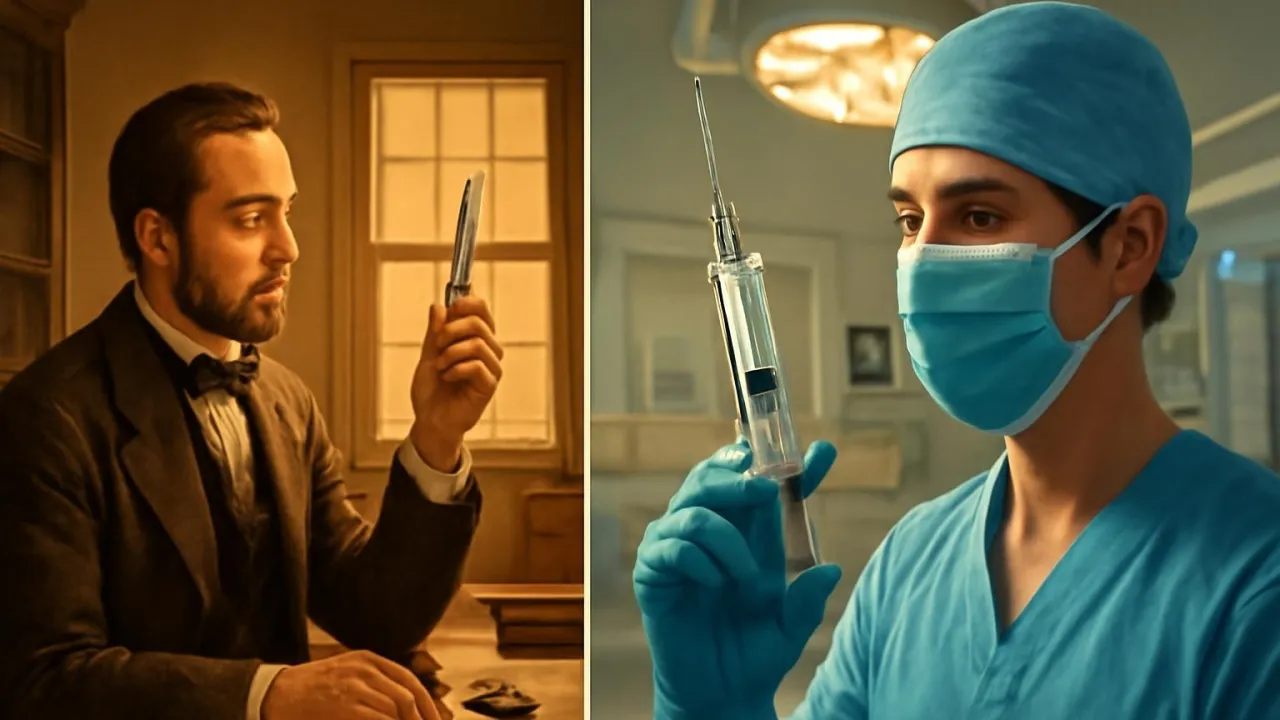
Some syringes are so tiny, they can help babies and animals too!
✨ Word Sparks (Grade 2 Glossary)
Tap 🔊 to hear
liquid
Something that flows like water
plunger
The part you push or pull
heal
To get better after being sick
🪝
Have you ever heard the soft pop of a nurse’s syringe?
1
The Helpful Tube
A nurse holds a clear tube with a small, sharp needle. She pulls the back, filling it with medicine. The syringe is ready to help you feel better.
2
How It Works
The nurse presses the , and the medicine moves through the needle. The medicine goes quickly into your body, helping you faster. Syringes are used in hospitals and doctor’s offices everywhere.
3
A Safe Tool
Doctors throw away the syringe after one use, keeping everyone safe. Syringes help people of all ages get well. They make medicine easy to give and easy to get.
Tiny syringes can even deliver medicine to a single drop of blood!
✨ Word Sparks (Grade 3 Glossary)
Tap 🔊 to hear
fluid
A liquid that can flow easily
pressure
A push that moves things
vaccine
A shot that protects you from sickness
🪝
Can you imagine how doctors give medicine right into your body so quickly?
1
A Clever Invention
Long ago, doctors had to find new ways to give medicine fast. The medical syringe uses a hollow needle and a plunger to push liquid medicine into the body. This invention changed how people heal from sickness or pain.
2
How a Syringe Works
The plunger creates when pushed, sending medicine through the needle. The needle is very thin, so it can enter the skin with little pain. This process uses the science of mechanics to move liquids quickly and safely.
3
A World of Uses
Doctors and nurses use syringes in hospitals, clinics, and even for animals. Syringes can deliver , draw blood, or give life-saving medicine. They are made of plastic or glass and are thrown away after one use to keep things clean.
4
From Past to Present
The first modern syringe was invented in 1853 by Charles Pravaz and Alexander Wood. Their design used a fine needle and a strong plunger, making medicine delivery much safer. Today, syringes help millions of people around the world every day.
Some syringes are so precise they can inject just one-millionth of a liter!
✨ Word Sparks (Grade 4 Glossary)
Tap 🔊 to hear
fluid mechanics
The science of how liquids move
precise
Very exact, with no mistakes
disposal
Getting rid of something safely
🪝
What if you could move medicine into the body with just a gentle push?
1
The Science Behind the Syringe
A medical syringe uses the principles of to deliver medicine directly into the body. When the plunger is pushed, it creates pressure that forces the liquid medicine through a narrow, hollow needle. This design allows for control, making sure the correct amount of medicine is given. The sharpness of the needle and the smooth action of the plunger help minimize discomfort for patients.
2
A History of Healing
Before the syringe, doctors used much slower and less accurate methods to deliver medicine. In 1853, Charles Pravaz in France and Alexander Wood in Scotland each invented a version of the modern syringe. Their designs included a fine, hollow needle and a glass barrel, which made it possible to inject medicine safely and quickly. This invention transformed medical care around the world.
3
Everyday Impact
Today, syringes are used in hospitals, clinics, and even at home for people with certain illnesses. They are essential for giving vaccines, drawing blood, and treating emergencies. Syringes are usually made of plastic and are safely disposed of after one use to prevent the spread of germs and disease.
4
A Global Difference
The invention of the syringe has saved countless lives by making medicine delivery fast and accurate. It is also used in animal care, research labs, and even in some science experiments. Thanks to this small but powerful tool, people everywhere can get the medicine they need to stay healthy.
Needle-free syringes can deliver medicine using only a jet of air—no needle needed!
✨ Word Sparks (Grade 5 Glossary)
Tap 🔊 to hear
hypodermic
Means 'under the skin'; describes the needle
sterility
Completely free from germs or bacteria
microfluidics
The science of moving tiny liquid amounts
🪝
Picture the gentle click as a nurse presses a plunger—how does that tiny motion bring medicine right where it's needed most?
1
Engineering the Medical Syringe
With a soft click and a steady hand, a nurse pushes the plunger and sends medicine flowing through a slender, hollow needle. This simple motion relies on the science of fluid mechanics: depressing the plunger creates positive pressure inside the barrel, forcing liquid medicine through the needle and directly into tissue or blood. The needle’s gauge, or thickness, determines both the comfort and speed of the injection. Medical syringes are usually made from medical-grade plastics to guarantee and safe, single use. Every part—from the clear barrel to the sharp tip—is designed for accuracy, safety, and ease.
2
Historical Breakthroughs and Global Impact
Before syringes, doctors struggled to deliver medicine quickly or accurately, often relying on less effective methods. In 1853, Charles Pravaz in France and Alexander Wood in Scotland each developed a practical syringe with a fine, hollow needle and glass barrel. Their invention allowed doctors to inject precise doses of anesthetics and vaccines, transforming surgery, emergency care, and disease prevention. Today, syringes are essential in every hospital and clinic worldwide, saving millions of lives each year.
3
Precision, Safety, and Innovation
The plunger’s tight seal prevents leaks, while the needle’s sharp bevel allows for smooth, minimally invasive entry into the body. Syringe design uses the principles of pressure and resistance to move fluids efficiently and safely. Innovations like auto-disable syringes and safety caps have greatly reduced the risk of infection and needle-stick injuries. In scientific research, micro-syringes can deliver substances as small as a microliter, supporting breakthroughs in genetics and chemistry. Every improvement has made syringes safer and more effective for everyone.
4
Beyond Human Medicine
Syringes are also vital in animal care, laboratory science, and even in certain industrial processes. Veterinarians use them to vaccinate animals and deliver treatments efficiently. In laboratories, scientists use syringes to measure and transfer precise amounts of liquids for experiments. , the science of moving tiny amounts of liquid, often depends on syringes to control flows in research and medical devices. The same basic principle—pressure moving liquid—applies in all these fields.
5
The Future of Syringe Technology
Soon, you might see syringes with smart chips that track doses or even needle-free injectors that use bursts of air to deliver medicine painlessly. Researchers are also developing dissolvable microneedles that can deliver vaccines through a patch. Despite their small size, syringes have played a massive role in global health by enabling vaccination campaigns, rapid emergency care, and scientific discovery. The next generation of syringes will keep building on this legacy, making medicine delivery even safer and more precise for people everywhere.