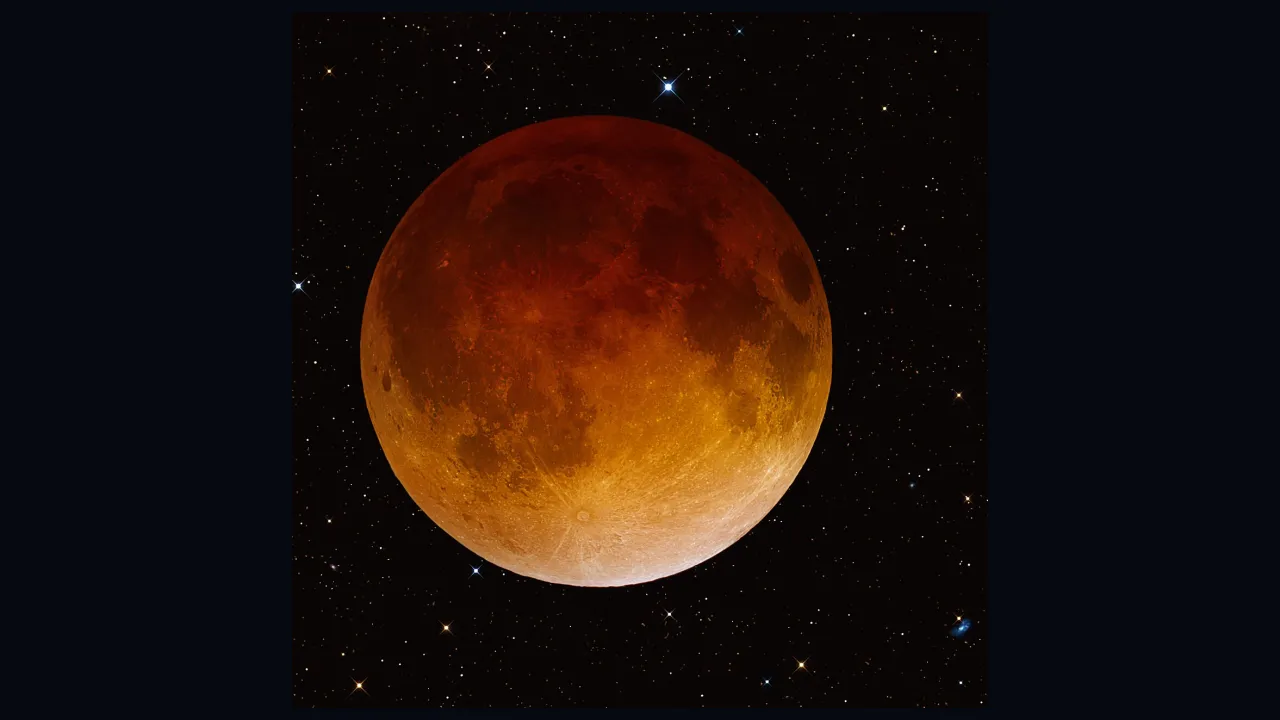
1. Which space neighbor casts its shadow onto the Moon during a lunar eclipse?
2. Do you need special eclipse glasses to watch a lunar eclipse at night?
🤯 Mind-Blowing Fact • Grade 2
After a giant volcano erupts on Earth, high volcanic ash blocks sunset light and makes the next total lunar eclipse look extra dark brown or charcoal gray!
✨ Word Sparks (Grade 2 Glossary)
Tap 🔊 to hear
sphere
A round 3D shape like a basketball
Blood Moon
Nickname for a red totally eclipsed Moon
volcanic ash
Tiny rock dust blasted high by volcanoes
🪝
How did a lunar eclipse help ancient thinkers prove Earth is round like a ball?
1
A Curved Bite Out of the Moon
Over two thousand years ago, Greek philosopher Aristotle watched Earth's dark shadow glide across the Full Moon. Every single time, the edge of Earth's shadow was smoothly curved! Only a round casts a circular shadow from every angle, proving Earth is a giant ball.
2
Why People Call It a Blood Moon
Once the Moon slides all the way inside Earth's darkest shadow, it turns orange, brick-red, or copper instead of black. Earth's air scatters away blue sunlight while bending warm red sunset light onto the dusty lunar rocks.
3
Half the World Watches Together
Unlike narrow solar eclipses, a lunar eclipse shines for everyone on Earth's nighttime side for more than an hour!
1. What clue during lunar eclipses proved to Aristotle that Earth is round?
2. What makes a totally eclipsed Moon look extra dark brown instead of bright orange?
🤯 Mind-Blowing Fact • Grade 3
Astronomers rate the brightness and color of every total lunar eclipse on the five-step Danjon Scale, from nearly black (0) to glowing bright copper-orange (4)!
✨ Word Sparks (Grade 3 Glossary)
Tap 🔊 to hear
refraction
Bending of light waves passing through air
partial eclipse
When only part of the Moon enters umbra
infrared
Heat radiation invisible to human eyes
🪝
Why are there three different flavors of lunar eclipses—and why is only one copper-red?
1
Two Shadows Concentric in Space
Earth trails a bullseye target of two shadows opposite the Sun: a pale outer ring called the penumbra, where Earth blocks only part of the Sun, and a deep central cone called the umbra, where Earth blocks direct sunlight completely. Depending on how squarely the Full Moon aims at that bullseye, three kinds of lunar eclipses happen!
2
Penumbral, Partial, and Total
If the Moon only skims the outer penumbra, it dims so gently most stargazers barely notice. In a partial lunar eclipse, part of the Moon dips into the dark umbra like a cookie with a bite taken out. In a total lunar eclipse, the entire Moon plunges into the umbra for up to 107 minutes!
3
Atmospheric Refraction Magic
Without an atmosphere on Earth, the totally eclipsed Moon would turn invisible black. Instead, Earth's air acts like a giant curved lens—filtering out blue wavelengths and refracting fiery red sunrise and sunset beams straight onto the Moon.
4
Thermal Shock on Lunar Rocks
telescopes show the Moon's sunlit surface plunges hundreds of degrees in minutes when Earth's shadow cuts off solar heat!
1. What would a total lunar eclipse look like if Earth had NO atmosphere at all?
2. What happens to the temperature of Moon dust during a lunar eclipse?
🤯 Mind-Blowing Fact • Grade 4
Look at the edge of Earth's shadow during a lunar eclipse through binoculars and you can spot a faint turquoise ribbon caused by Earth's protective ozone layer!
✨ Word Sparks (Grade 4 Glossary)
Tap 🔊 to hear
ecliptic plane
Flat orbital path Earth traces around the Sun
ozone layer
High sky shield absorbing ultraviolet and red light
biosignature
Chemical clue in air hinting at living things
🪝
How can astronomers study the atmospheres of distant alien exoplanets by watching a lunar eclipse right at home?
1
Orbital Nodes and Eclipse Seasons
Because the Moon's orbit tilts 5.14 degrees relative to Earth's , Full Moons usually pass slightly north or south of Earth's shadow cone. Roughly every six months during 'eclipse seasons,' Full Moon coincides with an orbital node. Because Earth's 12,742-kilometer diameter casts an umbra nearly 9,200 kilometers wide at the Moon's distance—more than 2.6 times wider than the Moon—totality can last nearly one hour and forty-seven minutes.
2
Rayleigh Scattering Meets Ozone Blue
Sunlight skimming through Earth's lower troposphere undergoes intense Rayleigh scattering, stripping out short violet and blue wavelengths while refracting long red wavelengths inward onto the lunar maria. Look closely through binoculars right near the umbral edge, however, and you can often spot a striking turquoise-blue band! That blue fringe comes from sunlight passing higher through Earth's stratospheric , which absorbs red light while letting blue slip through.
3
Earth as a Proxy Exoplanet
Using the Hubble Space Telescope during a 2019 total lunar eclipse, astronomers analyzed sunlight filtered through Earth's atmosphere and reflected off the Moon as a stand-in for 'transit spectroscopy'—proving space telescopes can detect ozone and oxygen around distant Earth-like exoplanets!
4
Cooling Craters Reveal Young Rocks
NASA's Lunar Reconnaissance Orbiter images eclipses in thermal infrared, spotting young boulder-strewn craters like Tycho staying warmer than powdery ancient dust.
1. What creates the subtle turquoise-blue band sometimes seen along the edge of Earth's shadow on the Moon?
2. Why did astronomers point the Hubble Space Telescope at the Moon during a total lunar eclipse?
🤯 Mind-Blowing Fact • Grade 5
On April 24, 1967, NASA's Surveyor 3 lander photographed a total lunar eclipse directly FROM the surface of the Moon, capturing Earth ringed in a dazzling beaded halo of twilight!
✨ Word Sparks (Grade 5 Glossary)
Tap 🔊 to hear
selenelion
Seeing setting Sun and eclipsed Moon simultaneously
regolith
Blanket of crushed rock dust covering the Moon
optical depth
Measure of how much haze blocks passing light
🪝
How did ancient Greek geometers measure the distance to the Moon using nothing more than a stopwatch-like timing of Earth's shadow?
1
Aristarchus, Hipparchus, and Shadow Geometry
In the third and second centuries BCE, Greek astronomers Aristarchus of Samos and Hipparchus realized a total lunar eclipse serves as a cosmic measuring tape. By timing how many hours the Moon took to cross Earth's umbral cone compared to one lunar diameter, and accounting for the Sun's half-degree angular convergence, Hipparchus calculated the Moon's distance at roughly 60 Earth radii—astonishingly close to the modern mean value of 60.3 Earth radii!
2
Transmission Spectroscopy and the Danjon Scale
French astronomer André-Louis Danjon devised his five-point luminosity scale ($L=0$ to $L=4$) in 1921 to link umbral brightness with solar cycle variations and terrestrial aerosols. Following major Plinian volcanic eruptions such as Mount Pinatubo in 1991 or Hunga Tonga in 2022, sulfate aerosols and water vapor injected into the stratosphere raise , plunging subsequent lunar eclipses down to ghostly $L=0$ or $L=1$ charcoal hues.
3
Selenelion: Seeing Sun and Eclipsed Moon Together
Geometry dictates the Sun and totally eclipsed Moon sit 180 degrees apart, seemingly impossible to view simultaneously. Yet atmospheric refraction lifts images near the horizon by ~0.5 degrees, letting hilltop observers witness a brief ''—rising crimson Moon opposite the setting Sun!
4
Regolith Thermophysics From Orbit
Aboard NASA's Lunar Reconnaissance Orbiter, the Diviner Lunar Radiometer maps thermal infrared emission as the lunar surface plunges from blistering ~390 K daylight down toward ~100 K within just a couple of hours! Because fluffy, fine-grained dust insulates heat while solid exposed bedrock retains warmth far longer, thermal eclipse snapshots pinpoint geologically young, boulder-rich impact craters across the entire nearside hemisphere.
5
Challenges for Lunar Power
Whereas two-week lunar nights occur predictably along a moon's latitude, multi-hour umbral transits also plunge sunlit equatorial landing sites and cislunar satellites into sudden darkness and deep cryogenic cold. Modern commercial lunar landers, orbital relays, and future Artemis surface habitats engineer high-density lithium-ion batteries, fuel cells, or radioisotope power systems specifically to weather total lunar eclipse blackouts.