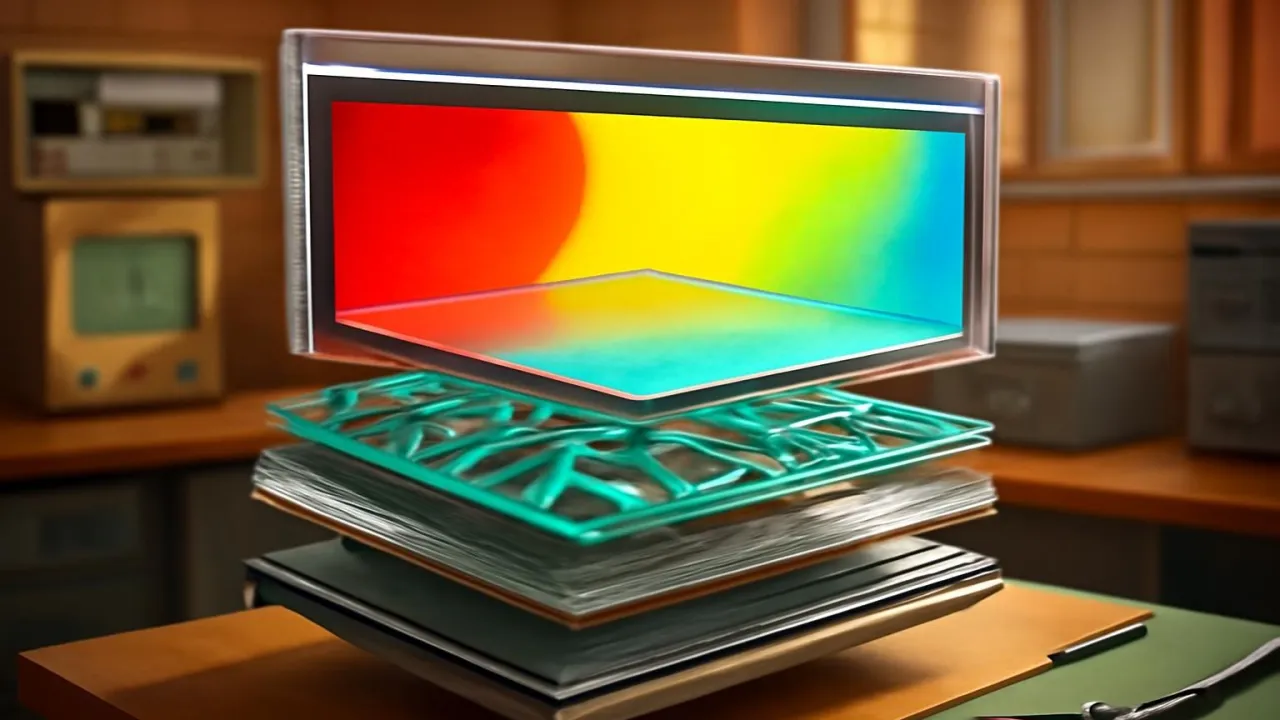
LCD screens can show millions of different colors!
✨ Word Sparks (Grade 2 Glossary)
Tap 🔊 to hear
liquid
Something that flows like water
electricity
Power that makes things work
glass
A clear, smooth material in windows
🪝
Have you ever wondered how your TV shows moving pictures?
1
Screens That Shine
LCD screens are in TVs, tablets, and computers. They are flat and light, so you can carry them. These screens show bright colors and clear pictures every day.
2
How Do They Work?
Tiny crystals live between two plates. When moves through them, the crystals twist and let light pass. This makes different colors and shapes appear on your screen.
3
Everywhere Around Us
LCD screens help us learn, play, and talk to friends. They are used in classrooms, cars, and even watches. The world is full of LCD screens now!
A single LCD TV screen can have over two million pixels!
✨ Word Sparks (Grade 3 Glossary)
Tap 🔊 to hear
pixel
A tiny dot that makes a picture
vibration
A quick back-and-forth movement
optical
About how light moves or works
🪝
What if you could see inside your TV and watch colors form?
1
A Window of Wonders
When you look at a tablet or TV, you see a bright, flat screen. This screen is actually made of layers stacked together. Each layer has a special job to help make pictures and words appear. The magic happens in the middle, where liquid crystals live.
2
The Science of Liquid Crystals
Liquid crystals are special materials that flow like liquid but have some order like solids. When electricity passes through them, they twist and change how light moves. This process is called , and it helps create the colors you see. Each tiny square, or , can change color in a flash.
3
How LCD Screens Work
Light shines from behind the screen, passing through the liquid crystals. The crystals block or let light pass by twisting in different ways. This makes bright images, sharp text, and fun videos possible. Engineers call this an 'acoustic' or '' process because it controls light and sometimes sound.
4
Changing the World
LCD screens are everywhere, from smartwatches to giant TVs in stadiums. They use less energy than old screens, so they help save power. The invention of LCDs made computers, phones, and games lighter and easier to carry. Today, almost everyone uses an LCD every day.
1. What do liquid crystals do when electricity flows?
2. Why are LCD screens used everywhere?
🤯 Mind-Blowing Fact • Grade 4
If you stacked all the pixels in a 50-inch LCD TV, they'd stretch over 2 miles end-to-end!
✨ Word Sparks (Grade 4 Glossary)
Tap 🔊 to hear
polarization
How light waves are lined up or blocked
wavelength
The length of a wave of light or sound
energy-efficient
Uses less power to do the same job
🪝
Imagine peering through a microscope and watching millions of crystals dance to create a picture—how does this happen?
1
Layers of Light and Color
An LCD screen is a marvel of engineering, built from several thin layers stacked together. The key layer holds liquid crystals, which are substances that flow like a liquid but have some order like a solid. When electricity is applied, these crystals twist at precise angles, changing how light passes through them. This twisting controls the brightness and color of each pixel you see.
2
The Physics Behind the Picture
A backlight shines white light through the back of the LCD screen. As the light travels forward, it passes through polarizing filters and the liquid crystal layer. The crystals' vibration and orientation determine which of light are blocked or allowed through. This process is called , and it lets each pixel display different colors and shades.
3
A 20th Century Breakthrough
The first working LCD was created in 1968 by George H. Heilmeier and his team at RCA in the United States. Before LCDs, screens were bulky and used a lot of electricity. The invention of LCD technology allowed for thinner, lighter, and more displays, changing how people used computers, watches, and televisions.
4
Impact on Daily Life
LCDs have made portable electronics possible, from smartphones to calculators and even airplane screens. Their low energy use helps save power in homes and schools around the world. Because LCD screens can be made in many sizes, they are used in everything from tiny fitness trackers to giant stadium displays.
The world’s largest LCD screen, in Las Vegas, covers over 100,000 square feet—larger than two football fields!
✨ Word Sparks (Grade 5 Glossary)
Tap 🔊 to hear
resolution
How clear and detailed a screen’s picture is
prototype
A first model used to test an idea
cathode-ray tube (CRT)
An old, bulky kind of screen used before LCDs
🪝
What if you could control millions of tiny molecules to paint pictures with light—how would you engineer it?
1
The Engineering Inside LCDs
Liquid Crystal Displays, or LCDs, are built from multiple ultra-thin layers, each with a specialized role in producing images. The central layer contains liquid crystals, which are unique molecules that behave both like liquids and solids. When an electric current is applied, these molecules align or twist, altering the direction of polarized light passing through them. This precise control allows each pixel to display an exact color and brightness, forming the high- images we see.
2
Physics of Light and Polarization
The LCD’s operation relies on the physics of polarization and optical filtering. A powerful backlight emits white light, which first passes through a polarizer, aligning the light waves in a single direction. As light travels through the liquid crystal layer, the crystals’ orientation, controlled by electric fields, rotates the light’s polarization. A second polarizer then either blocks or transmits the light, depending on its alignment, resulting in visible pixels that can be switched on or off at incredible speeds.
3
From Prototype to Everyday Tech
The first practical LCD was demonstrated in 1968 by George H. Heilmeier and his team at RCA Laboratories. Their early used a dynamic scattering mode, which was soon improved with twisted nematic designs for better clarity and efficiency. Over decades, advances in materials science, electronics, and manufacturing have made LCDs thinner, brighter, and more affordable, replacing older cathode-ray tube (CRT) displays in most devices.
4
Global Impact and Modern Uses
LCD technology revolutionized the way people interact with information and entertainment worldwide. From calculators and digital watches to smartphones, laptops, and massive stadium screens, LCDs are now central to daily life. Their energy efficiency has reduced electricity consumption globally, while their ability to be manufactured in various sizes has enabled innovations in everything from automotive dashboards to medical imaging equipment.
5
The Science Continues to Evolve
Today’s LCDs can display billions of colors and achieve greater than 8 million pixels on a single screen. Engineers continue to improve liquid crystal materials for faster response times and wider viewing angles. As new display technologies like OLED and quantum dots emerge, LCDs remain a cornerstone of modern electronics, demonstrating the power of scientific discovery and engineering creativity.