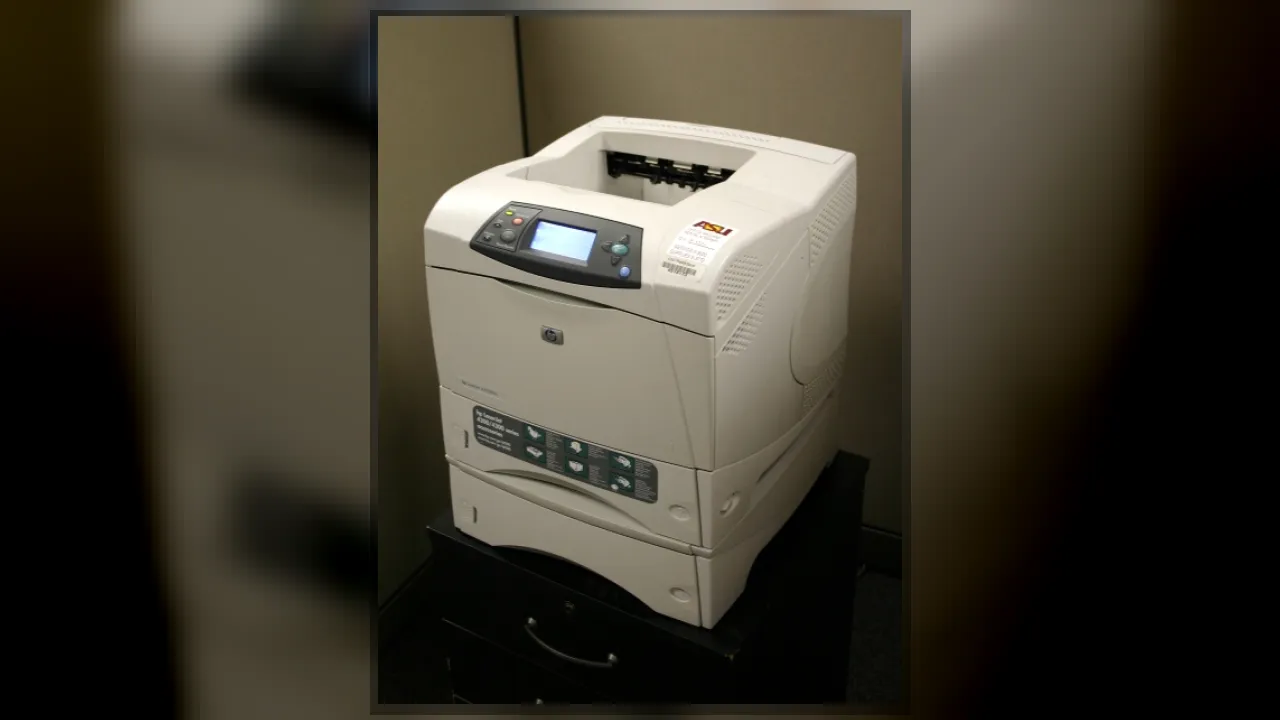
1. What does a laser printer use instead of wet liquid ink?
2. Why does a page feel warm right after it comes out of a laser printer?
🤯 Mind-Blowing Fact • Grade 2
Big office laser printers can zip out more than one hundred crisp pages in a single minute!
✨ Word Sparks (Grade 2 Glossary)
Tap 🔊 to hear
static
An electric charge that makes things cling
drum
A smooth spinning cylinder inside a printer
fuser
Hot rollers that melt toner onto paper
🪝
Have you ever rubbed a balloon on your hair and watched paper bits jump to it?
1
Static Magic Inside a Box
Rub a balloon on your sweater, and electricity makes dust cling to it! Inside a machine on your desk, that exact same static trick prints crisp words and pictures at lightning speed.
2
A Spinning Mirror and a Beam
Engineer Gary Starkweather built the first model in 1969. Inside, a bright laser bounces off a spinning mirror onto a metal . Everywhere the light touches, the electric charge changes like an invisible drawing.
3
Baking the Powder On
Fine plastic powder called toner jumps onto the invisible drawing, and a blank sheet rolls underneath to catch it. Finally, two hot rollers melt the powder right into the paper fibers.
1. What force makes toner powder jump onto the right spots on the drum?
2. Who invented the laser printer back in 1969?
🤯 Mind-Blowing Fact • Grade 3
Each grain of laser toner is tinier than a speck of flour and is actually made of microscopic plastic mixed with color pigment!
✨ Word Sparks (Grade 3 Glossary)
Tap 🔊 to hear
photoconductor
A surface that changes charge in light
pigment
Natural or made material that gives color
prototype
The very first working test model built
🪝
How did one curious engineer turn a noisy office copier into a quiet light-speed printer?
1
Goodbye Clacking Hammers!
Clack-clack-clack! Before the 1970s, computer printers worked like loud typewriters, hammering metal letters against inked ribbons. Printing a single chart took ages and sounded like a busy construction site.
2
Gary Starkweather's Bright Idea
In 1969, engineer Gary Starkweather worked at Xerox in New York. His boss told him lasers were too tricky for printers, yet Gary kept experimenting. He aimed a narrow laser at a spinning multi-sided mirror to sweep light across a copier drum.
3
Painting With Charges
First, the drum gets coated with an even static charge. As the laser flashes on and off millions of times per second, it erases charge in the exact shape of letters. Charged toner dust sticks only where the laser drew.
4
Pressed and Fused Forever
A sheet of paper with a stronger charge pulls the powdery letters off the drum. Then heated fuser rollers press the plastic toner into the paper so nothing ever smears.
1. How did old computer printers make letters before laser printers arrived?
2. What bounces the laser beam swiftly from side to side across the drum?
🤯 Mind-Blowing Fact • Grade 4
The laser beam inside a modern printer switches on and off millions of times every second to place up to 1,200 tiny dots inside a single inch!
✨ Word Sparks (Grade 4 Glossary)
Tap 🔊 to hear
xerography
Dry printing powered by light and static
electrostatic
Relating to stationary attracting electric charges
polygon
A flat shape with many straight sides
🪝
What happens inside a printer during the three seconds between clicking 'Print' and holding a crisp page?
1
A Lightning-Fast Light Show
Click the print button on a computer, and a hidden light show begins inside a dark plastic shell. Within seconds, millions of invisible dots organize themselves into razor-sharp paragraphs, graphs, and photographs without a single drop of liquid ink.
2
From Photocopier to Computer Partner
Photocopiers invented by Chester Carlson already used static electricity to copy paper documents, but computers needed a way to print digital data stored only in memory. In 1969, Xerox physicist Gary Starkweather solved the puzzle by replacing the copier camera lens with a focused laser beam controlled directly by electronic signals. By 1971 at Xerox PARC, his team had a working networked printer.
3
Six Steps of Xerography
Inside the cartridge, a corona wire or charging roller gives a light-sensitive drum a uniform charge. A laser reflects off a whirling mirror, discharging tiny dots where black marks belong. Electrically charged toner particles leap onto those discharged spots, transfer onto a stronger-charged sheet of paper, and pass through heated rollers near 200 degrees Celsius.
4
Sparking Desktop Publishing
When affordable compact models like the Hewlett-Packard LaserJet arrived in 1984 using Canon's replaceable all-in-one toner cartridge, offices transformed overnight. Schools, small businesses, scientists, and authors could suddenly typeset crisp newsletters, illustrated books, sheet music, and flyers right from their own desks.
1. How did Gary Starkweather change a regular photocopier to create the laser printer?
2. About how hot do the fuser rollers get to melt plastic toner onto paper?
🤯 Mind-Blowing Fact • Grade 5
Color laser printers repeat the entire laser-and-drum process four separate times—using cyan, magenta, yellow, and black toner—lining up every layer within micrometers!
✨ Word Sparks (Grade 5 Glossary)
Tap 🔊 to hear
insulator
Material that blocks electric charges from flowing
latent
Present in hidden form before becoming visible
polymer
Long chain molecule used to make plastics
🪝
How can a beam of pure light sculpt microscopic plastic dust with thousandths-of-an-inch precision?
1
Precision Hidden in Plain Sight
Peer closely through a magnifying glass at a page from an inkjet printer, and you might spot tiny feathered edges where liquid droplets soaked into paper fibers. Examine text from a laser printer, however, and every letter edge looks crisp as cut steel, sculpted by quantum optics and electrostatic physics.
2
Rebellion in the Research Lab
In 1969, optical engineer Gary Starkweather worked at Xerox's research center in Webster, New York, pondering how computers could generate pages directly from digital code. Management initially discouraged his laser experiments as impractical, so Starkweather transferred to Xerox's newly founded Palo Alto Research Center in California. By 1971, he modified a Xerox 7000 copier into the world's first networked laser printer, dubbed EARS, printing two pages per second.
3
Photoconductivity and Raster Scanning
Before printing, an internal processor translates fonts and vector graphics into a high-resolution bitmap grid. A charging roller blankets a cylindrical drum coated in organic photoconductive material with negative ions. In darkness, that coating acts as an electrical , holding its charge; wherever photons from a scanning laser diode strike the surface, its resistance plummets and charge drains away, leaving an invisible electrostatic image.
4
Triboelectric Toner and Thermal Fusing
Inside the hopper, microscopic spheres of styrene-acrylate and carbon or color pigment gain a negative charge through friction. Repelled by the drum's charged background, the toner leaps solely onto the laser-discharged dots. A positively charged transfer roller pulls the powder onto moving paper before Teflon-coated fuser rollers apply heat near 200 degrees Celsius and firm pressure, bonding polymer to cellulose fibers.
5
Democratizing the Printed Word
While early room-sized units like the 1977 Xerox 9700 served giant data centers, Canon and Hewlett-Packard introduced affordable compact engines in 1984. Combined with graphical computers, laser printing ignited the desktop publishing revolution worldwide.