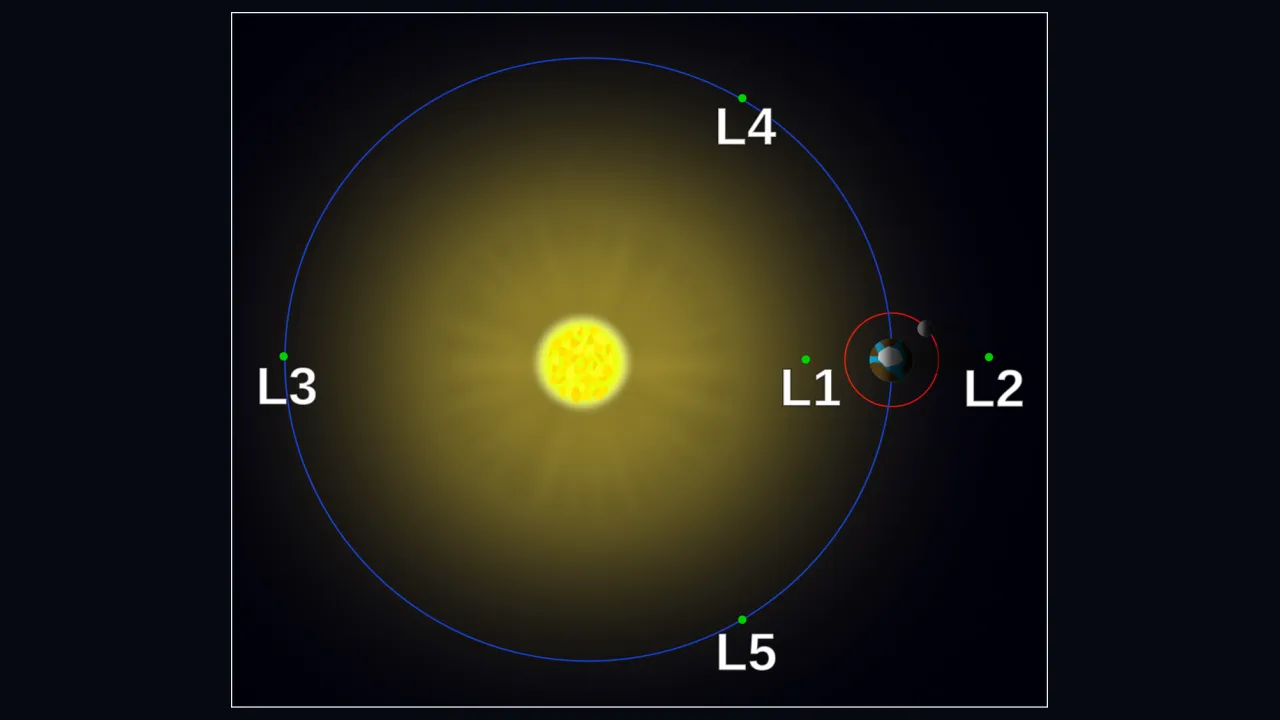
1. How many Lagrange points exist around each star-and-planet pair like the Sun and Earth?
2. Why do engineers love sending space telescopes to Lagrange points?
🤯 Mind-Blowing Fact • Grade 2
Over ten thousand space rocks called Trojan asteroids ride peacefully ahead of and behind giant Jupiter inside its L4 and L5 Lagrange points!
✨ Word Sparks (Grade 2 Glossary)
Tap 🔊 to hear
satellite
object or craft orbiting in space
asteroid
rocky chunk orbiting around the Sun
solar storm
burst of energy from the Sun
🪝
Where in space can a satellite watch the Sun all day without Earth ever blocking its view?
1
Balancing Pulls and Motion
Imagine swinging a bucket in a circle while two friends tug gently from different sides! Between the Sun and Earth, gravity pulls from two giant worlds combine with orbital motion to create five sweet spots called Lagrange points.
2
Meet L1 through L5
Scientists number these cosmic parking spots L1, L2, L3, L4, and L5. Point L1 sits straight toward the Sun, giving solar an unbroken daytime view to warn us about incoming !
3
Shady Views and Space Rocks
Point L2 sits nearly a million miles behind Earth, keeping heat-sensitive telescopes like James Webb cool. Meanwhile, L4 and L5 act like natural gravity bowls that collect thousands of hitchhiking !
1. Which Lagrange point sits right between Earth and the Sun, giving satellites a nonstop view of solar storms?
2. What naturally gathers inside giant Jupiter's L4 and L5 Lagrange points?
🤯 Mind-Blowing Fact • Grade 3
NASA's Lucy spacecraft is currently on a twelve-year voyage to visit multiple ancient Trojan asteroids trapped inside Jupiter's L4 and L5 Lagrange points!
✨ Word Sparks (Grade 3 Glossary)
Tap 🔊 to hear
equilibrium
state where opposing forces balance equally
halo orbit
looping path around a Lagrange point
thruster
small rocket engine steering a spacecraft
🪝
How can a telescope orbit slower-looking far from the Sun yet finish one year in exact lockstep with Earth?
1
Breaking the Usual Speed Rule
Normally in our Solar System, worlds farther from the Sun take longer to finish one orbit—Mars needs nearly two Earth years! Yet at Sun-Earth point L2, almost a million miles farther out than Earth, the James Webb Space Telescope still completes one trip around the Sun in exactly 365 days!
2
Teamwork Gravity
How does that trick work? Earth's gravity teams up with the Sun's gravity, adding just enough extra inward pull to swing a spacecraft around the Sun at Earth's exact yearly pace. Eighteenth-century mathematician Joseph-Louis Lagrange solved the famous three-body math behind these five zones.
3
Hilltops vs. Valleys
Points L1, L2, and L3 sit in a straight line and act like balancing a marble on a saddle: spacecraft loop around them in gentle '' using tiny nudges every few weeks.
4
Stable Triangle Pockets
Points L4 and L5 form giant equal-sided triangles 60 degrees ahead of and behind a planet. Like smooth bowls, they hold dust and Trojan asteroids steady for billions of years!
1. Why does a telescope at Sun-Earth L2 finish its orbit in 365 days even though it is farther from the Sun than Earth?
2. How are Lagrange points L4 and L5 different from L1, L2, and L3?
🤯 Mind-Blowing Fact • Grade 4
Earth actually has at least two known small Trojan asteroids of its own—2010 TK7 and 2020 XL5—quietly leading our planet around the Sun at Earth's L4 point!
✨ Word Sparks (Grade 4 Glossary)
Tap 🔊 to hear
centripetal
inward pull keeping circular motion curved
sunshield
layered visor blocking heat and sunlight
solar wind
stream of charged particles from Sun
🪝
Why do engineers loop the James Webb Space Telescope around empty space at L2 instead of parking dead center?
1
Solving the Three-Body Puzzle
Calculating gravity between two bodies is straightforward, but adding a third creates one of physics' trickiest puzzles. In 1767, mathematician Leonhard Euler identified three straight-line balance points—L1, L2, and L3—when the third object has negligible mass. Five years later, Joseph-Louis Lagrange discovered two triangular points, L4 and L5, completing the five-point cosmic map where gravitational attraction exactly matches required acceleration.
2
Why JWST Loops Around L2
Sun-Earth L2 lies 1.5 million kilometers anti-sunward of Earth. If James Webb sat motionless at the exact center of L2, Earth's shadow would partially block sunlight from its solar panels! Instead, Webb traces a sweeping halo orbit wider than the Moon's path around Earth—keeping its solar arrays bathed in sunshine while its tennis-court-sized blocks heat from the Sun, Earth, and Moon all in one direction.
3
Space Weather Sentinels at L1
Sunward point L1 hosts observatories like SOHO and DSCOVR, which taste particles nearly an hour before storms slam into Earth's magnetic shield, giving power-grid operators vital warning.
4
Coriolis Stability at L4 and L5
At triangular points L4 and L5, the Coriolis effect curves any drifting object back into a kidney-bean-shaped 'tadpole orbit,' preserving pristine fossils of Solar System birth.
1. Why does the James Webb Space Telescope fly in a wide halo loop around L2 rather than sitting right in Earth's shadow?
2. Why is Sun-Earth L1 the ideal outpost for space-weather satellites like DSCOVR?
🤯 Mind-Blowing Fact • Grade 5
China's Queqiao relay satellite orbits around the Earth-Moon L2 point so it can simultaneously see both Earth and landers exploring the otherwise radio-silent far side of the Moon!
✨ Word Sparks (Grade 5 Glossary)
Tap 🔊 to hear
collinear
lined up along one straight line
Coriolis effect
curving force inside a rotating system
station-keeping
small thruster burns holding exact orbit
🪝
How do mission planners link unstable Lagrange points across the Solar System into a fuel-saving 'Interplanetary Superhighway'?
1
Rotating Frames and Effective Potential
Analyze a star-and-planet pair inside a co-rotating reference frame, and gravitational potentials from both massive bodies combine with outward centrifugal potential to sculpt a 3D landscape of hills and valleys. Stationary points where the gradient of this effective potential vanishes are the five Lagrange points—three saddle points discovered by Leonhard Euler in 1767 and two equilateral-triangle extrema proved by Joseph-Louis Lagrange in 1772.
2
Station-Keeping at Collinear Saddles
points L1, L2, and L3 are dynamically unstable with characteristic drift timescales of roughly 23 days in the Sun-Earth system. Spacecraft such as JWST, Gaia, and ESA's Euclid ride three-dimensional Lissajous or halo trajectories around Sun-Earth L2 at 1.5 million kilometers, executing tiny hydrazine burns of just a few meters per second per year while keeping thermal radiation from Sun, Earth, and Moon aligned behind a single cryogenic shield.
3
Mass Ratios and Trojan Capture
Triangular points L4 and L5 achieve linear stability whenever the primary body exceeds roughly 24.96 times the secondary's mass—easily satisfied by Sun-Jupiter, Sun-Earth, and Earth-Moon pairs! Coriolis forces in the rotating frame deflect perturbations into stable tadpole and horseshoe orbits, trapping Jupiter's vast Greek and Trojan asteroid camps alongside Earth's own Kordylewski dust clouds.
4
Earth-Moon L2 Relay Gateways
Closer to home, Earth-Moon L2 hovers roughly 61,300 kilometers beyond the Moon's far side. China's Queqiao relay satellite and NASA's planned Lunar Gateway leverage nearby halo orbits to maintain unbroken radio sightlines between Earth ground stations and far-side lunar landers.
5
The Interplanetary Superhighway
Mathematicians even chain invariant manifold tubes stretching between different planets' L1 and L2 points into an 'Interplanetary Superhighway,' enabling sample-return probes like Genesis to coast vast cosmic distances on whisper-tiny propellant budgets.