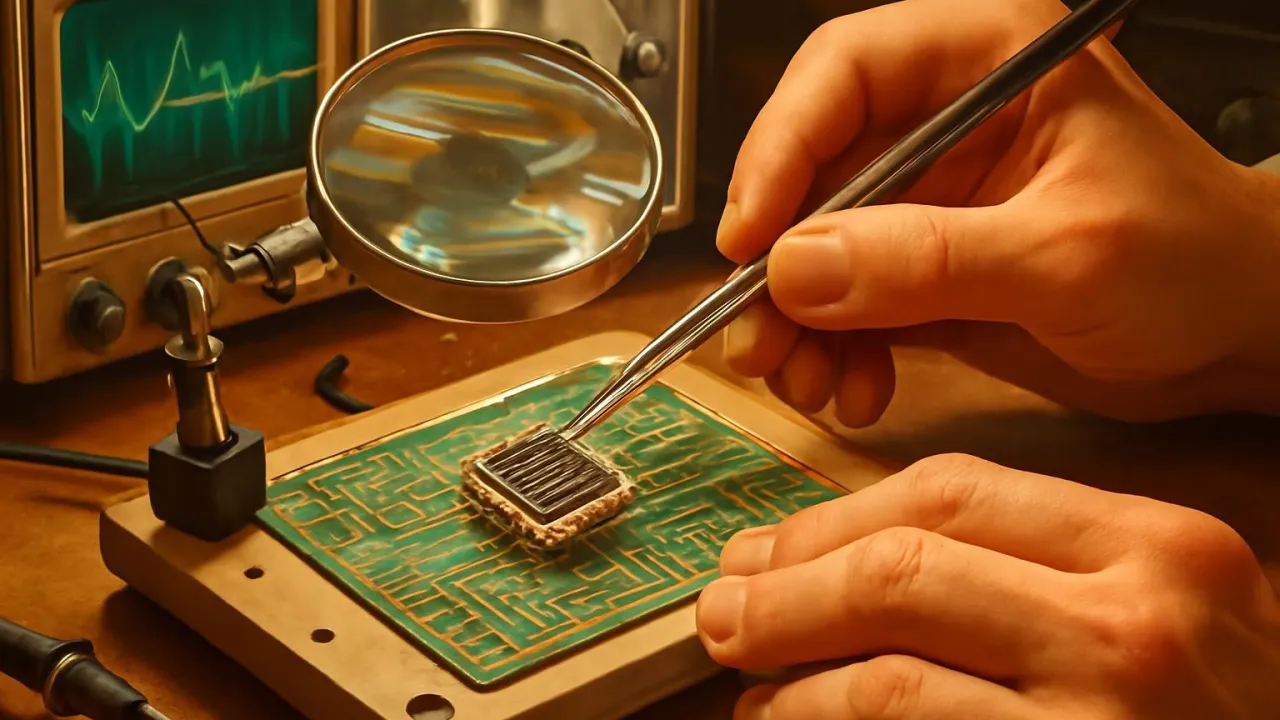
Integrated Circuit (Microchip)
Tiny Chips That Power Our World
A microchip can be smaller than your fingernail but hold millions of parts!
What if a whole computer fit on your fingertip?
1 Tiny, But Mighty
Microchips are very small and thin. They look like shiny puzzle pieces. People use them in many things.
2 Inside Your Gadgets
Microchips help phones and toys work. They send fast inside. Lights and sounds can change quickly.
3 Building With Chips
People put microchips on . Each has a special job. Chips make machines smart and quick.
1. Where do people use microchips?
2. What shape are microchips?
The first microchip could fit on a pencil tip, but now chips can hold billions of parts!
Can you imagine a tiny chip running your whole game?
1 A World of Tiny Circuits
Microchips are small, flat pieces made of shiny and metal. They hold many tiny parts that work together, and people put them in computers and toys.
2 How Microchips Help Us
Microchips send quick signals to help think and move. They let phones, cars, and even music players do many things at once.
3 Making Things Smarter
build microchips in clean rooms using special tools and machines. Each chip can do a special job, making our smarter and faster every year.
1. What do microchips help control?
2. Where are microchips built?
A modern microchip can have more than 50 billion transistors packed inside!
What would happen if a city of circuits lived inside your tablet?
1 A City on a Chip
Imagine a whole city squeezed onto a tiny chip. Microchips, also called integrated circuits, have millions of tiny parts called . These parts connect like roads, letting electric signals travel fast. The chip acts as the brain for many devices.
2 How Microchips Work
When you press a button, a signal travels through the chipâs circuits. Each can turn the signal on or off, like a tiny switch. This lets the chip do math, remember things, or play sounds. Engineers call this process logic.
3 Building the Microchip
Engineers design a before making real chips. They use silicon, a material from sand, because it conducts electricity well. The circuits are drawn with light and chemicals in a clean factory. This careful process makes sure each chip works perfectly.
4 Changing the World
Microchips made computers, phones, and robots possible. They are used everywhere, from hospitals to space rockets. The invention of the microchip won Jack Kilby a Nobel Prize. It changed how people live, work, and play every day.
1. What material are most microchips made from?
2. What do transistors do inside a chip?
The width of a microchipâs circuits can be less than one-thousandth the width of a human hair!
How did the tiniest invention ever spark the computer revolution?
1 The Birth of the Microchip
In the late 1950s, engineers Jack Kilby and Robert Noyce solved a huge problem: how to fit entire circuits onto a single piece of silicon. Before this, electronic devices used bulky wires and separate parts, which made them slow and easy to break. Their invention, the integrated circuit, allowed many transistors and connections to be built together on a tiny chip. This breakthrough made electronics smaller, faster, and much more .
2 How Microchips Work
A microchip is made from a thin slice of silicon, which is a , meaning it can control the flow of electricity. Engineers use a process called to etch microscopic circuits onto the chip. Each transistor on the chip acts as a switch, turning signals on or off to process information. Billions of these switches work together to make calculations, store data, and run programs.
3 Building and Testing Chips
Creating a microchip requires an extremely clean environment, called a cleanroom, to avoid dust that could ruin the tiny circuits. Engineers design a prototype, then use chemicals and light to build the final chip layer by layer. Each chip is tested to make sure all its circuits work perfectly before it is placed in computers, phones, or other devices.
4 A Global Impact
The integrated circuit changed the world by making powerful computers, smartphones, and medical equipment possible. It led to the digital age, where information can travel instantly and devices get smarter every year. The microchipâs invention helped launch the modern technology industry, creating millions of jobs and connecting people everywhere.
1. Why do engineers need cleanrooms to build microchips?
2. What does a microchip help devices do?
The worldâs fastest microchips can perform over one trillion calculations every single second!
What if the worldâs most powerful machine could fit on the tip of a pencil?
1 Revolution on a Sliver of Silicon
In 1958, Jack Kilby at Texas Instruments and, soon after, Robert Noyce at Fairchild independently engineered the first integrated circuits, forever transforming electronics. Before this invention, electronic devices depended on large, fragile vacuum tubes and tangled wires that made computers enormous and unreliable. By integrating all the necessary componentsâtransistors, resistors, and capacitorsâonto a single silicon wafer, Kilby and Noyceâs microchip ignited the era of miniaturized, powerful, and affordable technology.
2 The Science Behind the Microchip
A microchip is a wafer-thin slice of purified silicon, a material that can precisely control electrical current. Engineers use , a process involving ultraviolet light and chemical masks, to etch intricate circuit patterns onto the silicon surface. Each microchip contains billions of transistors, which act as tiny switches to process binary signalsâturning electrical pulses on or off to represent digital information. This dense network of circuits enables astonishing speed, memory, and logic functions in modern devices.
3 From Prototype to Mass Production
The first microchip prototypes were hand-built and tested in highly controlled cleanrooms, where even a single dust particle could destroy delicate circuitry. Modern microchip fabrication uses automated machines in ultra-clean environments, building chips layer by layer with atomic precision. After manufacturing, each chip undergoes rigorous testing to ensure every transistor and connection functions flawlessly, guaranteeing reliability for use in computers, smartphones, and spacecraft.
4 Global Impact and the Digital Age
The integrated circuitâs invention sparked the digital revolution, making possible everything from pocket-sized computers to global communication networks. Microchips are now found in medical devices, cars, satellites, and even smart appliances, powering nearly every aspect of modern life. This technology has created entire industries, transformed economies, and connected billions of people across the planet, shaping how we learn, work, and interact.
5 The Future: Smaller, Faster, Smarter
Todayâs microchips contain over 50 billion transistors packed into a space smaller than a postage stamp, with some circuits measuring just a few nanometers wide. Engineers are constantly pushing the limits of , which predicts that the number of transistors on a chip doubles every two years, leading to exponential increases in computing power. As artificial intelligence, quantum computing, and new materials emerge, the microchipâs evolution will continue to drive innovation and redefine whatâs possible for generations to come.
1. How did integrated circuits change computer size and reliability?
2. What is one reason microchips keep getting more powerful?