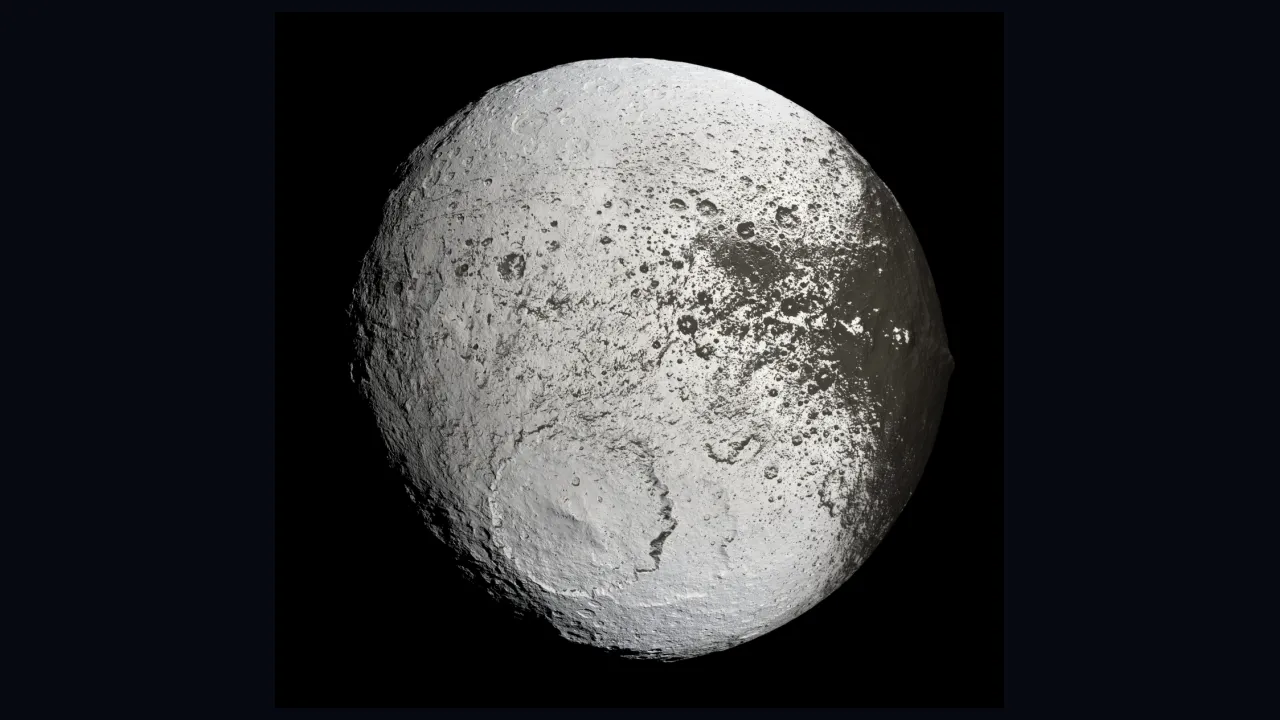
1. What two contrasting colors cover opposite sides of Iapetus?
2. What nut does Iapetus look like thanks to its giant middle mountain ridge?
🤯 Mind-Blowing Fact • Grade 2
When Giovanni Cassini got a stronger telescope in 1705, he finally spotted the dark side of Iapetus hiding on the east side of Saturn!
✨ Word Sparks (Grade 2 Glossary)
Tap 🔊 to hear
Hemisphere
One full half of a round planet or moon.
Telescope
An instrument using lenses or mirrors to see space.
Equator
The middle line halfway between north and south poles.
🪝
Why did this moon seem to vanish every time it orbited to the east side of Saturn?
1
A 300-Year-Old Space Mystery
When astronomer Giovanni Cassini spotted Iapetus in 1671, he noticed a spooky trick. On the west side of Saturn, Iapetus shone brightly in his . On the east side, it disappeared! Cassini guessed one half was dark and one half was bright.
2
Sweeping Up Space Dust
Like bugs hitting a car windshield, dark dust from a distant outer moon coats the front side of Iapetus as it orbits Saturn every 79 days.
3
The Great Walnut Wall
Right along its rises a jaw-dropping mountain wall twelve miles high, wrapping over three-quarters of the way around the moon!
1. Why does dark space dust collect mostly on one side of Iapetus?
2. How tall are the highest peaks of Iapetus's equatorial mountain ridge?
🤯 Mind-Blowing Fact • Grade 3
A single day-night cycle on slow-spinning Iapetus lasts more than 79 Earth days, giving sunlight plenty of time to bake its dark side!
✨ Word Sparks (Grade 3 Glossary)
Tap 🔊 to hear
Retrograde
Orbiting backward compared to a planet's spin direction.
Vapor
Gas formed when solid ice or liquid heats up.
Debris
Scattered broken pieces of rock and ice.
🪝
How did a tiny pinch of dark dust trigger a runaway ice-moving machine on Iapetus?
1
Dust From Distant Phoebe
Far beyond Iapetus, a dark captured moon named Phoebe orbits Saturn backward! Micrometeorites constantly chip dark reddish dust off Phoebe, sending particles spiraling inward right into the path of oncoming Iapetus.
2
Sunlight Moves the Ice
Once a thin coat of dark dust lands on Iapetus's front side—called Cassini Regio—sunlight warms that dark patch more than bright white ice. Because Iapetus spins so slowly, each sunny day lasts nearly forty Earth days! Warmed water ice turns to and hops over to freeze onto the freezing back side and poles.
3
Mystery of the Equatorial Ridge
No other moon has a mountain belt quite like Iapetus's 12-mile-tall equatorial spine. Scientists think Iapetus either spun much faster when young and froze before flattening, or an ancient mini-ring of moon rained straight down onto its equator!
4
Front-Row Seats to the Rings
Most big Saturnian moons orbit flat beside the rings, seeing them only edge-on. Because Iapetus's orbit tilts fifteen degrees, its skies showcase Saturn's dazzling full rings!
1. Which outer retrograde moon sheds the dark dust that coats the front of Iapetus?
2. Why would an astronaut on Iapetus get a better view of Saturn's rings than on Titan or Enceladus?
🤯 Mind-Blowing Fact • Grade 4
Iapetus's dark side reflects only 3 to 5 percent of sunlight—like fresh blacktop pavement—while its bright side reflects up to 60 percent like clean snow!
✨ Word Sparks (Grade 4 Glossary)
Tap 🔊 to hear
Thermal segregation
Heat driving ice away from dark spots onto cold ones.
Feedback loop
A process where an effect makes its own cause stronger.
Sub-satellite
A tiny moonlet orbiting around a larger moon.
🪝
Why are there zero gray shades on Iapetus—only stark black terrain or brilliant white snow?
1
Runaway Thermal Segregation
Close-up images from NASA's Cassini flyby in September 2007 revealed something startling along the border of dark Cassini Regio: there are no gentle gray transitions! Instead, craters look like crisp black-and-white Dalmatian spots. Dark dust absorbs solar heat until noon temperatures hit 129 kelvins (-227°F)—just warm enough in vacuum for water ice to sublimate while brighter ice stays 15 degrees cooler. As ice flees dark patches, dark lag residue thickens and bright slopes grow even whiter in a runaway !
2
Low Density, Ancient Crust
Measuring 1,469 kilometers across with a bulk density of only 1.088 grams per cubic centimeter, Iapetus is roughly eighty percent water ice and twenty percent rock. Giant impact basins like Turgis—spanning 580 kilometers wide with 15-kilometer cliffs—prove its cold lithosphere froze thick very early.
3
Testing the Fallen-Ring Hypothesis
Because craters pockmark the 20-kilometer-high equatorial ridge itself, geologists know the ridge is billions of years old. One leading model proposes Iapetus once hosted its own miniature that spiraled inward past the Roche limit, broke into a flat ring, and gently pancaked onto the equator!
4
Giant Long-Runout Landslides
Inside Iapetus's massive craters, towering ice walls collapsed in frictionless landslides that skidded dozens of miles across crater floors on flash-heated slippery ice.
1. Why does Iapetus show sharp black-and-white patches instead of smooth gray blending?
2. What is one leading scientific explanation for Iapetus's 20-kilometer-high equatorial ridge?
🤯 Mind-Blowing Fact • Grade 5
Cassini's radar pierced Iapetus's coal-black hemisphere and proved the dark coating is less than a foot thick—pure bright water ice still lies right underneath!
✨ Word Sparks (Grade 5 Glossary)
Tap 🔊 to hear
Albedo dichotomy
Sharp contrast between very dark and very bright halves.
Synchronous
Spinning once per orbit so one face points inward.
Isotope
Form of an atom that can release natural heat.
🪝
How did short-lived radioactive isotopes and a vanished moonlet sculpt Saturn's strangest satellite?
1
Cassini's Dichotomy Decoded
When Giovanni Domenico Cassini discovered Iapetus in October 1671, its dramatic two-magnitude brightness swing between western and eastern elongations posed astronomy's first planetary albedo puzzle. Three centuries later, NASA's Spitzer Space Telescope discovered the colossal Phoebe Ring—extending from 128 to over 207 Saturn radii—confirming that Poynting-Robertson drag spirals dark carbonaceous dust inward onto Iapetus's tidally locked leading hemisphere.
2
Sublimation Kinetics Over a 79-Day Rotation
Crucially, Iapetus's slow 79.32-day rotation is what unlocks runaway thermal migration. Unlike inner moons whose rapid spins average out daytime heat, Iapetus bakes its dark carbonaceous lag layer (only tens of centimeters thick according to Cassini radar!) at 129 kelvins for weeks. Over geologic spans, meters of water ice sublimate ballistically from Cassini Regio to cold-trap onto Roncevaux Terra, Saragossa Terra, and both poles.
3
Fossil Bulge and Aluminium-26 Decay
Geophysical modeling reveals Iapetus wears the 'frozen figure' of an ancient 16-hour rotation period! Early heating from short-lived radioactive like aluminium-26 ($^{26}Al$) softened its interior so spin flattened it into an oblate spheroid; rapid cooling then locked a thick 100-kilometer lithosphere into place before tidal despinning slowed its day to 79 days.
4
Exogenic Ring Accretion Along the Equator
Whether triggered by despinning stresses or an impact-generated sub-satellite decaying inward to deposit a 1,300-kilometer chain of peaks, Iapetus's equatorial ridge strictly hugs zero degrees latitude with striking geometric precision.
5
Inclination Clues to Giant Planet Migration
Orbiting 3.56 million kilometers out at a steep 15.47-degree orbital inclination, Iapetus escaped the coplanar damping of Saturn's inner circumplanetary disk, preserving dynamical fingerprints of early giant-planet encounters in the young Solar System.