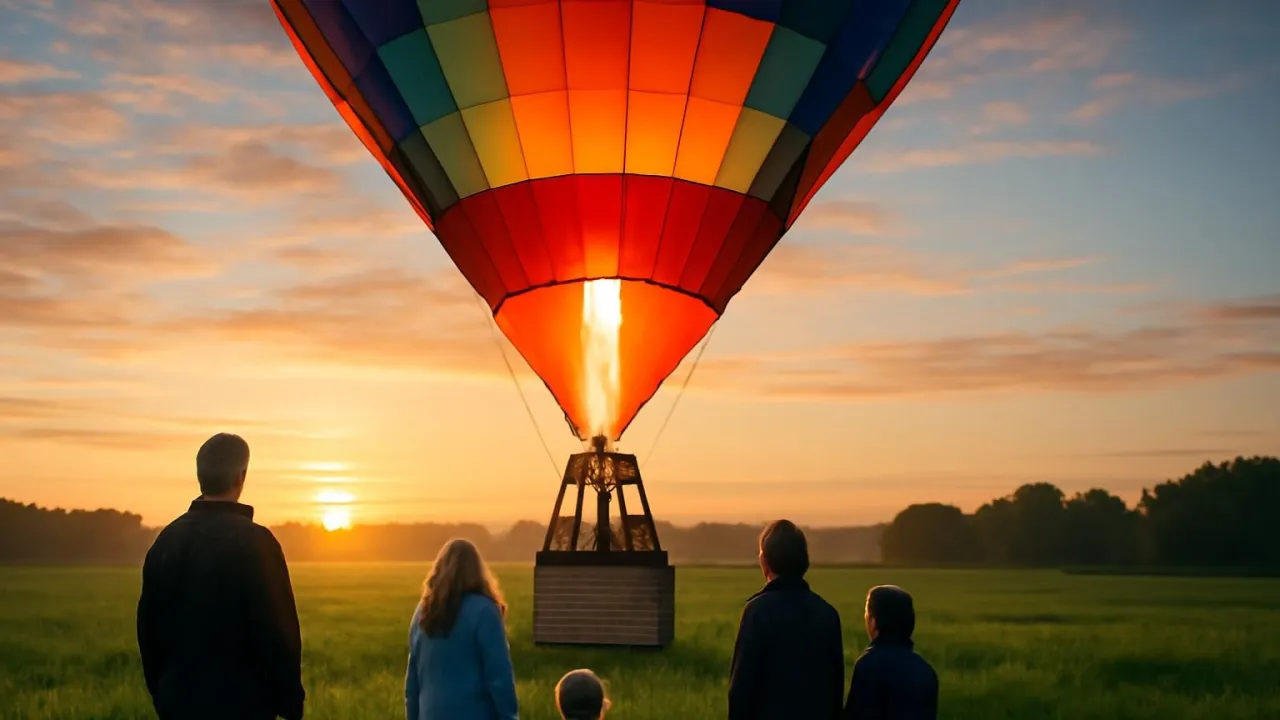
The first people to fly in a hot air balloon were launched in 1783 in France.
✨ Word Sparks (Grade 2 Glossary)
Tap 🔊 to hear
pilot
The person who flies the balloon
float
To move gently in the air
flame
The fire that heats the air
🪝
Have you ever wondered how people float above the trees?
1
Floating Above the World
A hot air balloon rises when warm air fills its giant bag. The heats the air, and the balloon lifts off the ground. People wave as the balloon higher and higher.
2
Bright Colors and Big Baskets
Hot air balloons are painted with bright shapes and stripes. The basket is strong and holds people safely as they fly. Riders can see fields, rivers, and towns from way up high.
3
How It Works
Hot air is lighter than cold air, so it makes the balloon . The can control the to go higher or lower. Riding in a balloon feels calm, quiet, and magical.
The first hot air balloon passengers were a sheep, a duck, and a rooster in 1783!
✨ Word Sparks (Grade 3 Glossary)
Tap 🔊 to hear
envelope
The balloon’s big fabric bag
burner
The machine that makes the flame
expand
To get bigger or stretch out
🪝
Can you imagine hearing a whoosh and suddenly floating above rooftops?
1
The First Flight
Long ago, people dreamed of flying like birds. In 1783, the Montgolfier brothers made a giant hot air balloon. They used a flame to heat the air inside, and the balloon slowly lifted off the ground.
2
How Hot Air Lifts
When air is heated, it and becomes lighter than the cooler air around it. This lighter air rises, carrying the balloon and its basket upward. The pilot controls the height by making the flame bigger or smaller.
3
The Balloon’s Design
A hot air balloon has three main parts: the , the basket, and the . The envelope is a giant fabric bag that holds the hot air. The burner sits above the basket and creates a strong flame.
4
A Peaceful Adventure
Riding in a hot air balloon is calm and quiet, except for the ’s roar. Passengers see fields, forests, and rivers from high above. Today, balloon festivals fill the sky with bright colors and happy cheers.
The Montgolfier brothers’ first human passengers were a courtier and a scientist in Paris.
✨ Word Sparks (Grade 4 Glossary)
Tap 🔊 to hear
density
How tightly packed something is
propane
A fuel used to make fire
altitude
How high something is above ground
🪝
What would it feel like to rise silently over a city, powered only by warm air?
1
Dreaming of Flight
For centuries, people wondered how to soar above the earth. In 1783, Joseph and Étienne Montgolfier finally achieved this dream by launching the first hot air balloon in France. Their invention used a large envelope made of cloth and paper, which was filled with hot air from a fire.
2
The Science of Rising
Hot air balloons work because of a simple physics principle: hot air is less dense than cold air. When the burner heats the air inside the envelope, the air expands and becomes lighter than the cooler air outside. This difference in causes the balloon to rise, carrying the basket and its passengers upward.
3
Design and Operation
A hot air balloon has three main parts: the envelope, the burner, and the basket. The burner uses gas to create a powerful flame, heating the air inside the envelope. The pilot controls by adjusting the flame, making the balloon rise or sink gently through the atmosphere.
4
Changing the World
The Montgolfier flight amazed crowds and proved that human flight was possible. Today, hot air balloons are used for recreation, scientific observation, and even competitions. Balloon festivals around the world celebrate this invention with colorful displays and peaceful journeys above the landscape.
2. What do pilots use to control the balloon’s height?
🤯 Mind-Blowing Fact • Grade 5
The largest modern hot air balloons can carry over 30 people and soar more than 3,000 meters high.
✨ Word Sparks (Grade 5 Glossary)
Tap 🔊 to hear
buoyancy
The force that makes things float
ripstop nylon
A strong, lightweight balloon fabric
venting
Letting air escape to go lower
🪝
Imagine the deep hush above the earth, broken only by the whoosh of a flame—how did humans first conquer the sky?
1
The Dawn of Human Flight
In the late 18th century, Joseph and Étienne Montgolfier revolutionized the world by inventing the hot air balloon in Annonay, France. Their first public demonstration in 1783 used a linen and paper envelope, heated by burning straw and wool, to lift a balloon into the sky. This event marked the first time humans left the ground using a controlled, lighter-than-air craft, astonishing crowds and inspiring inventors everywhere.
2
Physics That Lifts the Balloon
The hot air balloon operates on the principle that heated air expands and becomes less dense than cooler air, causing it to rise. The envelope, often over 20 meters tall and holding more than 2,000 cubic meters of air, traps this hot air, providing enough lift to carry several passengers. The burner, fueled by propane, produces a flame that can reach temperatures above 1,000 degrees Celsius, allowing precise altitude control by adjusting the air’s temperature within the envelope.
3
Engineering and Safety Innovations
Modern hot air balloons are engineered for safety and efficiency, using for the envelope and stainless steel for the burner assembly. The basket, typically made of woven wicker, absorbs shock during landings and provides a stable platform for passengers. Pilots use a combination of burner blasts and systems to ascend, descend, or stabilize the balloon, while weather forecasting and GPS technology help ensure safe flights.
4
From Curiosity to Global Phenomenon
The Montgolfier brothers’ invention quickly spread across Europe, sparking scientific interest and public excitement. In 1783, the first human passengers—Jean-François Pilâtre de Rozier and François Laurent d’Arlandes—flew nearly nine kilometers over Paris. Today, hot air balloons are used in scientific research, aerial photography, and competitive sports, and they remain a symbol of adventure and innovation at festivals worldwide.
5
Legacy and Lasting Impact
The hot air balloon was the first successful human-carrying flight technology, paving the way for future aeronautics, including airships and airplanes. Its invention demonstrated the practical application of and density principles, which are still fundamental in modern flight engineering. Ballooning continues to inspire curiosity about physics, weather, and the possibilities of human exploration above the earth.