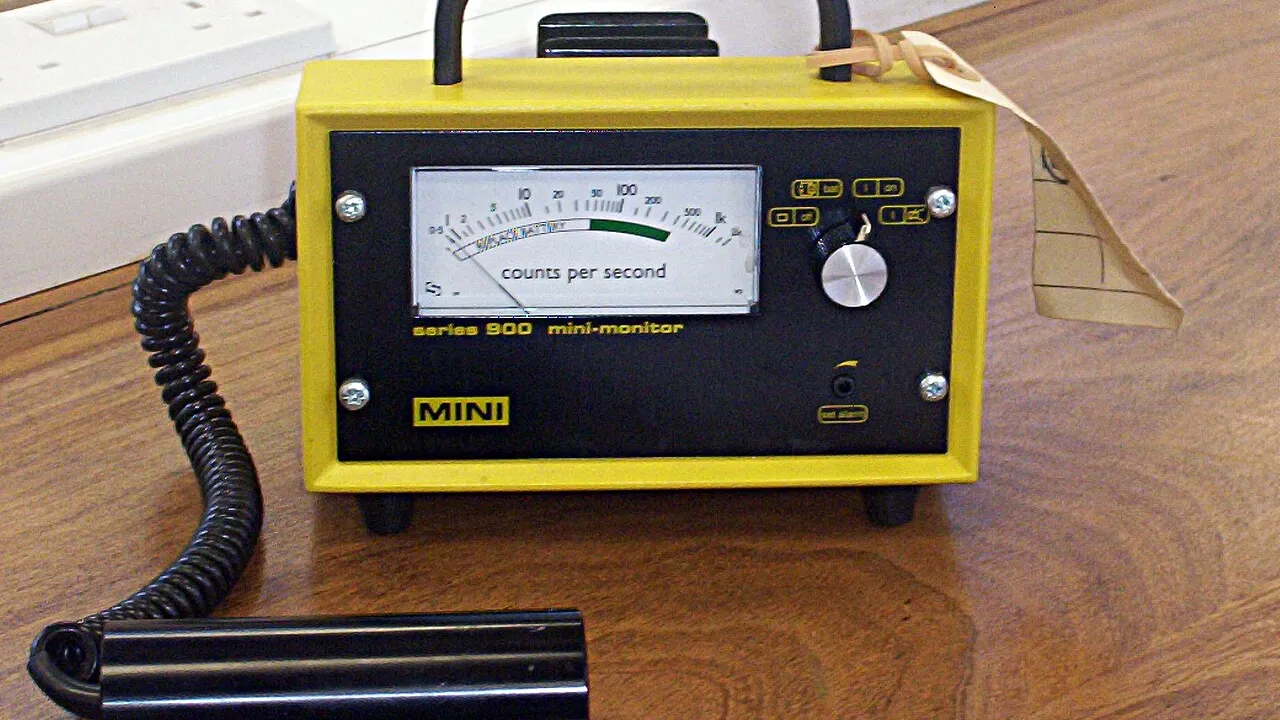
1. Why do scientists need a special detector to spot radiation?
2. What fills the sealed metal tube inside the detector wand?
🤯 Mind-Blowing Fact • Grade 2
Before Hans Geiger built his electric counter, scientists had to sit in pitch-dark rooms for hours counting tiny flashes on a screen through a magnifying glass!
✨ Word Sparks (Grade 2 Glossary)
Tap 🔊 to hear
radiation
Fast energy or particles shooting from atoms
atom
Tiny building block of everything around us
particle
An ultra-small speck of matter
🪝
Why does an ordinary granite countertop or a bunch of bananas hold a tiny secret that makes this gadget click?
1
A Sixth Sense for Scientists
Wave a silver sensor tube near an antique glowing watch dial, and suddenly the speaker crackles like popping corn! That brisk clicking reveals invisible energy shooting out of unstable .
2
Built by Two Curious Physicists
German scientist Hans Geiger built the first counter in 1908 while studying in England. Twenty years later in 1928, he teamed up with his student Walther Müller to create a sturdy handheld tube that spotted many kinds of .
3
One Ray, One Electric Pop
Inside the sealed tube runs a thin wire carrying electricity through calm gas. Whenever one fast zooms through the window, it bumps gas into a tiny electric spark that moves the needle and clicks!
1. How did scientists count atomic particles before Hans Geiger invented an electric counter?
2. Who teamed up with Hans Geiger in 1928 to make the detector much stronger and more useful?
🤯 Mind-Blowing Fact • Grade 3
Natural potassium inside bananas and Brazil nuts is mildly radioactive—though completely healthy to eat—and sensitive lab detectors can actually measure it!
✨ Word Sparks (Grade 3 Glossary)
Tap 🔊 to hear
nucleus
Dense center core inside every atom
ionize
Knock electrons loose from neutral atoms
mica
Flaky mineral split into ultra-thin windows
🪝
How can one single subatomic particle—trillions of times smaller than a speck of dust—make a loud click you can hear across a room?
1
Starting an Electron Avalanche
Picture one tiny snowball rolling down a steep snowy mountain and knocking loose thousands more until a giant roar echoes below! Inside a Geiger counter, a single invisible particle triggers a microscopic electrical avalanche.
2
Unlocking the Atom's Nucleus
In 1908, working with Ernest Rutherford in Manchester, England, physicist Hans Geiger built a brass tube that detected alpha particles—helping prove that every atom has a tiny, dense at its center! In 1928 in Germany, Geiger and Walther Müller improved the tube so it detected speedy beta electrons and high-energy gamma rays too.
3
Inside the Gas Tube
The sealed cylinder holds low-pressure neon or argon gas around a positively charged center wire. Normally no current flows across the gas. When ionizing radiation zips through a paper-thin window, it knocks electrons off gas atoms; high voltage yanks those electrons toward the wire, bumping millions more loose in one crisp pulse!
4
Everyday Guardians of Safety
Today hospital technicians check medical tracers, geologists hunt uranium minerals, and space engineers shield astronauts using descendants of Geiger and Müller's clever tube.
1. What major discovery about atoms did Hans Geiger's early 1908 counter help prove?
2. Why does the end of a Geiger tube often have a window made of paper-thin mica?
🤯 Mind-Blowing Fact • Grade 4
America's very first satellite, Explorer 1 in 1958, carried a Geiger counter into orbit—and suddenly stopped clicking when radiation belts around Earth overwhelmed the tube with too many hits at once!
Why did counting glowing dots in a dark basement lead to one of the most iconic clicking instruments in all of science?
1
Tired Eyes in a Darkened Lab
In 1907 at Manchester University, young researchers Hans Geiger and Ernest Marsden spent grueling evenings in total darkness, peering through microscopes at zinc-sulfide screens to count pinpoint flashes as alpha particles bounced off thin gold foil. One blink meant missed data—so Geiger set out to make electricity do the counting automatically.
2
From Alpha Detector to Universal Tube
Geiger's 1908 prototype passed over a thousand volts across a brass cylinder containing thin air, making a needle jump whenever an alpha particle passed through. Twenty years later at the University of Kiel, Geiger and doctoral researcher Walther Müller redesigned the geometry and gas mixture, unveiling the rugged 1928 Geiger-Müller tube capable of registering alpha particles, beta electrons, X-rays, and penetrating gamma photons alike.
3
The Townsend Avalanche and Quenching
Inside the chamber, inert helium, neon, or argon gas surrounds a central tungsten wire held at 400 to 900 volts. A single incoming ionizing ray strips an electron from a gas atom. Accelerated fiercely toward the positive wire, that electron collides with neighboring atoms, knocking loose billions of electrons in microseconds—a cascade called a Townsend ! A trace of halogen '' gas immediately absorbs excess energy so the tube resets in fractions of a millisecond for the next click.
4
Protecting Medicine, Energy, and Spaceflight
From James Van Allen's 1958 Explorer 1 satellite—which used a tiny Geiger tube to discover Earth's protective radiation belts—to modern hospital cancer therapies and environmental monitoring, this simple gas tube keeps invisible energy safely measured.
1. What job does the small amount of 'quenching' halogen gas perform inside a modern Geiger-Müller tube?
2. What major space discovery did a Geiger counter aboard the 1958 Explorer 1 satellite make?
🤯 Mind-Blowing Fact • Grade 5
During a Geiger tube's 100-microsecond 'dead time' while a spark clears, a second ray sneaking in goes uncounted—which is why super-intense radiation in space briefly tricked Explorer 1's counter into reading zero!
✨ Word Sparks (Grade 5 Glossary)
Tap 🔊 to hear
cathode
Negatively charged outer cylinder of the tube
dead time
Brief microsecond pause while the tube resets
radioisotope
Unstable atom form that emits radiation naturally
🪝
How does a sealed cylinder of noble gas amplify the energy of a single ionizing photon by ten billion times in less than a microsecond?
1
Amplifying the Subatomic Realm
Every second, cosmic-ray muons born in the upper atmosphere and trace in soil, brick, and potassium-rich foods pass silently through your body. Detecting a single ionizing event requires extraordinary amplification—turning the minuscule kinetic energy of one subatomic particle into a macroscopic voltage pulse strong enough to drive a loudspeaker or digital scaler.
2
Rutherford's Lab to the 1928 Breakthrough
Working beside Ernest Rutherford in Manchester in 1908, German physicist Hans Geiger replaced exhausting visual scintillation counting with an electrical gas-ionization cylinder, providing the quantitative data that revealed the atomic nucleus in 1911. Because early counters responded mainly to heavy alpha nuclei, Geiger and his doctoral student Walther Müller at the University of Kiel re-engineered the coaxial electrode field in 1928, creating the universal Geiger-Müller tube sensitive to alpha, beta, X-ray, and gamma radiation.
3
Townsend Cascades and Halogen Quenching
A classic end-window tube encloses low-pressure (~0.1 atmosphere) neon or argon gas inside a grounded cylindrical , pierced along its axis by a fine tungsten anode wire biased at 400 to 900 volts. When an alpha or beta particle traverses the 2-milligram-per-square-centimeter mica window—or a gamma photon ejects a photoelectron from the tube wall—it strips electrons from neutral gas atoms, forming ion pairs. Plucked into the steep radial electric field near the wire, free electrons trigger an exponential Townsend avalanche of $10^9$ to $10^{10}$ charge carriers. Trace chlorine or bromine halogen molecules quench ultraviolet photons and neutralize positive ions without being consumed, restoring readiness after a ~100-microsecond '.'
4
Counts Versus Energy Spectroscopy
Because every particle that crosses the threshold triggers a full-tube saturation pulse of identical height, a Geiger-Müller tube excels at counting radiation flux (counts per minute) rather than distinguishing particle energies—a task handled by crystal scintillators or semiconductor diodes.
5
Safeguarding Science From Hospitals to Deep Space
From mapping Earth's Van Allen magnetospheric belts aboard Explorer 1 in 1958 to verifying clean rooms in nuclear medicine, semiconductor labs, and planetary rovers, Geiger and Müller's gas tube remains science's frontline sentinel.