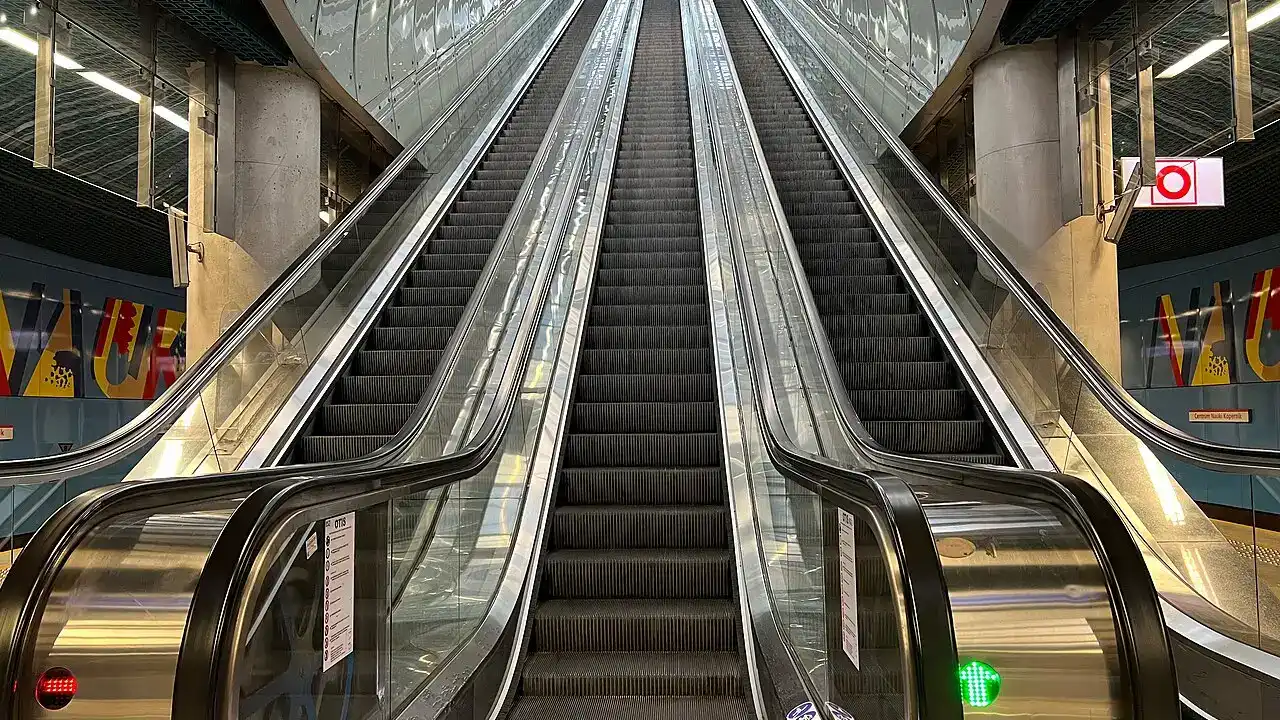
1. Where do escalator steps go after they disappear into the top floor?
2. Where was the first working moving-stair ride built in 1896?
🤯 Mind-Blowing Fact • Grade 2
Department stores in the early 1900s still used wooden escalator steps until fireproof aluminum steps replaced them decades later!
✨ Word Sparks (Grade 2 Glossary)
Tap 🔊 to hear
conveyor
A moving belt or chain carrying objects
incline
A slanted surface that goes up or down
groove
A narrow line cut into a surface
🪝
How can a flat moving floor suddenly fold itself into a staircase and flatten back out again?
1
From Fun Ride to Busy Buildings
Step onto the grooved metal plate at a mall or airport, and suddenly the floor lifts you skyward! In 1896, inventor Jesse Reno built an early slanted ride at Coney Island in New York, thrilling thousands of curious beachgoers.
2
Naming the Moving Stairs
Four years later, inventor Charles Seeberger teamed up with the Otis company to show flat-step moving stairs at the 1900 World's Fair in Paris. He blended a Latin word for ladder with the word elevator to create the name escalator.
3
Two Clever Wheel Tracks
Underneath each step sit two sets of hidden wheels riding on separate metal tracks. Changing the gap between those tracks tilts each plate into a level stair on the slope and flattens it at both ends!
1. How did Charles Seeberger invent the word 'escalator'?
2. What keeps each step flat and level while climbing the slanted ramp?
🤯 Mind-Blowing Fact • Grade 3
Hong Kong's Central–Mid-Levels escalator system links eighteen covered escalators and three moving walkways stretching over 2,600 feet up a steep city hillside!
✨ Word Sparks (Grade 3 Glossary)
Tap 🔊 to hear
continuous
Moving steadily onward without stopping or pausing
synchronized
Moving together at the exact same speed
balustrade
The side wall supporting the moving handrail
🪝
Why can one escalator move far more airport travelers each hour than a regular elevator?
1
Never Waiting for Doors
Stand inside a bustling subway station during rush hour and watch rivers of commuters glide smoothly up from deep tunnels. Unlike an elevator car that must stop, load, close doors, and return, a stairway carries new riders every single second.
2
Pioneers of Moving Steps
Massachusetts inventor Nathan Ames sketched revolving stairs back in 1859, though nobody built his design. Jesse Reno constructed the first working inclined belt at Coney Island in 1896, and Charles Seeberger introduced true horizontal steps at the 1900 Paris Exposition.
3
Motors, Gears, and Comb Plates
Inside the top landing pit, an electric motor turns large drive gears connected to two heavy steel chains. Grooved treads on each step mesh neatly through metal teeth called comb plates so shoelaces cannot slip into the gap.
4
Synchronized Handrails
The same main drive shaft turns pulleys that pull the rubber handrail along the . Because the handrail and steps share linked gearing, your hands and feet travel upward at the exact same speed.
1. Why do escalator steps have narrow grooves cut along their top surfaces?
2. Why does the rubber handrail move at the same pace as the steps?
🤯 Mind-Blowing Fact • Grade 4
Until 1950, 'Escalator' was actually a private trademark owned by the Otis Elevator Company before courts ruled the word had become everyday language for everyone!
✨ Word Sparks (Grade 4 Glossary)
Tap 🔊 to hear
truss
A rigid steel framework supporting heavy loads
riser
The upright vertical face between two steps
bottleneck
A narrow spot where crowds slow down
🪝
What mechanical geometry lets rigid metal triangles transform from a flat walkway into steep stairs and back again?
1
Inside the Hidden Steel Truss
Beneath your sneakers on any airport escalator lies a hollow structural bridge called a spanning between two building floors. Inside that steel frame, dozens of triangular die-cast aluminum steps link into an endless conveyor loop driven by a compact electric motor at the upper landing.
2
Reno, Wheeler, and Seeberger
After Jesse Reno's 1892 patent proved that cleated inclined belts could lift passengers safely at a 25-degree angle, inventor George Wheeler patented flat steps guided by rollers. Buying Wheeler's rights, Charles Seeberger partnered with Otis Elevator Company in 1899, winning first prize at Paris in 1900 and later merging Reno's comb-plate safety ideas with flat-tread geometry.
3
Offset Tracks Control the Tilt
Each wedge-shaped step carries four wheels: two step-chain wheels near its front axle and two trailer wheels near its rear corner, riding along separate parallel rails. Where the two rails sit side by side at the landings, three or four steps line up into a flat floor; on the 30-degree incline, offsetting the rails lifts each rear edge to form crisp horizontal .
4
Shaping Vertical Cities
Before escalators, shoppers rarely climbed above the second story of department stores, and deep underground metro stations faced dangerous crowd . Today, sensor-controlled escalators slow down to save electricity when empty and carry up to 9,000 people an hour through transit hubs worldwide.
1. How did escalators change multi-story department stores in the early twentieth century?
2. What causes an escalator step to change from a flat landing platform into a raised stair?
🤯 Mind-Blowing Fact • Grade 5
When a crowded downward escalator carries heavy commuters toward a subway platform, gravity helps spin its motor as a generator that actually puts electricity back into the building!
✨ Word Sparks (Grade 5 Glossary)
Tap 🔊 to hear
kinematics
The branch of physics describing mechanical motion
regenerative
Capturing motion energy and turning it into electricity
interlock
An automatic safety switch that stops machinery
🪝
How do offset cam tracks, regenerative motors, and spiral kinematics allow modern escalators to move entire subway crowds safely?
1
High-Capacity Vertical Transit
Watch two thousand passengers spill off an underground metro train forty meters below street level and ascend smoothly toward daylight without waiting a single second for doors to open. Operating continuously at 0.5 to 0.65 meters per second up a standard 30-degree incline, one single-meter-wide escalator moves roughly 6,000 to 9,000 riders every hour—nearly five times the capacity of a conventional elevator shaft.
2
Converging Nineteenth-Century Patents
Following Nathan Ames's unbuilt 1859 revolving-stairs patent, American engineer Jesse W. Reno installed a cleated inclined conveyor on Coney Island's Iron Pier in 1896 and soon built moving inclines for London's Underground. Meanwhile, Charles Seeberger refined George Wheeler's flat-step design alongside Otis in Yonkers, New York, for the 1900 Paris Exposition; in 1911 Otis acquired Reno's patent too, merging Reno's grooved comb plates with Seeberger's level steps.
3
Dual-Track Kinematics Inside the Truss
Supported by a rigid welded-steel structural Warren truss spanning between building floors, two heavy roller chains pull one-piece die-cast aluminum steps along precision steel guide tracks. Each wedge-shaped step mounts front chain rollers on a narrower gauge and rear trailer rollers on a wider gauge so shifting track offsets hold every tread strictly horizontal on the climb, flatten three steps at each landing, and flip them upside down underneath.
4
Safety Interlocks and Regenerative Descent
Modern transit escalators monitor dozens of microprocessor safety —checking skirt-panel clearance, step sag, chain tension, handrail speed synchronization, emergency brakes, and comb-plate foreign-object impacts. Remarkably, when a heavily crowded downward escalator descends, passenger weight pushes the three-phase AC induction motor slightly faster than synchronous speed, turning the motor into an electrical generator that feeds clean power back into the station.
5
Deep Tubes and Helical Engineering
Extreme geological depths push escalator engineering to monumental lengths, such as Saint Petersburg's Admiralteyskaya metro escalators spanning nearly 69 vertical meters and 137 meters of inclined track. Meanwhile, Japanese engineers introduced curved spiral escalators in 1985 by shifting step centers of gravity and varying drive-chain angles along a smooth three-dimensional helix inside grand architectural atriums.