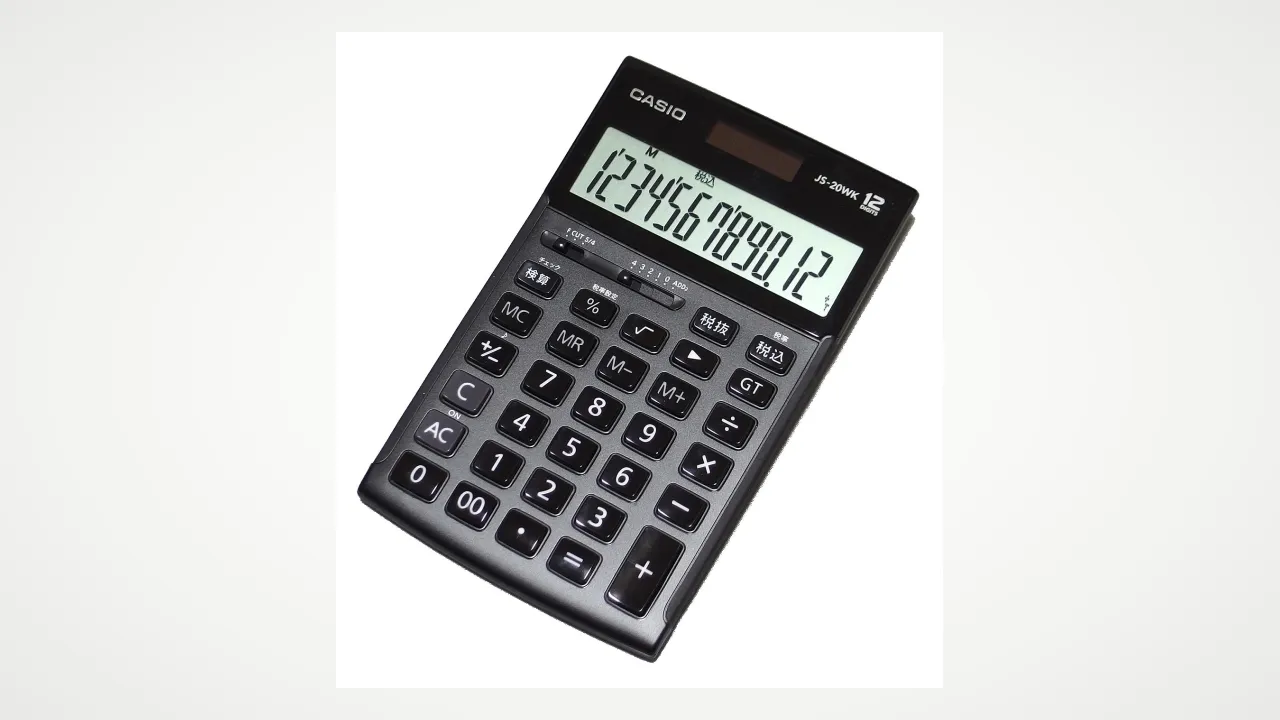
1. What hides underneath the buttons to solve math problems so fast?
2. What does the dark solar strip at the top of many calculators do?
🤯 Mind-Blowing Fact • Grade 2
Jack Kilby's very first handheld calculator in 1967 had no screen at all and printed answers onto a thin strip of heat-sensitive paper!
✨ Word Sparks (Grade 2 Glossary)
Tap 🔊 to hear
microchip
A fingernail-sized slice packed with tiny circuits
digit
Any single number symbol from zero to nine
handheld
Small enough to hold in one hand
🪝
What if your school calculator weighed more than a microwave oven and needed to plug into the wall?
1
When Math Machines had Gears
Spin, clunk, ding! Sixty years ago, shopkeepers pulled heavy metal levers to add grocery bills on gear machines. Nothing inside was electronic, and fixing one big multiplication problem took lots of cranking.
2
Shrinking Into Your Pocket
In 1961, British engineer Norbert Kitz built ANITA, the first desktop machine to calculate silently with glowing tubes. Six years later, Jack Kilby and his team in Texas used tiny silicon to build the first model.
3
Zeros and Ones at Work
Every time you press a number key, electric switches translate that into fast on-and-off signals. The combines those signals in a flash and lights up neat black segments on the screen.
1. How did Jack Kilby's 1967 handheld calculator show you the answer?
2. What made electronic calculators much quieter than older mechanical ones?
🤯 Mind-Blowing Fact • Grade 3
The name ANITA stood for 'A New Inspiration To Arithmetic'—and it weighed nearly 15 kilograms on an office desk!
✨ Word Sparks (Grade 3 Glossary)
Tap 🔊 to hear
binary
A code using only zeros and ones
circuit
A complete path where electricity can travel
segment
One small bar of a digital number
🪝
How can a silent chip with zero moving parts multiply millions faster than a room full of mathematicians?
1
Before Pocket Brains Existed
Imagine multiplying 4,829 by 7,316 during a science experiment using only pencil, paper, or a sliding ruler! For centuries, engineers spent hours checking tables of numbers by hand, hoping a single tiny mistake would not ruin a bridge design.
2
From Glowing Tubes to Silicon Chips
In 1961, a British team led by Norbert Kitz unveiled ANITA, the world's first all-electronic desktop calculator. It used glass vacuum tubes and cost as much as a small car! Then in 1967, engineer Jack Kilby and his colleagues at Texas Instruments proved that tiny integrated could fit a calculator right into a coat pocket.
3
Speaking in Binary Code
Beneath the rubbery keypad lies a board grid. Pressing the number 5 closes a switch, and the microchip converts 5 into code—patterns of 1s and 0s made of tiny electrical charges. Logic gates add, subtract, multiply, or divide those binary patterns in milliseconds.
4
Seven Bars Make Every Number
Look closely at a basic calculator screen and count the little bars in the number 8. Just seven liquid-crystal turn dark or clear in different combinations to form every digit from 0 through 9!
1. How many bar segments are needed on a classic screen to display any digit from 0 to 9?
2. Why did Texas Instruments build the 1967 pocket calculator prototype?
🤯 Mind-Blowing Fact • Grade 4
While building chips for a Japanese calculator company named Busicom in 1971, engineers created the Intel 4004—the world's very first computer microprocessor!
✨ Word Sparks (Grade 4 Glossary)
Tap 🔊 to hear
transistor
A tiny electronic switch built from silicon
register
Small high-speed memory spot inside a chip
microprocessor
A programmable computer brain on one chip
🪝
How did a handheld math gadget spark the microchip revolution that led to your computer and smartphone?
1
A Gadget Worth Thousands of Dollars
Picture walking into an electronics shop in 1970 and seeing a pocket calculator locked inside a velvet jewelry case with a four-hundred-dollar price tag! Back then, squeezing thousands of microscopic switches onto a sliver of silicon seemed almost like science fiction.
2
Tubes, Transistors, and Integrated Circuits
The journey began in 1961 when Britain's Bell Punch Company released the ANITA Mk VII, replacing noisy brass gears with cold-cathode vacuum tubes. Soon made desktop machines smaller, yet wiring hundreds of separate parts by hand stayed expensive. At Texas Instruments in 1967, Nobel Prize winner Jack Kilby, Jerry Merryman, and James Van Tassel etched complete arithmetic circuits onto four tiny silicon chips, creating the 1.3-kilogram 'Cal Tech' handheld prototype.
3
Inside the Logic Gates
When your finger presses a key, two conductive layers touch on a printed circuit board. A scanning processor reads the row and column coordinates, translates your decimal number into binary voltage pulses, and stores it in a . Inside the arithmetic logic unit, microscopic switches called logic gates perform all four operations—even turning division into lightning-fast repeated subtraction.
4
Solar Cells and Liquid Crystals
Early pocket displays used glowing red light-emitting diodes that drained batteries in hours. Pairing low-power liquid crystal displays with amorphous silicon solar cells created calculators that run for decades on ordinary desk light.
1. Why did early 1970s pocket calculators run out of battery power so quickly?
2. What historic invention came directly from designing chips for a 1971 calculator?
🤯 Mind-Blowing Fact • Grade 5
A basic solar calculator uses fewer than ten millionths of a watt of power—meaning a million calculators together use less electricity than one tiny night-light bulb!
✨ Word Sparks (Grade 5 Glossary)
Tap 🔊 to hear
algorithm
Exact step-by-step recipe for solving a problem
photovoltaic
Converting light rays directly into electric voltage
semiconductor
Material like silicon controlling electric current flow
🪝
How can pure logic gates that only switch electricity on and off calculate square roots, sines, and logarithms?
1
When Slide Rules Ruled Engineering
Watch footage of Apollo mission engineers in the 1960s, and you will spot white plastic slide rules protruding from shirt pockets. For three centuries, scientists multiplied and estimated roots by sliding logarithmic scales by eye—until solid-state microelectronics compressed instant multi-digit accuracy into the palm of a hand.
2
From ANITA to the Single-Chip Revolution
In 1961, mathematician Norbert Kitz and Britain's Bell Punch Company introduced the ANITA Mk VII and Mk VIII, using roughly 170 cold-cathode thyratron tubes to execute silent electronic arithmetic. Six years later at Texas Instruments, Jack Kilby, Jerry Merryman, and James Van Tassel built the battery-powered 'Cal Tech' prototype to showcase integrated circuits. By 1971, Mostek and Texas Instruments packed every memory register, decoder, and arithmetic circuit onto a single metal-oxide- chip, driving prices down from hundreds of dollars to under ten.
3
Boolean Algebra in Silicon
Beneath the keypad lies an X-Y conductive matrix scanned thousands of times per second by a clock signal. Each pressed digit converts into binary-coded decimal format—four bits per numeral—and enters temporary memory registers. Inside the arithmetic logic unit, thousands of microscopic CMOS transistors form AND, OR, and XOR logic gates that execute Boolean algebra, combining carry bits across columns in microseconds.
4
Clever Algorithms for Complex Math
Scientific and graphing models do not store giant lookup tables for every angle or root. Instead, their read-only memory runs an elegant 1959 called CORDIC, which computes trigonometric functions, exponents, and square roots using nothing more than rapid bit-shifting and addition.
5
Photovoltaic Independence
Because twisted-nematic liquid crystal displays twist polarized ambient light rather than generating their own glow, a modern pocket calculator draws mere microwatts—easily supplied by a postage-stamp cell indoors.