1. What is dark energy doing to distant galaxies across the universe?
2. Where is dark energy found?
🤯 Mind-Blowing Fact • Grade 2
Dark energy does not stretch your house or our Solar System because local gravity and atomic bonds easily hold nearby things together!
✨ Word Sparks (Grade 2 Glossary)
Tap 🔊 to hear
supernova
giant bright explosion of a star
accelerate
go faster and faster over time
cosmos
another word for the whole universe
🪝
What happens if you bake raisin bread and the dough keeps puffing up forever?
1
Cosmic Raisin Bread
Imagine baking warm raisin bread in an oven! As the soft dough puffs up, every raisin moves farther away from its neighbors. Our universe stretches much like that dough, carrying galaxies apart through expanding space.
2
A Huge 1998 Surprise
For decades, astronomers thought gravity would gently slow down that cosmic stretching. Then in 1998, scientists watched exploding stars far across space and gasped! Instead of slowing down, the universe was speeding up!
3
Gravity's Cosmic Opposite
Scientists named this invisible space-stretcher dark energy. While gravity pulls planets and stars together locally, dark energy pushes vast galaxy groups apart across deep space.
1. In the raisin bread model of space, what do the raisins stand for?
2. What shocked astronomers when they studied distant exploding stars in 1998?
🤯 Mind-Blowing Fact • Grade 3
The three scientists who led the two teams that discovered cosmic acceleration won the 2011 Nobel Prize in Physics!
✨ Word Sparks (Grade 3 Glossary)
Tap 🔊 to hear
light-year
distance light travels in one year
Type Ia supernova
star blast with predictable peak brightness
repulsive
pushing things away instead of pulling
🪝
How did exploding stars billions of light-years away reveal the biggest mystery in physics?
1
Cosmic Mile Markers
Imagine judging how far away a car is at night by checking how dim its headlights look! Astronomers use a special kind of exploding star, called a , in the exact same way. Because these stellar blasts shine with a known brightness, they act as cosmic mile markers across billions of .
2
Dimmer Than Expected
In 1998, two rival teams of astronomers measured dozens of ancient supernovae expecting to see gravity braking the universe's expansion. Instead, the explosions looked fainter and farther away than predicted! Space had stretched faster over recent billions of years.
3
Dark Matter vs. Dark Energy
Despite similar names, dark matter and dark energy are cosmic opposites. Dark matter acts like glue whose gravity pulls galaxies together, while dark energy acts like an invisible spring stretching empty space wider.
4
Majority Ruler of the Cosmos
Measurements show dark energy makes up about 68 percent of everything in the universe! Solving what powers this runaway expansion is the grandest puzzle in modern astronomy.
2. Why are Type Ia supernovae so helpful to astronomers?
🤯 Mind-Blowing Fact • Grade 4
A cubic meter of empty outer space holds only enough dark energy to power a tiny LED bulb for a trillionth of a second, yet across the vast cosmos it dominates everything!
✨ Word Sparks (Grade 4 Glossary)
Tap 🔊 to hear
redshift
stretching of light toward redder wavelengths
vacuum
space completely empty of ordinary matter
cosmological constant
Einstein's math term for space energy
🪝
Why did an idea Albert Einstein once threw in the trash suddenly return to explain 68 percent of the universe?
1
Einstein's Cosmic Balancing Act
Over a century ago, Albert Einstein realized his equations of general relativity meant gravity should make the universe expand or collapse. Believing space was static, he added a mathematical term called the —an innate outward push built into empty space. When Edwin Hubble proved in 1929 that galaxies really are moving apart, Einstein abandoned his constant.
2
The Supernova Shock of 1998
Seventy years later, teams led by Saul Perlmutter, Brian Schmidt, and Adam Riess tracked Type Ia supernovae—white dwarf stars exploding at a uniform critical mass. By comparing each supernova's apparent brightness with its , how much stretching space lengthened its light waves, both teams proved cosmic expansion began speeding up roughly five billion years ago!
3
Energy Built into Empty Space
Cosmologist Michael Turner named this accelerating driver dark energy. Unlike ordinary matter, which thins out as space grows larger, dark energy appears to be a property of the itself: as new cubic miles of space emerge, more dark energy comes along with them!
4
A Cosmic Tug-of-War
For the first eight billion years after the Big Bang, densely packed matter slowed cosmic growth. Once space expanded enough to dilute matter's gravitational grip, dark energy won the cosmic tug-of-war.
1. Why did dark energy win the cosmic tug-of-war about five billion years ago?
2. What two measurements of Type Ia supernovae revealed cosmic acceleration?
🤯 Mind-Blowing Fact • Grade 5
Recent 3D galaxy maps from the Dark Energy Spectroscopic Instrument (DESI) tracking over 14 million galaxies hint that dark energy may actually be weakening slightly over billions of years!
✨ Word Sparks (Grade 5 Glossary)
Tap 🔊 to hear
standard candle
cosmic object with known true brightness
quintessence
proposed dark energy field that changes
observable horizon
farthest distance light can reach us
🪝
Is dark energy an unchanging property of empty space, or could it slowly change strength over billions of years?
1
Standard Candles Across Deep Time
Peer through a giant observatory telescope at a flash of light ten billion light-years away—the thermonuclear detonation of a carbon-oxygen white dwarf reaching 1.4 solar masses. Because every Type Ia supernova peaks at nearly identical intrinsic luminosity, astrophysicists treat them as '.' In 1998, Saul Perlmutter's Supernova Cosmology Project and Brian Schmidt and Adam Riess's High-Z Supernova Search Team discovered these distant candles were 25 percent dimmer than expected in a decelerating cosmos.
2
Reviving Lambda in the Cosmic Budget
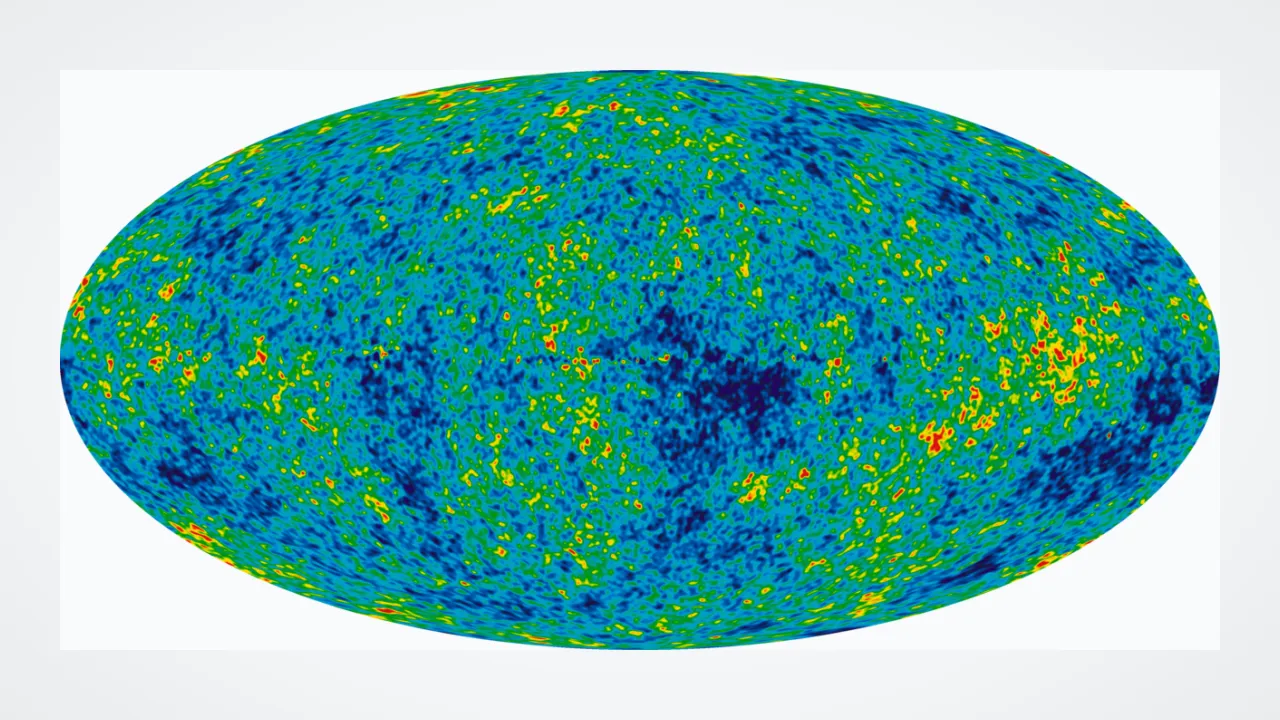
That faintness meant space had expanded faster during the light's multi-billion-year journey, reviving Albert Einstein's 1917 cosmological constant, denoted by the Greek letter Lambda. Precision satellite maps of the cosmic microwave background from Planck confirm that dark energy accounts for 68.3 percent of the universe's energy density, outstripping dark matter at 26.8 percent and atomic matter at 4.9 percent.
3
Vacuum Energy vs. Quintessence
Two leading hypotheses compete to explain dark energy's physics. First, quantum field theory predicts that 'empty' vacuum seethes with fleeting virtual particles generating constant negative pressure—though naive quantum calculations overshoot observed dark energy by 120 orders of magnitude! Alternatively, dark energy might be ',' a dynamic energy field whose strength evolves across cosmic epochs.
4
Mapping Baryon Acoustic Oscillations
Today, instruments like the Dark Energy Spectroscopic Instrument (DESI), the Vera C. Rubin Observatory, ESA's Euclid spacecraft, and NASA's Nancy Grace Roman Space Telescope measure 'baryon acoustic oscillations'—frozen 490-million-light-year sound-wave ripples from the infant universe—as a cosmic ruler.
5
The Ultimate Fate of the Universe
Whether dark energy remains strictly constant or slowly weakens will decide the destiny of the cosmos: an endless 'Big Freeze' where distant galaxy clusters slip beyond our , or an evolving cosmic turnaround.