🪐 Scale / Diameter78 mi (125 km) event horizon • 21.2 solar masses
☄️ Composition & OrbitSiphons stellar wind from blue supergiant HDE 226868 • 5.6-day close orbit
⚡ Cosmic SparkFirst widely accepted black hole in history, shining fiercely in X-rays as it feasts on a giant star
🤯 Mind-Blowing Fact • Grade 1
Even though Cygnus X-1 weighs twenty-one times as much as our Sun, it would fit between two nearby cities on Earth!
✨ Word Sparks (Grade 1 Glossary)
Tap 🔊 to hear
X-rays
High-energy invisible light from super-hot space gas
partner
One of two objects circling close together
siphon
To pull gas or liquid steadily across space
🪝
How did scientists find their very first black hole hiding beside a bright blue star?
1
Hiding in the Swan
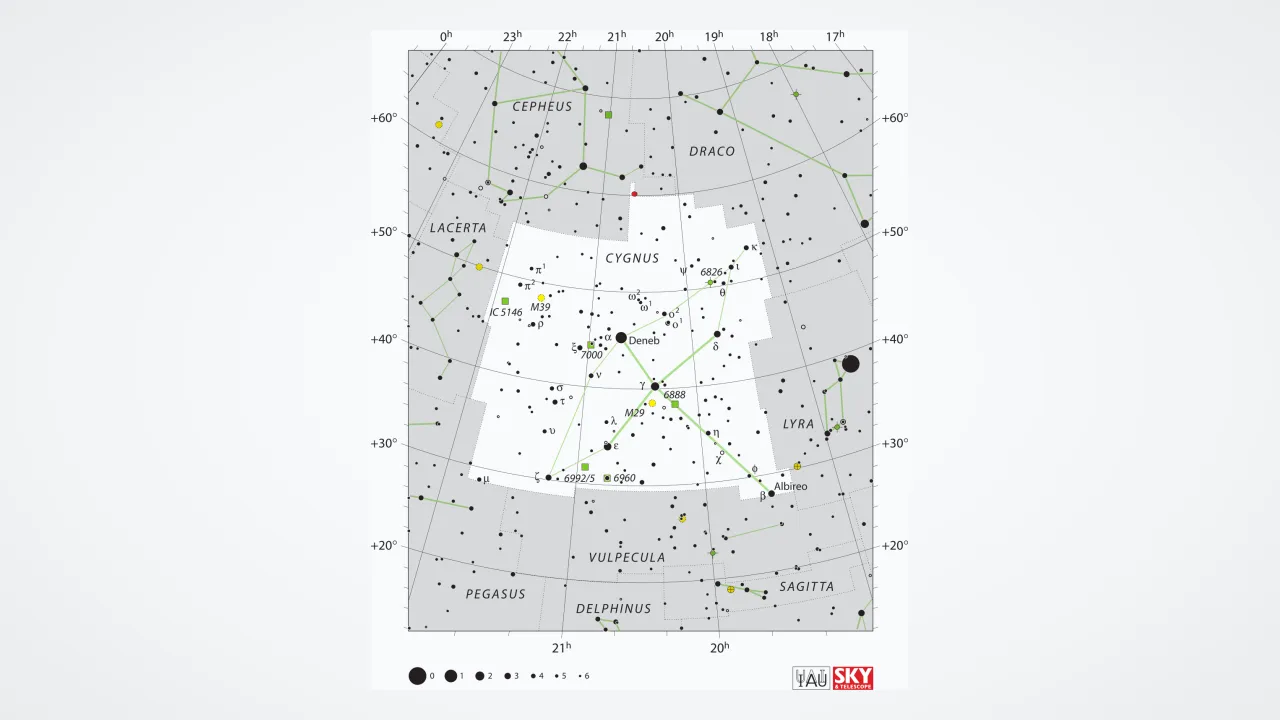
Look up at the starry shape of Cygnus the Swan! High in its neck hides Cygnus X-1, the first black hole scientists ever proved was real. You cannot see the black hole itself with your eyes.
2
Sipping From a Giant Partner
Right beside it shines a huge, hot blue star. Strong gravity pulls glowing gas off that big blue neighbor like a cosmic straw!
3
Shining With X-Rays
As the stolen gas spins fast, it heats up and blasts out bright that space rockets can spot!
1. In which bird-shaped star group does Cygnus X-1 hide?
2. How do space telescopes spot Cygnus X-1 if the black hole itself is dark?
🤯 Mind-Blowing Fact • Grade 2
Famous physicist Stephen Hawking once made a friendly bet in 1974 hoping Cygnus X-1 was NOT a black hole, and happily conceded defeat in 1990 when the evidence became crystal clear!
✨ Word Sparks (Grade 2 Glossary)
Tap 🔊 to hear
atmosphere
Blanket of air wrapped around Planet Earth
detector
Science tool built to sense light or energy
wobble
Rocking back and forth from a partner's tug
🪝
Why did scientists launch X-ray sensors on a rocket in 1964 and find a cosmic mystery?
1
A Rocket Reveals Secret Light
Earth's blanket of air blocks X-rays from space—which keeps us safe, but hides X-ray stars from ground telescopes! In 1964, scientists launched high above the air on a rocket and discovered a blazing X-ray beacon in Cygnus the Swan, naming it Cygnus X-1.
2
Wobbling With an Invisible Partner
Telescopes soon matched that X-ray spot to a giant blue star wobbling in a tight circle every five and a half days. Something super heavy yet completely invisible was swinging that giant star around!
3
Twenty-One Suns in Seventy-Eight Miles
That unseen partner packs 21 suns of mass into a sphere just 78 miles wide—humanity's first proven black hole!
1. Why did scientists have to launch detectors on a rocket to discover Cygnus X-1?
2. How long does it take Cygnus X-1 and its giant blue partner star to orbit each other?
🤯 Mind-Blowing Fact • Grade 3
Cygnus X-1 spins so fast that its outer boundary drags nearby space around at more than 95 percent of the speed of light!
✨ Word Sparks (Grade 3 Glossary)
Tap 🔊 to hear
binary system
Two space objects orbiting around each other
accretion disk
Flat spinning whirlpool of super-hot captured gas
stellar wind
Stream of gas blowing off a star's surface
🪝
How can a black hole smaller than a U.S. state outshine entire stars in X-ray light?
1
A Cosmic Binary Dance
Located 7,200 light-years from Earth in the constellation Cygnus, Cygnus X-1 is a stellar-mass black hole locked in a tight with a dazzling blue supergiant star cataloged as HDE 226868. Separated by just one-fifth of the distance between Earth and the Sun, the pair whips through a complete orbit every 5.6 days.
2
Feeding the Accretion Disk
Fierce constantly blow gas off the bloated blue supergiant. Cygnus X-1's intense gravity captures a ribbon of that wind and flattens it into a spinning whirlpool called an , where friction heats the gas to millions of degrees so it blazes with X-rays.
3
Too Heavy to Be Anything Else
Collapsed dead stars called neutron stars top out around three solar masses before caving in completely. Measuring 21.2 solar masses inside a 78-mile (125 km) horizon proved Cygnus X-1 had to be a black hole!
4
Hawking's Famous Bet
Before Cygnus X-1, black holes existed only as math equations on chalkboards. Confirming it turned theoretical black holes into real astronomical objects!
1. How close together do Cygnus X-1 and its blue supergiant partner orbit?
2. Why couldn't the dark object in Cygnus X-1 be an ordinary neutron star?
🤯 Mind-Blowing Fact • Grade 4
In 2021, radio parallax measurements pushed Cygnus X-1's known distance out to 7,200 light-years, making it the heaviest electromagnetic stellar black hole ever measured without gravitational waves!
✨ Word Sparks (Grade 4 Glossary)
Tap 🔊 to hear
sounding rocket
Research rocket making a brief hop into space
millisecond
One thousandth of a single fast second
direct collapse
Star caving straight into black hole without exploding
🪝
How could a massive star collapse into Cygnus X-1's black hole without blowing itself to smithereens?
1
Sub-Orbital Rockets Launch X-Ray Astronomy
During a brief four-minute Aerobee flight from White Sands, New Mexico, in June 1964, Geiger counters scanned the Milky Way and recorded one of the sky's brightest X-ray sources in Cygnus. By 1971, radio and optical astronomers pinpointed rapid X-ray flickers—changing within —right beside 9th-magnitude blue supergiant HDE 226868. Because nothing can flicker faster than light crosses its width, the X-ray engine had to be tinier than Planet Earth yet tremendously massive!
2
Precision Distance Doubles the Mass Surprise
For decades, astronomers estimated Cygnus X-1 sat about 6,000 light-years away and weighed roughly 15 solar masses. Then in 2021, researchers using the Very Long Baseline Array measured tiny parallax shifts in radio waves from its jets, revising its true distance outward to 7,200 light-years—and bumping the black hole's mass up to an astonishing 21.2 solar masses!
3
Quiet Collapse Without a Supernova Kick
How did a star inside our metal-rich Milky Way leave behind such a hefty 21-solar-mass remnant without shedding most of its gas first? Even stranger, Cygnus X-1 glides smoothly along the Milky Way's plane, suggesting its parent star collapsed directly into a black hole with almost zero supernova explosion kick!
4
Spinning Near the Cosmic Speed Limit
X-ray reflections off iron atoms swirling right above its event horizon show Cygnus X-1 rotates faster than almost any stellar black hole ever measured.
1. Why did millisecond X-ray flickers prove Cygnus X-1's X-ray source had to be very compact?
2. What did Cygnus X-1's smooth, calm orbit through the Milky Way tell astronomers about its birth?
🤯 Mind-Blowing Fact • Grade 5
NASA's IXPE space telescope used polarized X-rays in 2022 to map the billion-degree plasma corona just miles from Cygnus X-1's horizon—finding it hugs the accretion disk flat like a glowing pancake!
✨ Word Sparks (Grade 5 Glossary)
Tap 🔊 to hear
TOV limit
Maximum mass a neutron star holds before collapsing
radial velocity
Speed of a star moving toward or away
X-ray corona
Billion-degree plasma cloud surrounding inner black hole disk
🪝
How did Geiger counters on a four-minute rocket flight, Doppler star wobbles, and X-ray polarimetry turn black holes from mathematical curiosities into astrophysical reality?
1
From 1964 Aerobee Flight to Historical Turning Point
Before the 1970s, Karl Schwarzschild's and Roy Kerr's exact solutions to Einstein's field equations were widely dismissed as purely mathematical artifacts that nature might avoid. Everything changed after a 1964 Aerobee suborbital rocket detected intense X-rays from Cygnus. In 1971, NASA's Uhuru satellite clocked erratic X-ray variability on millisecond timescales, while radio interferometers matched a sudden radio flare to 9th-magnitude O9.7 Iab blue supergiant HDE 226868. Independent spectroscopic radial-velocity curves published in 1972 by Louise Webster and Paul Murdin, and by Tom Bolton, revealed a 5.6-day orbital period around a dark companion far exceeding the Tolman-Oppenheimer-Volkoff neutron-star mass limit.
2
VLBA Astrometry and the 21.2-Solar-Mass Revision
In 2021, millimeter-precise radio astrometry with the Very Long Baseline Array tracked Cygnus X-1's annual trigonometric parallax across a full orbital cycle, refining its distance to 7,240 light-years (2.22 kiloparsecs). Recalibrating the system's geometry raised HDE 226868's mass to ~40.6 solar masses and Cygnus X-1's black hole mass to 21.2 solar masses—challenging stellar-wind mass-loss models for massive stars in solar-metallicity environments.
3
Extreme Kerr Spin and Corona Geometry
Relativistic iron K-alpha emission lines and continuum-fitting analyses indicate Cygnus X-1's dimensionless spin parameter exceeds a* > 0.99, dragging spacetime around its 125-kilometer event horizon near the theoretical Kerr speed limit. In 2022, NASA's Imaging X-ray Polarimetry Explorer (IXPE) measured polarized X-rays showing its billion-degree Comptonizing corona stretches horizontally like a sandwich around the inner accretion disk rather than hovering as a lamp-post blob.
4
Relativistic Jets Carving an Interstellar Ring
Twin collimated jets launch perpendicular to that inner disk, plowing into surrounding interstellar gas to inflate a 15-light-year radiatively shocked nebula ring across Cygnus.
5
Future Binary Black Hole Progenitor
Because 40-solar-mass HDE 226868 is itself nearing core exhaustion within a few million years, Cygnus X-1 offers a living preview of how massive star pairs evolve toward binary black holes.