🌌 COSMOS
🔭 Relic Recombination Radiation • 2.725 K Blackbody Afterglow
VA Science SOL 1.6, 4.5, 4.6 (Solar System, Stars & Space Exploration)
Cosmic Microwave Background
The Baby Picture of Our Universe Glowing Everywhere
Grade 5 • Advanced • 289 words
🌌 Cosmic Location & DistanceFills All of Space Equally • Released 380,000 years after the Big Bang
🪐 Scale / DiameterSpans the entire 360-degree sky • ~411 ancient photons in every cubic cm
☄️ Composition & OrbitStretched from 3,000 K orange glow down to icy 2.725 K (-454.8°F) microwaves
⚡ Cosmic SparkPreserves a 13.8-billion-year-old baby snapshot showing the tiny seeds of every galaxy!
🤯 Mind-Blowing Fact • Grade 1
Back when old analog TVs showed fuzzy black-and-white 'snow' static between channels, about one out of every hundred tiny dots was real ancient light from the Big Bang!
✨ Word Sparks (Grade 1 Glossary)
Tap 🔊 to hear
ancient
From a very, very long time ago
microwaves
Invisible light waves longer than red light
fog
Thick cloud that blocks light from passing
🪝
What if you could look at an actual baby photo of the entire universe?
1
Oldest Light Ever!
Point a special radio dish at ANY dark patch of sky. Surprise—a faint, invisible glow shines back from every direction! It is the oldest light in the universe.
2
When Space Turned Clear
Long, long ago, baby space was a hot, thick . When the fog cooled down and cleared, that bright first light raced free forever!
3
Stretched Cool Today
Growing space stretched that warm glow into gentle —giving us a real baby picture of space!
1. Where in the sky can special telescopes detect the Cosmic Microwave Background?
2. Why couldn't light travel far in the very earliest days of the baby universe?
🤯 Mind-Blowing Fact • Grade 2
Right inside your bedroom right now, about 400 harmless Cosmic Microwave Background light packets float inside every sugar-cube-sized bit of air!
✨ Word Sparks (Grade 2 Glossary)
Tap 🔊 to hear
antenna
Metal dish or horn that catches radio waves
afterglow
Faint leftover light after a hot event
speckle
A tiny spot slightly different from nearby
🪝
How did two scientists cleaning pigeon droppings off a giant antenna stumble onto the oldest light in space?
1
A Mystery Hiss in the Horn
In 1964, two scientists in New Jersey—Arno Penzias and Robert Wilson—tested a giant horn-shaped radio . No matter where they aimed it, day or night, they heard a faint steady hiss! They even shooed away nesting pigeons and scrubbed the antenna clean, yet the hiss stayed.
2
Leftover Glow From the Big Bang
Down the road at Princeton University, physicists were just getting ready to search for the leftover glow of the Big Bang! Penzias and Wilson had accidentally found the Cosmic Microwave Background (CMB), winning the Nobel Prize.
3
Seeds of Every Galaxy
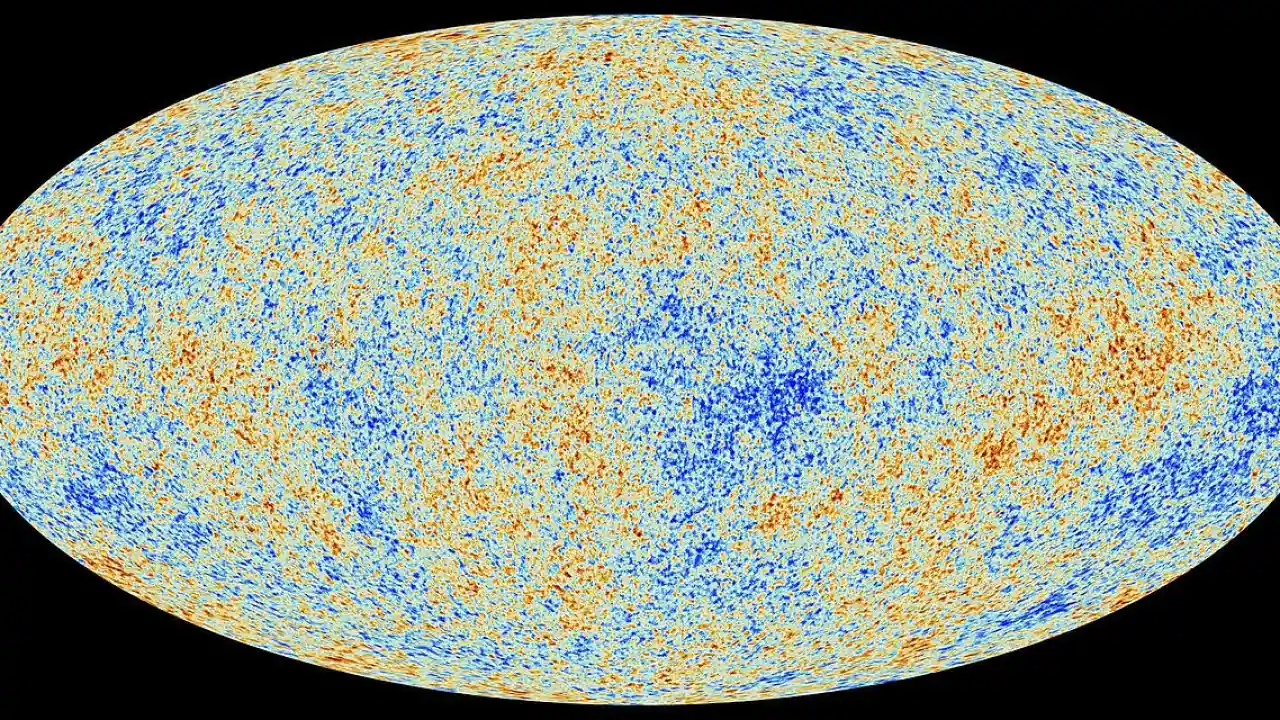
Spacecraft maps of that glow show tiny warmer and cooler —the tiny gravity seeds that grew into all galaxies today!
1. What did Arno Penzias and Robert Wilson first think might be causing the mysterious hiss in their giant horn antenna?
2. What did the tiny speckles in maps of the Cosmic Microwave Background eventually grow into?
🤯 Mind-Blowing Fact • Grade 3
Physicists Ralph Alpher and Robert Herman predicted the leftover Big Bang glow way back in 1948—sixteen years before Penzias and Wilson accidentally heard it!
✨ Word Sparks (Grade 3 Glossary)
Tap 🔊 to hear
neutral atom
Atom with balanced protons and bound electrons
absolute zero
Coldest possible temperature where heat motion stops
transparent
Clear enough for light to travel straight through
🪝
Why did the entire universe suddenly turn from blinding orange fog to crystal-clear glass 380,000 years after the Big Bang?
1
Trapped Inside Glowing Fog
For the first 380,000 years after the Big Bang, no stars or galaxies existed yet. All of space burned hotter than a red star's surface, packed with loose protons and zippy electrons! Light couldn't travel straight—every photon bumped instantly off free electrons like sunlight lost inside a thick cloud.
2
The Day Atoms Teamed Up
As the expanding universe cooled to about 5,000 degrees Fahrenheit (3,000 kelvins), protons finally caught electrons to form neutral hydrogen and helium atoms! Instantly, the cosmic fog vanished. Orange-white light burst free across space in every direction.
3
Stretched a Thousand Times Longer
Over the next 13.8 billion years, space expanded 1,100 times wider! That huge stretch lengthened those orange light waves into icy-cold microwaves just 2.7 degrees above (-455°F).
4
Spacecraft Baby Photographers
Three famous space missions—COBE, WMAP, and Planck—mapped this oval sky portrait in sharper and sharper detail, pinning down our universe's exact age at 13.8 billion years!
1. What made the baby universe suddenly turn transparent 380,000 years after the Big Bang?
2. Why is the Cosmic Microwave Background made of cold microwaves today instead of bright orange light?
🤯 Mind-Blowing Fact • Grade 4
When team leader John Mather projected COBE's first graph of the Cosmic Microwave Background in 1990, the data points fit the Big Bang curve so tightly the error bars were thinner than the printed line!
✨ Word Sparks (Grade 4 Glossary)
Tap 🔊 to hear
recombination
Epoch when protons and electrons formed first atoms
blackbody
Object glowing with an ideal temperature spectrum
anisotropy
Tiny temperature differences across different sky directions
🪝
How did sound waves echoing through the baby universe leave rings across the entire sky?
1
Recombination and Last Scattering
Cosmologists call the moment at 380,000 years ''—when cooling below ~3,000 kelvins let plasma combine into neutral hydrogen and helium gas. Looking out at the Cosmic Microwave Background is like looking up at the bottom of a cloud bank: we see the spherical 'surface of last scattering' at redshift $z \approx 1,100$, beyond which early opaque plasma hides.
2
Nature's Most Perfect Thermal Curve
In 1990, when NASA's Cosmic Background Explorer (COBE) measured the CMB's spectrum across microwave wavelengths, scientists at an astronomy conference stood up and cheered! Its curve matched a theoretical 2.725-kelvin thermal '' to within 0.005 percent—crushingly proving the hot Big Bang model over rival steady-state theories.
3
Frozen Sound Waves in Primordial Plasma
Color-coded maps from NASA's WMAP and Europe's Planck spacecraft show temperature ripples ('anisotropies') of just 1 part in 100,000—mere microkelvins! Before fog cleared, gravity pulled matter into dense pockets while photon pressure pushed back out, ringing the early universe like a giant drum with acoustic sound waves that froze in place the instant atoms formed.
4
Weighing Cosmic Ingredients
Measuring the exact sizes of those frozen sound spots revealed our universe's recipe: ~5% normal atoms, ~27% dark matter, and ~68% dark energy!
1. What caused the tiny hot and cold spots (1 part in 100,000) frozen into the Cosmic Microwave Background?
2. According to Planck spacecraft CMB measurements, about what fraction of the universe is ordinary atomic matter (stars, planets, and us)?
🤯 Mind-Blowing Fact • Grade 5
By measuring slight Doppler warming on one half of the CMB sky and cooling on the other, astronomers clocked our Milky Way and Local Group hurtling through the universe at 1.4 million miles per hour (627 km/s)!
✨ Word Sparks (Grade 5 Glossary)
Tap 🔊 to hear
Thomson scattering
Bouncing of light photons off free electrons
cosmic inflation
Ultra-fast exponential expansion in the earliest split-second
baryon
Ordinary heavy particles like protons and neutrons
🪝
How can subtle swirls of polarized light inside the Cosmic Microwave Background probe the very first trillionth of a trillionth of a second of time?
1
From Alpher-Herman to Holmdel Horn
Working alongside George Gamow in 1948 on Big Bang nucleosynthesis, Ralph Alpher and Robert Herman calculated that an expanding, hot early cosmos must leave behind a ~5 K thermal background today. Independently recalculated by Robert Dicke and Jim Peebles at Princeton in 1964, that relic glow materialized unexpectedly just miles away at Bell Labs' Holmdel Horn Antenna—where Arno Penzias and Robert Wilson isolated an isotropic $3.5\text{ K}$ excess antenna noise at 4.08 GHz.
2
Thomson Scattering and the Acoustic Power Spectrum
Prior to $t \approx 379,000$ years ($z \approx 1090$), tight coupled photons and into a relativistic fluid oscillating inside dark-matter potential wells. Plotting Planck's microkelvin temperature fluctuations ($\Delta T / T \sim 10^{-5}$) by angular scale reveals harmonic acoustic peaks: the first peak (~1 degree across) proves spatial geometry is flat ($\Omega_{\text{total}} = 1.00$), while the ratio of second-to-third peaks independently pins down baryon versus cold dark matter densities!
3
The CMB Dipole: Earth's Cosmic Speedometer
Before revealing microkelvin speckles, astronomers subtract a prominent $3.36\text{-millikelvin}$ 'dipole': half the sky looks slightly warmer (blueshifted) toward Leo and the opposite half cooler—clocking our Local Group's $627 \text{ km/s}$ motion relative to the universe's rest frame!
4
Sunyaev-Zel'dovich Shadows and Lensing
Traveling 13.8 billion years to reach our detectors, ancient CMB photons act as a cosmic backlight for modern structure. Passing through 100-million-kelvin X-ray gas inside massive galaxy clusters boosts low-energy microwave photons to higher frequencies via inverse Compton scattering—casting a distance-independent 'Sunyaev-Zel'dovich' shadow that has uncovered thousands of distant galaxy clusters—while weak gravitational lensing subtly warps CMB spots around intervening dark-matter filaments.
5
Hunting Primordial B-Mode Polarization
High-altitude cryogenic polarimeters at the South Pole Observatory and Chile's Simons Observatory at 5,200 meters in the Atacama Desert painstakingly filter out foreground galactic dust to hunt curl-like 'B-mode' polarization swirls—the predicted signature of primordial gravitational waves rippled into spacetime during just $10^{-36}$ seconds after time began!