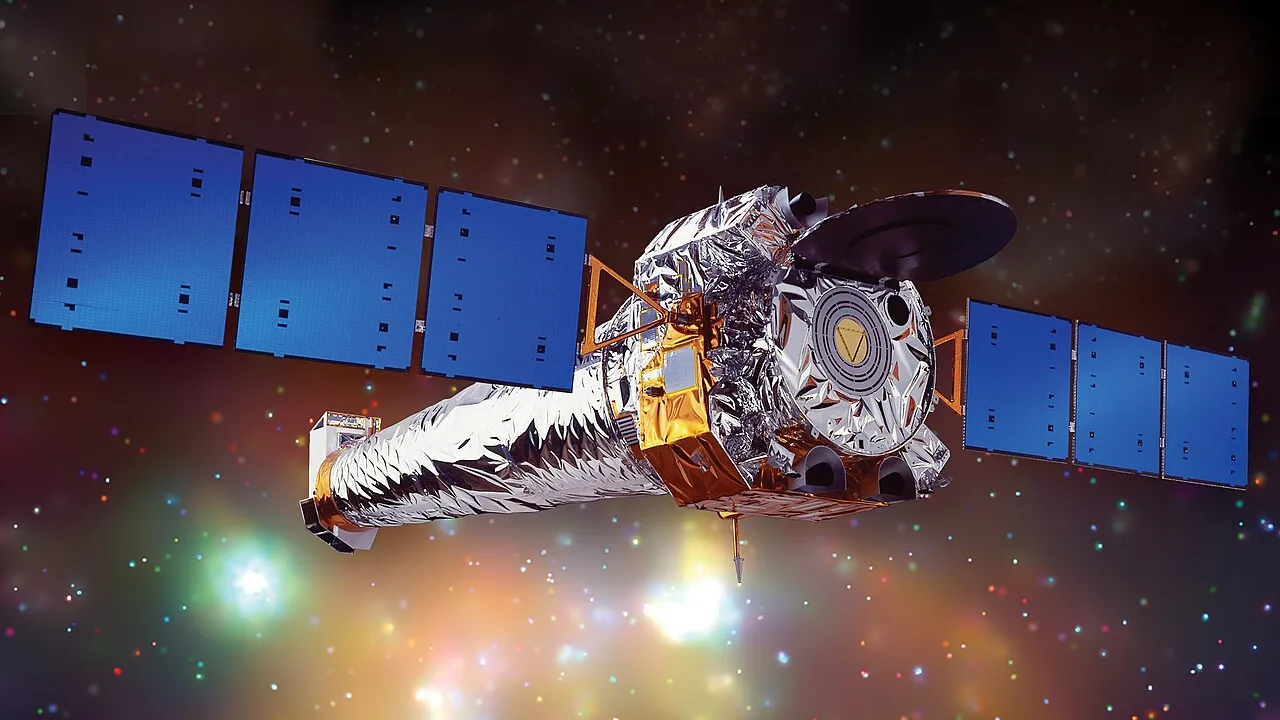
1. Why must an X-ray telescope fly high up in space instead of sitting on a mountain?
2. How do Chandra's barrel-shaped mirrors focus X-ray light?
🤯 Mind-Blowing Fact • Grade 2
Chandra's eyesight is so sharp it could read the letters on a stop sign from twelve miles away!
✨ Word Sparks (Grade 2 Glossary)
Tap 🔊 to hear
observatory
Science craft equipped with telescopes to study space
supernova
Giant explosion at the end of a massive star's life
elliptical
Stretched oval path rather than a round circle
🪝
Why did Space Shuttle Columbia struggle to lift its heaviest-ever treasure into orbit in 1999?
1
Heaviest Ride on the Shuttle
In July 1999, Commander Eileen Collins—the first woman to command a Space Shuttle—piloted Columbia with its heaviest cargo ever: the Chandra X-Ray and its attached booster rocket! Once released, that booster pushed Chandra one-third of the way to the Moon.
2
Why Fly So High?
Looping 86,500 miles above Earth keeps the telescope high outside Earth's radiation belts, letting it stare uninterrupted at cosmic explosions for over two days per orbit!
3
Hot Universe in Action
Named after astrophysicist Subrahmanyan Chandrasekhar, this sharp-eyed giant reveals million-degree gas swirling around black holes and shattered stars.
1. How far out into space does Chandra's stretched-out oval orbit carry it?
2. What historic milestone did Astronaut Eileen Collins achieve when launching Chandra on STS-93?
🤯 Mind-Blowing Fact • Grade 3
Chandra discovered deep sound waves rippling out from a supermassive black hole in the Perseus galaxy cluster—playing a bass note fifty-seven octaves below middle C!
✨ Word Sparks (Grade 3 Glossary)
Tap 🔊 to hear
iridium
Ultra-dense shiny metal coating Chandra's X-ray mirrors
friction
Heat created when fast-moving matter rubs together
remnant
Glowing cloud of debris left after a star explodes
🪝
How can a telescope see an invisible black hole if not even light can escape from inside it?
1
Catching a Black Hole's Messy Dinner
True, zero light escapes once anything crosses inside a black hole! Yet just outside that edge, fierce gravity whips falling gas into a spinning disk rubbing at millions of miles per hour. heats that gas to millions of degrees until it blazes brightly with X-rays—lighting up a beacon right into Chandra's detectors!
2
Four Barrels Coated in Iridium
Inside Chandra's front tube nest four Russian-doll-like glass cylinders coated in , one of the densest metals known. Incoming X-rays graze off at tiny angles and focus thirty-three feet back at the tail.
3
Star Dust That Built Our Bodies
Studying supernova like Cassiopeia A, Chandra mapped glowing rings of iron, silicon, calcium, and oxygen blasted into space—the exact elements now inside your bones and blood!
4
Teaming With Hubble and Webb
Combining Chandra's X-rays with Hubble's visible light and Webb's infrared creates breathtaking full-spectrum portraits of the universe.
1. How does Chandra spot black holes if black holes themselves trap all light?
2. What vital connection to human life did Chandra illuminate inside exploded stars like Cassiopeia A?
🤯 Mind-Blowing Fact • Grade 4
Subrahmanyan Chandrasekhar calculated the famous stellar collapse limit named after him when he was just nineteen years old while sailing on a steamship from India to university in England!
✨ Word Sparks (Grade 4 Glossary)
Tap 🔊 to hear
dark matter
Invisible cosmic matter detected only through its gravitational pull
neutron star
City-sized ultra-dense core left when a giant star collapses
photon
Single tiny packet of electromagnetic light energy
🪝
How did two colliding galaxy clusters let an X-ray telescope catch invisible dark matter red-handed?
1
Third Sister of NASA's Great Observatories
Different cosmic dramas shine in completely different wavelengths: cool dust glows in infrared, Sun-like stars shine in visible light, and violent multi-million-degree events radiate X-rays. Launched in 1999 alongside siblings Hubble, Compton, and later Spitzer, the Chandra X-Ray Observatory honored Nobel laureate Subrahmanyan Chandrasekhar—who calculated at age nineteen on a ship voyage from India to England the exact mass limit above which dying white-dwarf stars collapse!
2
Wolter Grazing-Incidence Optics
Because X-ray carry thousands of times more energy than visible light, hitting a normal curved mirror head-on embeds them straight into the glass like darts in cork. Chandra's High-Resolution Mirror Assembly nests four paraboloid-hyperboloid Zerodur ceramic-glass barrels polished to atomic-scale smoothness of a few angstroms, deflecting X-rays by less than two degrees down a ten-meter optical bench.
3
Smoking Gun of Dark Matter: The Bullet Cluster
In 2006, Chandra delivered landmark evidence that mysterious truly exists. When two giant galaxy clusters smashed through each other in the Bullet Cluster, Chandra saw normal hot X-ray gas slam together and slow down in the middle like colliding fog—yet gravitational lensing maps showed most of the cluster's mass coasted straight through untouched, proving invisible dark matter outweighs normal gas!
4
Quarter-Century of Discovery
Guided from Cambridge, Massachusetts by the Smithsonian Astrophysical Observatory, Chandra has observed neutron-star mergers, exoplanet X-ray flares, and Jupiter's shimmering X-ray auroras for over twenty-five years.
1. How did Chandra's observation of the Bullet Cluster provide direct evidence for dark matter?
2. Why must X-rays strike Chandra's mirrors at shallow angles of less than two degrees?
🤯 Mind-Blowing Fact • Grade 5
Every single X-ray photon Chandra catches gets logged individually by four numbers at once: where it hit on the sky, the exact fraction of a second it arrived, and its exact X-ray color energy!
✨ Word Sparks (Grade 5 Glossary)
Tap 🔊 to hear
arcsecond
Tiny angle equal to 1/3,600th of one degree
apogee
Farthest point from Earth along an elliptical orbit
pulsar
Rapidly spinning magnetized neutron star beaming regular pulses
🪝
Why does mapping the hottest, most violent structures in the cosmos require mirrors smoother than any telescope glass ever ground before?
1
Conquering Sub-Arcsecond X-Ray Imaging
Before 1999, X-ray astronomy yielded comparatively blurry maps compared to optical telescopes because tiny surface bumps scatter short-wavelength X-ray photons (0.1 to 10 nanometers). NASA's Advanced X-ray Astrophysics Facility—renamed Chandra—shattered that barrier with a 0.5- angular resolution ten times sharper than any predecessor. Grinding and ion-polishing its four nested, two-ton Zerodur glass-ceramic Wolter Type-I mirror pairs took years, leaving root-mean-square surface roughness smaller than a handful of atoms before sputtering a 33-nanometer iridium coat.
2
Surviving STS-93 and Reaching Deep Elliptical Orbit
Chandra's July 23, 1999 launch aboard Space Shuttle Columbia (STS-93) nearly turned hair-raising: five seconds after liftoff, a gold pin popped loose and punctured three hydrogen cooling tubes in a main engine nozzle while an electrical short knocked out two engine controllers! Backup systems and Commander Eileen Collins guided the 22,750-kilogram payload stack safely to low orbit, where an Inertial Upper Stage and Chandra's own thrusters raised past one-third lunar distance (139,000 kilometers).
3
Spectrometers and Imaging Arrays at Ten Meters
At the focal plane of its ten-meter graphite-epoxy optical bench—shielded against micrometers of thermal expansion—sit the Advanced CCD Imaging Spectrometer (ACIS) and High Resolution Camera (HRC), recording every individual X-ray photon's arrival position, millisecond timing, and kiloelectronvolt energy simultaneously.
4
Inside Pulsars, Quasars, and Supernova Cores
Chandra's very first calibration image of Cassiopeia A stunned theorists by revealing an unseen central neutron star and showing that iron forged deepest inside the dying star had flipped outward past lighter silicon layers during an asymmetric explosion! Subsequent decades mapped relativistic wind nebulae like the Crab Nebula, supermassive black hole feedback jets regulating galaxy growth, and gravitational-wave kilonova GW170817.
5
Irreplaceable High-Energy Eye
Even past its twenty-fifth anniversary, no launched or near-term observatory matches Chandra's sub- X-ray sharpness—making every multi-wavelength portrait paired with JWST and Hubble an enduring treasure of modern astrophysics.