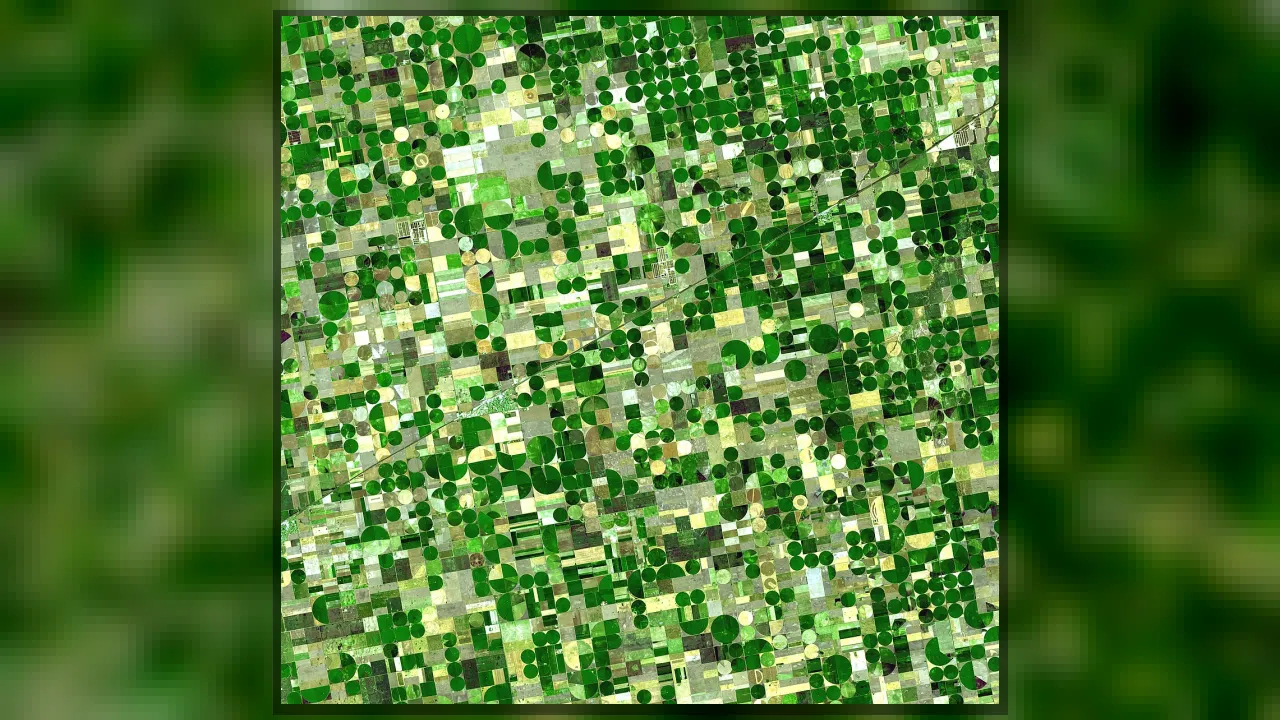
Some center-pivot sprinklers are longer than six school buses!
✨ Word Sparks (Grade 2 Glossary)
Tap 🔊 to hear
irrigation
Bringing water to help plants grow
wheels
Round things that help things move
crop
Plants grown for food
🪝
Have you ever seen a field shaped like a giant green circle?
1
How It Spins
A long sprinkler arm turns around a center point, spraying water as it moves. The arm is held up by , and it rolls in a big circle. This helps water reach all the plants in the field.
2
Why Farmers Use It
Farmers use center-pivot to help grow in dry places. The spinning sprinkler gives every plant a drink, even when there is not much rain. This makes the fields look like green from above.
3
Amazing Circles
The fields become huge green circles, easy to spot from airplanes. People all over the world use this invention to grow food. It helps farms make more for everyone.
A single center-pivot system can water up to 130 acres at once!
✨ Word Sparks (Grade 3 Glossary)
Tap 🔊 to hear
rotation
Turning around a center point
boom
A long arm that holds sprinklers
pressure
A force that pushes water out
🪝
Can you imagine a giant metal arm slowly spinning and watering a whole field?
1
How Center-Pivot Irrigation Works
A center-pivot irrigation system has a long metal arm called a . The boom rotates around a fixed central point, powered by motors and wheels. Water travels through pipes along the boom and sprays out through sprinklers. This creates a large, green circle as the crops are watered evenly.
2
The Invention and Its Inventor
Frank Zybach invented center-pivot irrigation in Nebraska in the 1940s. He wanted to help farmers grow more crops in dry places. His invention used a pivot point and moving wheels to cover more land. Farmers quickly saw how useful this system was for their fields.
3
Why Circles, Not Squares?
The pivot system moves in a circle because the arm rotates around the center. This means the water reaches every part of the circular field, but not the corners of a square. From above, these circles look like green coins or wheels across the land.
4
Changing the World’s Farms
Center-pivot irrigation uses engineering ideas like and water . It helps farmers grow crops even in places with little rain. This invention has spread to farms all over the world. Today, it helps feed millions of people every year.
Some center-pivot booms stretch over 1,600 feet long—longer than four football fields!
✨ Word Sparks (Grade 4 Glossary)
Tap 🔊 to hear
pivot
The fixed center point that spins
drought
A long time with little rain
innovation
A new idea that changes things
🪝
What if you could watch a giant mechanical arm sweep across a field, turning dry ground into a sea of green?
1
A Spinning Solution for Dry Land
Center- irrigation was invented by Frank Zybach in Nebraska during the 1940s, revolutionizing farming in dry regions. The system uses a long pipe, or boom, mounted on wheeled towers that rotate around a fixed pivot. Water pumped from a well travels through the boom and sprays out of sprinklers along its length. This rotating movement allows the system to cover a huge circular area, making it possible to grow crops where rainfall is scarce.
2
Engineering the Circle
The point acts as the center of a giant wheel, while the boom forms the radius. As the motorized towers roll slowly in a circle, the boom’s sprinklers deliver water evenly to every part of the field. The system relies on water pressure and precise engineering to keep the flow steady and the circle perfect. Because the corners of square fields are missed, the result is a patchwork of green circles visible from airplanes.
3
Changing How the World Farms
Before center- irrigation, many regions could not grow enough crops due to . This invention allowed farmers to use underground water efficiently, turning deserts into farmland. Today, center-pivot systems are used on millions of acres across the world. They have increased food production and helped feed growing populations.
4
A Lasting Impact
Center- irrigation combines mechanical engineering, water science, and agricultural . It has inspired further inventions, like drip irrigation and automated watering controls. The green circles it creates have become symbols of modern farming and human ingenuity. Thanks to this invention, many dry places can now produce food year after year.
1. What is the main reason for using center-pivot irrigation?
2. Why do the corners of square fields stay dry?
🤯 Mind-Blowing Fact • Grade 5
The largest center-pivot systems can irrigate over 500 acres with a single rotation.
✨ Word Sparks (Grade 5 Glossary)
Tap 🔊 to hear
aquifer
Underground layer that stores water
automation
Machines working by themselves
sustainability
Using resources without wasting them
🪝
Imagine standing in a field as a massive metal arm sweeps past, spraying a fine mist and leaving a perfect green arc behind—how does such a marvel work?
1
Engineering the Modern Miracle
Center-pivot irrigation, patented by Frank Zybach in 1952, revolutionized agriculture by mechanizing water delivery on a massive scale. The system consists of a long pipeline, or boom, supported by a series of wheeled towers that rotate around a fixed central pivot. Water is pumped from underground wells or reservoirs into the pivot, where it travels through the pipeline and is distributed by sprinklers spaced along the boom. Electric or hydraulic motors drive the towers, ensuring the entire structure moves in a precise circular path.
2
Physics in Motion: How It Works
The key engineering principle is rotation around a central axis, with each tower moving at a speed proportional to its distance from the center. The outermost towers travel faster than those near the pivot, maintaining a straight boom and even water coverage. Water pressure, typically between 40 and 60 psi, is carefully regulated to ensure consistent spray patterns. This design minimizes evaporation and runoff, making irrigation more efficient than traditional flood methods.
3
From Nebraska to the World
Initially developed for the semi-arid plains of Nebraska, center-pivot irrigation rapidly spread to farms worldwide. Today, over 30 million hectares are irrigated using this technology, from the United States to Australia and Saudi Arabia. The distinctive green circles seen from space are a testament to its global impact. By making agriculture possible in regions with less than 20 inches of annual rainfall, it has transformed food security for millions.
4
Environmental and Economic Impacts
While center-pivot irrigation increases crop yields and land value, it also poses environmental challenges. Overuse can deplete groundwater , and the energy required to pump and move water adds to operational costs. Modern systems address these issues with soil moisture sensors, variable-rate sprinklers, and GPS-guided , which help conserve water and energy. Farmers must balance productivity with to protect natural resources.
5
The Legacy of Circular Innovation
Center-pivot irrigation is a prime example of how engineering, physics, and agricultural science can solve real-world problems. Its invention led to further advances, including low-pressure nozzles and remote monitoring systems. The green circles it creates are now iconic symbols of modern farming ingenuity. As technology evolves, center-pivot systems continue to adapt, ensuring that future generations can grow food efficiently and responsibly, even in challenging environments.