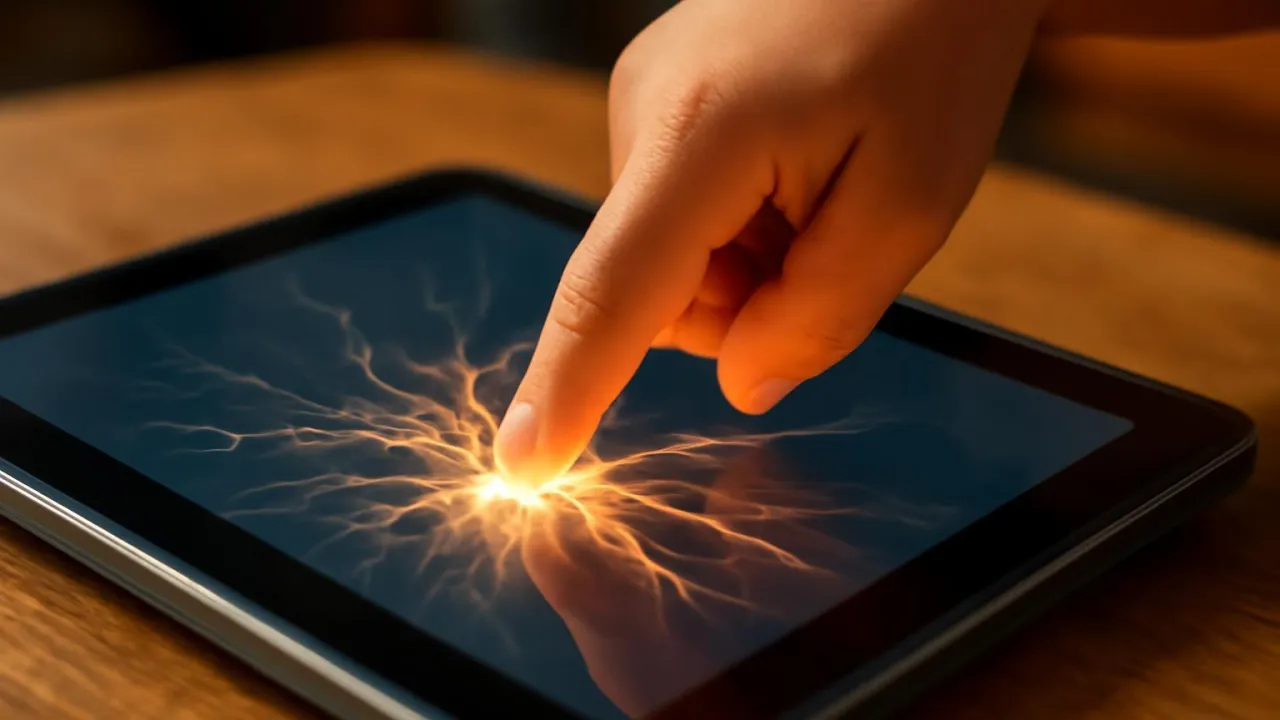
Touchscreens can sense your finger even through thin gloves!
✨ Word Sparks (Grade 2 Glossary)
Tap 🔊 to hear
tablet
A flat computer you can hold
charge
A tiny bit of electricity
app
A game or tool on a device
🪝
Have you ever wondered how your finger makes pictures move on a screen?
1
Touch and See
When you touch a , the screen lights up and things move. You can swipe to turn pages or tap to play games. The glass feels smooth and cool under your finger.
2
How It Knows
The screen can feel your finger’s touch because you have a tiny electric . When you touch the glass, it senses your finger and knows where you touched. That is how it opens or draws lines.
3
Why It’s Special
Capacitive touchscreens help people play, learn, and talk to friends. You can use them on phones, , and even some computers. They make using technology easy and fun.
Some touchscreens can sense more than ten fingers at once—perfect for playing music or games!
✨ Word Sparks (Grade 3 Glossary)
Tap 🔊 to hear
capacitance
How much electric charge something can hold
conductor
Material that lets electricity flow
stylus
A special pen for screens
🪝
Why does your phone react only to your touch, but not a pencil’s?
1
A Glass That Feels
Capacitive touchscreens sense the gentle tap of your finger. The screen is made of glass with a special electric layer beneath. When your finger touches, it changes the electric field. This lets the device know exactly where you touched.
2
Tiny Electric Fields
Your body carries a small electric charge, which the screen detects. The glass uses a grid of transparent to measure changes in . When you touch, the vibration of electrons shifts in the grid. That’s why a plastic pen or stick won’t work.
3
From Idea to Invention
The first capacitive touchscreen was invented by E.A. Johnson in England in 1965. Later, smartphones and tablets made this technology famous worldwide. These screens replaced older ones that needed pressure or a .
4
Changing How We Connect
Capacitive touchscreens made it easy to swipe, tap, and zoom with just a finger. They help people draw, play music, and talk to friends across the world. This invention changed how we use computers every day.
1. Why doesn't a pencil work on a capacitive screen?
2. Who invented the first capacitive touchscreen?
🤯 Mind-Blowing Fact • Grade 4
Capacitive screens can even sense your touch through thin water droplets—so rain won’t always stop your swipe!
✨ Word Sparks (Grade 4 Glossary)
Tap 🔊 to hear
algorithm
A set of rules a computer follows
resistive
Needs pressure to work
multi-touch
Using more than one finger at once
🪝
Imagine a world where you could control a computer just by touching glass—how does it sense you?
1
Electric Glass at Your Fingertips
Capacitive touchscreens are engineered with a transparent layer that stores and senses electric charge. When your finger, which naturally carries a small charge, touches the glass, it disrupts the local electric field. This change in capacitance is detected by circuits beneath the surface, which instantly pinpoint your touch location. That’s why the screen responds only to your skin or a special stylus.
2
A Revolution in Human-Computer Interaction
The first working capacitive touchscreen was developed by E.A. Johnson in the 1960s for air traffic control. Decades later, Apple’s iPhone popularized the technology for everyday use, making swiping and pinching gestures possible. Capacitive screens replaced older types, which required pressure and could only sense one touch at a time. Now, lets you zoom, rotate, and play complex games.
3
The Science Behind the Swipe
Under the glass, a grid of transparent conductors creates an invisible map of electric fields. When you touch the screen, the capacitance at that spot changes, and sensors measure this difference. The system uses to translate these signals into precise movements, like opening an app or drawing a picture. This technology works quickly, so the response feels instant.
4
Impact on Our Digital World
Capacitive touchscreens have transformed how people interact with technology around the globe. They are found in smartphones, tablets, ticket machines, and even car dashboards. Their durability, speed, and ability to sense multiple touches at once make them ideal for modern life. This invention has made technology more accessible and fun for people of all ages.
1. What happens when your finger touches a capacitive screen?
2. Why did capacitive screens replace resistive ones?
🤯 Mind-Blowing Fact • Grade 5
The electric field in a modern touchscreen grid can be smaller than a single human hair—almost invisible to the naked eye!
✨ Word Sparks (Grade 5 Glossary)
Tap 🔊 to hear
indium tin oxide
A see-through material that conducts electricity
femtofarad
A super tiny unit for measuring electric charge
mutual capacitance
How two objects store electric charge together
🪝
If you could see invisible electricity, what patterns would you spot under your fingertips on a touchscreen?
1
Invisible Patterns Beneath the Glass
Every time you touch a capacitive touchscreen, you’re interacting with a hidden world of electric fields. The glass is coated with a grid of transparent conductors, often made from , arranged in rows and columns. When your finger approaches, its natural electric charge disturbs the local capacitance at precise points on this grid. The screen’s controller instantly measures these tiny changes, mapping your touch with remarkable accuracy. This process is so sensitive that it can detect multiple fingers, enabling complex gestures like pinch-to-zoom or multi-finger drawing.
2
Engineering the Touch Experience
The science behind capacitive touchscreens relies on the principle of . Each intersection in the grid acts as a capacitor, storing and releasing electric charge. When your finger bridges the electric field between the grid’s layers, it causes a measurable drop in capacitance at that location. Advanced algorithms process these signals in milliseconds, converting them into digital commands. Unlike older resistive screens, which depended on physical pressure, capacitive screens respond to the unique electrical properties of human skin.
3
From Air Traffic Control to Your Pocket
E.A. Johnson’s pioneering work in the 1960s led to the first practical capacitive touchscreen, initially used for air traffic control displays in the United Kingdom. It wasn’t until the 2000s that advances in materials and microelectronics made the technology affordable for consumer devices. Apple’s 2007 iPhone launch marked a turning point, making capacitive multi-touch the global standard for smartphones and tablets. Today, this invention powers billions of devices worldwide.
4
Global Impact and Future Possibilities
Capacitive touchscreens have revolutionized human-computer interaction by making technology more intuitive and accessible. They are now found in everything from medical equipment and cars to interactive museum exhibits and voting machines. Their durability, clarity, and ability to sense gestures have reshaped communication, education, and entertainment. As engineers develop flexible and foldable screens, capacitive technology continues to evolve, promising new ways to interact with the digital world.
5
Quantitative Specs and Scientific Frontiers
Modern capacitive touchscreens can detect changes in capacitance as small as a few (10^-15 farads), and their response times are often less than 10 milliseconds. The transparent conductor grid can be as thin as a few micrometers, making screens lightweight and highly responsive. Researchers are now exploring materials like graphene and new sensing techniques to improve sensitivity and reduce power consumption. The capacitive touchscreen’s journey from a laboratory invention to a global interface is a story of physics, engineering, and creativity working together.