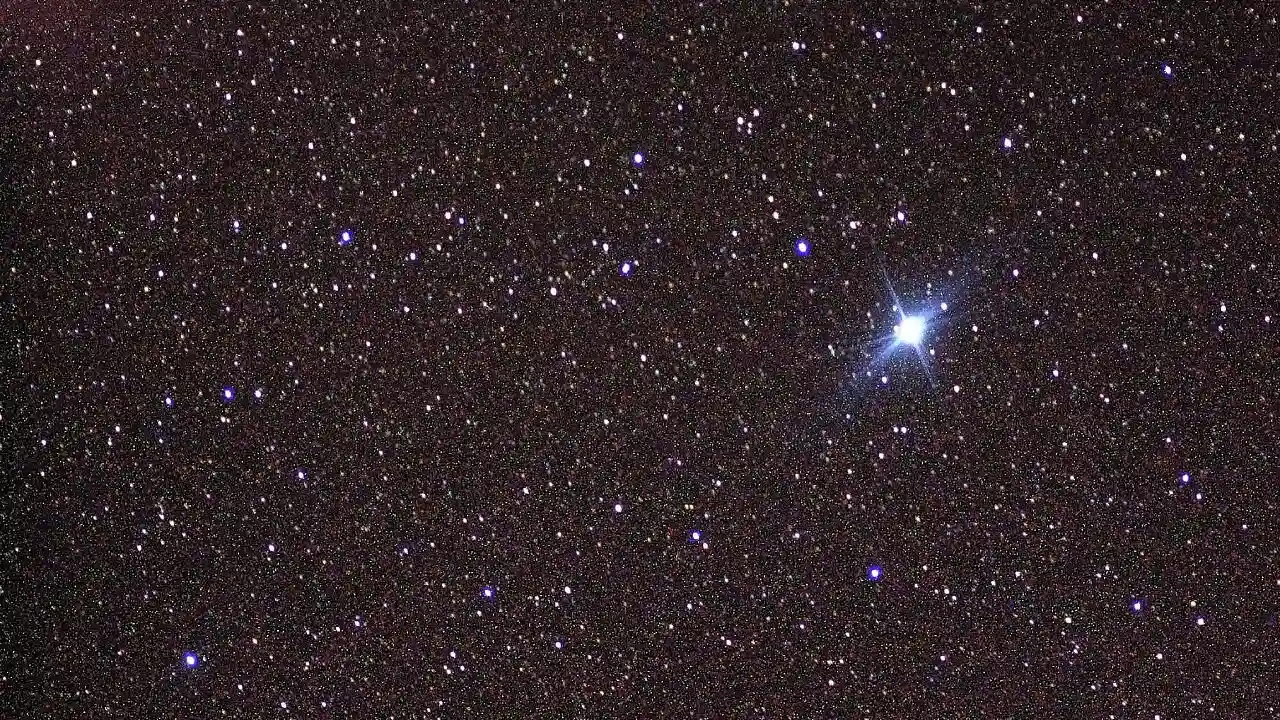
Light leaving Canopus takes 310 years to reach your eyes, so tonight you see light that started traveling centuries ago!
✨ Word Sparks (Grade 2 Glossary)
Tap 🔊 to hear
navigate
To plan and follow a safe path
light-year
How far light travels in one year
probe
A robot spacecraft that explores deep space
🪝
Why do NASA space probes carry a special camera just to look at one star?
1
Second Brightest at Night
Sail south across Earth's oceans and look up at the dark sky. You will spot a dazzling yellow-white jewel called Canopus. Out of every star at night, only Sirius looks brighter from Earth. Ancient sailors once used Canopus to steer wooden ships across open seas.
2
A Faraway Giant
Canopus looks bright even though it sits 310 away! That is because it is a monster star. It stretches seventy-one times wider than our Sun and shines over ten thousand times brighter.
3
A Compass for Rockets
Today, robot explorers still use Canopus to . Spacecraft flying to Mars, Jupiter, and Saturn carry star-tracker cameras. By keeping Canopus in view, a knows exactly which way it is pointing.
1. Which star is the ONLY night star that looks brighter than Canopus from Earth?
2. About how many Suns could fit side by side across Canopus?
🤯 Mind-Blowing Fact • Grade 3
NASA's Voyager 1 and Voyager 2 spacecraft both locked onto Canopus to aim their radio antennas straight back at Earth!
✨ Word Sparks (Grade 3 Glossary)
Tap 🔊 to hear
constellation
A group of stars forming a pattern
bright giant
An aging star swollen to enormous size
helium
A light gas fused inside older stars
🪝
How can a star 310 light-years away outshine almost every neighbor near our Solar System?
1
The Keel of a Sky Ship
Gaze toward the southern Carina, named after the wooden keel of a legendary ship. Shining right along that starry hull is Canopus, the second-brightest star in Earth's night sky. Observers in southern states like Florida and Texas can watch it skim above the winter horizon.
2
Inside a Bright Giant
Most stars near Earth look bright simply because they sit close to us. Canopus is different. It blazes 310 light-years away, yet its enormous size makes it impossible to miss. Classified as a yellow-white , it spans nearly 61.5 million miles across.
3
Fusing Helium Fuel
Canopus has already burned through the hydrogen fuel in its central core. Now its super-hot core fuses atoms together, releasing about 10,700 times more light energy than our Sun every single second.
4
Deep-Space Star Trackers
NASA engineers love Canopus because it sits far south of the path where planets orbit. Sunlight and drifting planets never block it, making Canopus the perfect cosmic landmark for spacecraft star trackers.
1. Why is Canopus located in such a helpful spot for spacecraft star-tracker cameras?
2. What fuel is Canopus currently fusing deep inside its core?
🤯 Mind-Blowing Fact • Grade 4
Canopus has a magnetically heated corona roughly ten times hotter than its 7,400-kelvin surface, beaming detectable X-rays into space!
✨ Word Sparks (Grade 4 Glossary)
Tap 🔊 to hear
luminosity
Total light energy a star gives off
attitude control
Steering how a spacecraft tilts and points
celestial
Positioned in or relating to outer space
🪝
Why did rocket engineers invent a special sensor named after an ancient southern star?
1
Beacon of the Southern Sky
Imagine piloting a robotic probe millions of miles from Earth, where magnetic compasses fail and there are no road signs. To keep your spacecraft steady, you need two reference points: our Sun and a reliable distant star. Since the dawn of the Space Age, engineers have trusted Alpha Carinae, famously known as Canopus, as their favorite anchor.
2
Why Sirius Loses to Second Place
Sirius appears brighter than Canopus from Earth, only because Sirius sits a cozy 8.6 light-years away. Canopus shines from 310 light-years away! In a fair side-by-side contest, Canopus would completely overwhelm Sirius. With roughly eight to nine times the Sun's mass and seventy-one times its diameter, Canopus radiates 10,700 times our Sun's .
3
Three-Axis Attitude Control
When NASA's Mariner 4 flew to Mars in 1964, it debuted the Canopus Star Tracker. Positioned high at a steep southern angle from Earth's orbital plane, Canopus never gets lost in the glare of Venus, Mars, or Jupiter, and floating interplanetary dust rarely confuses its clean optical signature. By locking one optical sensor on our bright Sun and a second sensor on steady Canopus, a deep-space probe stabilizes all three axes of roll, pitch, and yaw so its dish antenna stays pointed straight home.
4
A Star on the Borderline
Canopus also straddles an exciting cosmic boundary in stellar lifecycles. Its eight-to-nine-solar-mass bulk places it right near the dividing line between intermediate stars that end their lives quietly as heavy white dwarfs and massive stars heavy enough to collapse and explode as brilliant supernovae.
1. Why does Sirius look slightly brighter than Canopus in our night sky even though Canopus is much more luminous?
2. How many orientation axes can a spacecraft lock in place by tracking both the Sun and Canopus?
🤯 Mind-Blowing Fact • Grade 5
If Canopus occupied the center of our Solar System, its glowing photosphere would extend nearly two-thirds of the way to Mercury's orbit!
✨ Word Sparks (Grade 5 Glossary)
Tap 🔊 to hear
parallax
Apparent shift used to measure star distances
ecliptic plane
Flat disk where Earth and planets orbit
white dwarf
Dense glowing core left by dying stars
🪝
How did an aging bright giant 310 light-years away become the backbone of interplanetary navigation?
1
Mythology Meets Astrodynamics
Across thousands of years, open-ocean navigators from Polynesia to the ancient Mediterranean steered wooden vessels by Alpha Carinae—Canopus—named either for the legendary pilot of King Menelaus's Greek fleet or a bustling port on Egypt's Nile Delta. Centuries later, aerospace engineers at NASA's Jet Propulsion Laboratory realized this dazzling southern beacon solved a critical challenge in interplanetary flight: maintaining precise three-axis attitude control across hundreds of millions of miles where magnetic compasses are useless.
2
True Scale Revealed by Hipparcos
For decades, astronomers debated Canopus's exact distance because it lay just beyond reliable ground-based measurements, with estimates swinging wildly from 100 to over 1,000 light-years. In the 1990s, the European Space Agency's Hipparcos astrometry satellite pinned down its tiny 10.55-milliarcsecond parallax shift from orbit, confirming a distance of roughly 310 light-years (95 parsecs). Combined with optical interferometry from Australia and Chile, that measurement proved Canopus is an A9 II bright giant spanning 71 solar radii—about 99 million kilometers—with an intrinsic luminosity 10,700 times greater than our Sun.
3
Why Space Probes Choose Canopus
To aim narrow high-gain radio beams at Earth and fire trajectory-correction thrusters accurately, robotic pioneers like Mariner, Pioneer, and Voyager needed a roll-reference star positioned nearly ninety degrees away from the Sun. Canopus sits near minus 75 degrees ecliptic latitude, meaning sunlit planets and zodiacal dust glare never wander into the tracker's field of view, while its -0.74 apparent magnitude guarantees unmistakable brightness.
4
Stellar Evolution at the Threshold
Having exhausted hydrogen in its central core tens of millions of years ago, Canopus now fuses core helium into carbon and oxygen while executing a 'blue loop' across the Hertzsprung-Russell diagram at an effective surface temperature near 7,400 kelvins and magnetically heated X-ray coronal loops reaching millions of degrees.
5
A Rare Neon-Oxygen Fate
Containing roughly eight to nine solar masses, Canopus straddles the delicate evolutionary boundary separating core-collapse supernovae from progenitors; stellar interior models suggest fierce winds may shed its outer envelope first, leaving behind an ultra-dense neon-oxygen white dwarf.