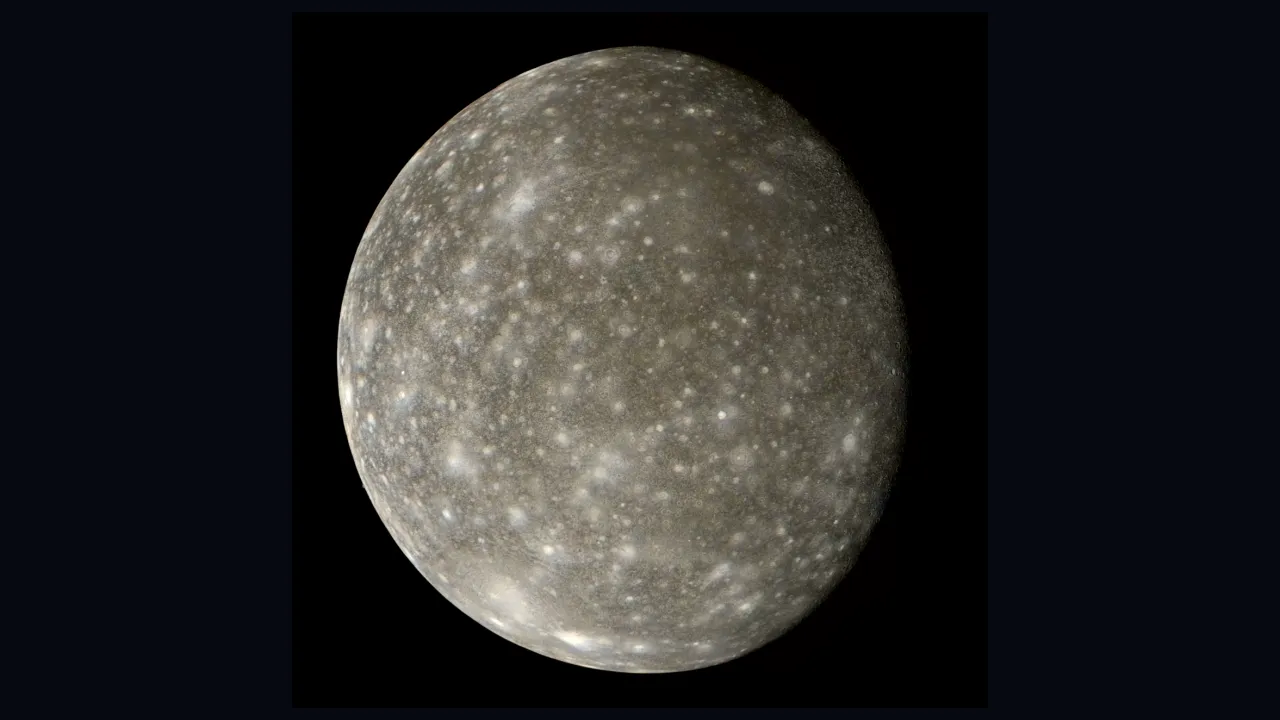
1. What covers almost every inch of Callisto's surface?
2. What surprising feature may hide deep inside quiet Callisto?
🤯 Mind-Blowing Fact • Grade 2
Callisto's giant Valhalla impact basin has icy ripples stretching 2,400 miles wide—nearly as wide as the United States!
✨ Word Sparks (Grade 2 Glossary)
Tap 🔊 to hear
Basin
A giant wide bowl made by a huge impact.
Radiation
Invisible high-energy particles trapped around giant Jupiter.
Comet
An icy space snowball flying around the Sun.
🪝
Why does Callisto look like a giant disco ball sprinkled with bright white rings?
1
The Farthest Galilean Moon
Travel over a million miles out from Jupiter's clouds and you reach Callisto. It is the outermost of Jupiter's four big Galilean moons and almost matches the planet Mercury in size!
2
Frozen Bullseyes
Dark dust blankets most of Callisto, but crashes punch through to clean white ice underneath. One huge crash made Valhalla, a giant bullseye surrounded by dozens of frozen ripples!
3
A Safe Base for Astronauts
Because Callisto orbits far from Jupiter's strongest belts, future astronauts could build a safe moon base on its ancient ice.
1. What is the name of Callisto's giant bullseye-shaped impact zone?
2. Why do scientists think Callisto could be a good place for a future human base?
🤯 Mind-Blowing Fact • Grade 3
Chains of craters called catenae stripe Callisto where passing comets were ripped into tidy strings of fragments by Jupiter's gravity before crashing!
✨ Word Sparks (Grade 3 Glossary)
Tap 🔊 to hear
Multi-ring basin
A huge crater circled by rings of frozen cliffs.
Concentric
Circles of different sizes sharing the exact same center.
Catenae
Straight chains of craters formed by broken comet pieces.
🪝
How did Callisto preserve four billion years of cosmic history without erasing a single chapter?
1
A Cosmic Time Capsule
Picture an ancient scrapbook made of dark rock and glittering ice. Unlike volcanic Io or cracked Europa, Callisto has had zero volcanoes or shifting plates for four billion years. Every comet and asteroid strike stays locked in place on the Solar System's most heavily cratered surface.
2
Ripples Frozen in Ice
When a massive object slammed into Callisto long ago, warm slushy ice splashed outward and froze mid-wave! Today that scar is called Valhalla, a ringed by ridges stretching thousands of miles.
3
Blended Inside Like Oatmeal
Most big moons melted early on, letting heavy rock sink to the middle. Callisto stayed cool enough that much of its interior remained a partial mix of rock and ice.
4
A Surprise Magnetic Clue
When NASA's Galileo spacecraft flew past in the 1990s, Callisto responded to Jupiter's magnetic pull just like an electric conductor—pointing to a hidden salty ocean 100 miles down!
1. Why hasn't Callisto's surface erased its ancient craters?
2. What caused straight lines of craters on Callisto?
🤯 Mind-Blowing Fact • Grade 4
Even though Callisto is 99 percent as wide as the planet Mercury, it has only one-third of Mercury's mass because half of Callisto is ice!
✨ Word Sparks (Grade 4 Glossary)
Tap 🔊 to hear
Tidal flexing
Squeezing and stretching caused by a planet's gravity.
Sublimation
When solid ice turns straight into gas without melting.
Antifreeze
Dissolved salts or chemicals that keep cold water liquid.
🪝
Why did Callisto miss out on the gravitational tug-of-war that heats its three giant neighbors?
1
Solo Outside the Resonance
Orbiting 1,882,700 kilometers from Jupiter every 16.69 days, Callisto travels well beyond its siblings Io, Europa, and Ganymede. While those inner three Galilean moons lock into an energetic orbital resonance that kneads and heats their insides, Callisto glides along independently. Without strong , Callisto never fully melted during its youth.
2
An Undifferentiated Slush
Gravity measurements from NASA's Galileo probe revealed something astonishing: Callisto lacks a dense metallic core! Instead, beneath its battered outer crust, rock and compressed water ice remain partially mixed together like frozen gravel in snow, slowly growing denser toward the center.
3
Jagged Spires and Sublimation
Close-up spacecraft photos show eerie fields of bright, jagged ice knobs rising hundreds of feet out of dark dust plains. As weak sunlight strikes Callisto, volatile frost turns directly from solid to gas—a process called —leaving dark rocky powder slumping into low valleys while pure water-ice spires gleam above.
4
How an Ocean Survives the Cold
Even without tidal heating, slow radioactive decay in Callisto's rocky material generates mild warmth. Paired with high pressure and natural compounds like ammonia or salts, that trickle of heat can sustain a deep briny ocean sealed beneath 100 to 150 kilometers of solid ice.
1. Why does Callisto experience almost no tidal heating compared to Io and Europa?
2. How do tall bright ice spires form across Callisto's dark plains?
🤯 Mind-Blowing Fact • Grade 5
Callisto receives about 700 times less dangerous radiation from Jupiter than neighboring Europa, making it the safest Galilean world for human astronauts to land on!
✨ Word Sparks (Grade 5 Glossary)
Tap 🔊 to hear
Saturation
Packed so full of craters new impacts erase old ones.
Exosphere
A whisper-thin halo of gas hugging an airless world.
Graben
A sunken valley block dropped between two parallel faults.
🪝
How can an unmelted world with no iron core still generate magnetic signals of a buried ocean?
1
A Benchmark for Early Bombardment
Discovered by Galileo Galilei on January 7, 1610, Callisto spans 4,821 kilometers in diameter with a low bulk density of 1.83 grams per cubic centimeter—the lowest of all four Galilean satellites. Because its lithosphere reached impact billions of years ago without subsequent endogenic resurfacing, planetary geologists use Callisto's crater size-frequency distributions to calibrate the bombardment history of the outer Solar System.
2
Multi-Ring Mechanics at Valhalla and Asgard
Callisto's colossal impact structures—led by the 3,800-kilometer Valhalla system and the 1,600-kilometer Asgard basin—look strikingly different from rocky lunar craters. When giant impactors pierced Callisto's brittle cold crust, warmer ductile ice beneath flowed inward toward the transient cavity, fracturing the overlying shell into dozens of concentric troughs and outward-facing scarps.
3
Moment of Inertia and Partial Differentiation
Radio-Doppler tracking during Galileo flybys measured Callisto's dimensionless moment of inertia at roughly 0.355—intermediate between a uniform sphere (0.40) and a strongly centrally condensed world like Ganymede (0.311). This proves Callisto accreted slowly enough in Jupiter's outer circumplanetary disk that accretional heat never triggered global runaway melting.
4
Induced Magnetism and Thin Exosphere
Despite lacking an internal core dynamo, Callisto produced unmistakable magnetic perturbations whenever Jupiter's tilted magnetosphere swept across it every ten hours. These induced eddy currents require a globally continuous, electrically conductive layer—strongly pointing to a saline subsurface ocean nestled between Ice I above and denser Ice V below, topped at the surface by an ultra-tenuous carbon dioxide and molecular oxygen .
5
Gateway to the Jovian System
At 26 Jupiter radii, Callisto receives roughly seven hundred times less ionizing radiation than Europa's surface, earning NASA's designation as a prime gateway outpost where future crews could harvest water ice for rocket propellant and life support while teleoperating robotic explorers deeper in the Jovian system.