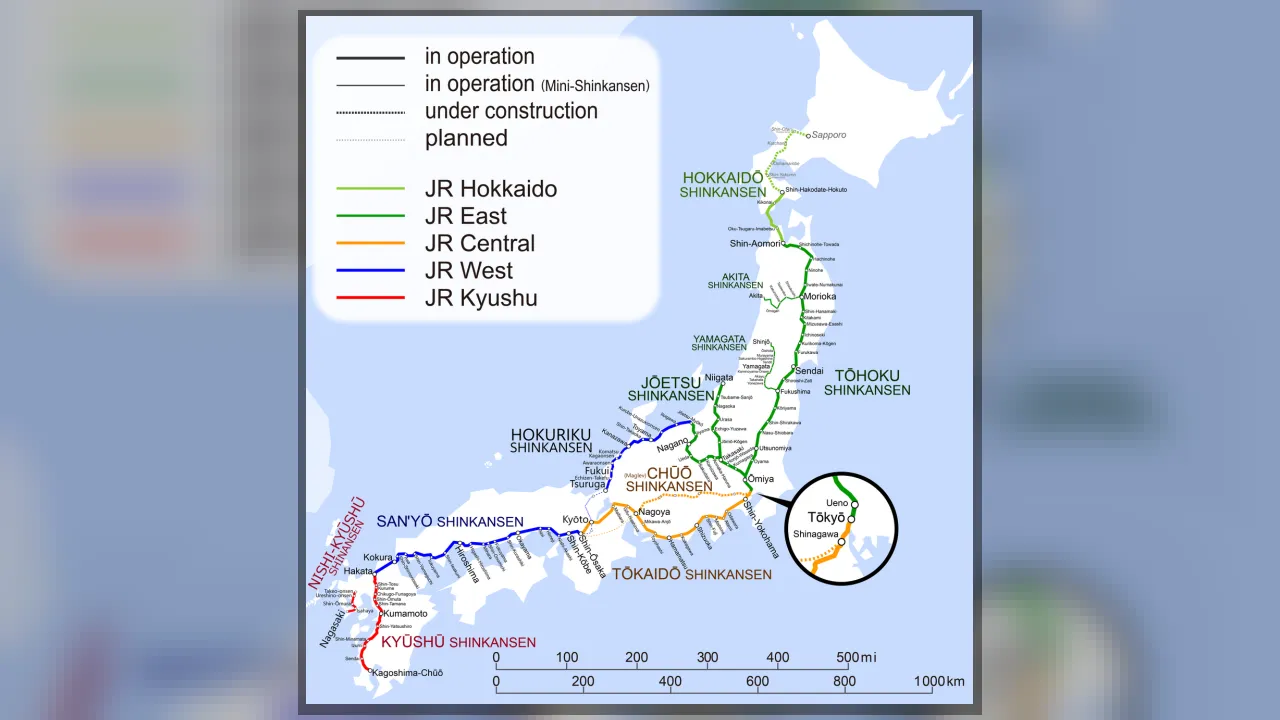
1. Which country opened the world's first bullet train line in 1964?
2. Why did people nickname this fast train a 'bullet train'?
🤯 Mind-Blowing Fact • Grade 2
Cleaning crews at Tokyo Station tidy an entire bullet train and turn every row of seats around in a famous 'seven-minute miracle'!
✨ Word Sparks (Grade 2 Glossary)
Tap 🔊 to hear
welded
Melted together into one smooth metal piece
dedicated
Set aside for only one special job
kingfisher
A diving bird with a sleek pointed beak
🪝
How did watching a diving bird help engineers make fast trains much quieter?
1
Racing Toward the Olympics
Zip! Just days before the 1964 Tokyo Olympics, a gleaming blue-and-white train glided out of Tokyo Station toward Osaka at 130 miles per hour. Japan called the new railway Shinkansen, cutting travel time nearly in half!
2
Tracks Built for Speed
Ordinary trains share tracks with slow freight cars and stop near road crossings. High-speed trains run on bridges and tunnels with smoothly rails and gentle curves so riders feel almost no bumps.
3
Learning From a Bird's Beak
When faster trains blasted out of narrow tunnels, trapped air made a loud boom! Bird-watching engineer Eiji Nakatsu copied the long narrow beak of a bird so the train's nose slipped quietly through tunnels.
1. Why did engineer Eiji Nakatsu shape a bullet train nose like a kingfisher's beak?
2. Why don't bullet trains ever have to wait for cars at street intersections?
🤯 Mind-Blowing Fact • Grade 3
Special seismometers stationed along Japan's coast detect earthquake tremors seconds before shaking arrives and automatically cut power to apply bullet train brakes!
✨ Word Sparks (Grade 3 Glossary)
Tap 🔊 to hear
aerodynamic
Shaped so air flows past with little drag
pantograph
A hinged roof arm touching overhead power wires
biomimicry
Solving human engineering problems by copying nature
🪝
Why do bullet trains spread small electric motors under almost every car instead of using one heavy engine in front?
1
A Bold Bet on Rail
Back in the 1950s, many experts thought airplanes and highways would make passenger trains obsolete. Chief engineer Hideo Shima and railway leader Shinji Sogo disagreed, opening Japan's Tokaido Shinkansen on October 1, 1964.
2
Power Under Every Car
Instead of one heavy locomotive tugging unpowered coaches, most bullet trains use distributed traction. Roof arms called draw electricity from overhead wires to spin compact motors beneath many cars at once, allowing rapid acceleration and gentler track wear.
3
Biomimicry Stops Sonic Booms
As speeds climbed toward 186 miles per hour, trains acted like pistons pushing compressed air waves ahead through narrow tunnels. Copying how a kingfisher plunges from thin air into dense water without a splash eliminated thunderous tunnel booms and trimmed energy use.
4
High-Speed Networks Worldwide
Soon France launched its fast TGV in 1981, followed by Germany's ICE, Spain's AVE, and China's vast high-speed network. Automatic train computers and earthquake sensors keep high-speed rail among the safest, cleanest ways to travel.
1. How does a bullet train draw electricity while speeding down the track?
2. What is one big advantage of placing electric motors under many cars instead of using one heavy front locomotive?
🤯 Mind-Blowing Fact • Grade 4
On April 3, 2007, a specially tuned French TGV test train running on steel wheels and welded steel rails reached an astonishing world record of 357.2 miles per hour (574.8 km/h)!
✨ Word Sparks (Grade 4 Glossary)
Tap 🔊 to hear
catenary
Overhead wire system kept taut above train tracks
traction
Pulling grip between powered wheels and steel rails
shockwave
A sharp burst of compressed air moving fast
🪝
How do welded rails, wide curves, and computer cab signals let steel wheels safely cruise at 200 miles per hour?
1
Reinventing the Railway From Scratch
Stand on a platform in Kyoto or Lyon as a 400-ton electric train whispers past faster than a small airplane flies! When Hideo Shima designed Japan's 1964 Tokaido Shinkansen, he realized speed required reinventing the entire system—eliminate every road crossing, widen curves to radii of several miles, and weld steel rails into seamless ribbons.
2
Distributed Traction and Regenerative Braking
In electric multiple-unit designs, motors sit beneath nearly every coach. When slowing down from 300 kilometers per hour, those same motors flip into electrical generators—creating magnetic resistance that slows the wheels smoothly while sending captured electricity back into the overhead wire to help power nearby trains.
3
Taming Micro-Pressure Waves
At speeds above 250 kilometers per hour, aerodynamic drag outweighs mechanical rolling resistance. Engineer Eiji Nakatsu's 15-meter kingfisher-inspired nose on the 500 Series Shinkansen gradually displaced tunnel air instead of compressing it into an explosive , cutting aerodynamic drag by roughly 30 percent.
4
Connecting Continents Cleanly
Because roadside signs blur past too fast for human eyes to read at 200 miles per hour, Automated Train Control transmits target speeds directly into the driver's cab computer. Today, over 35,000 miles of high-speed rail across Asia and Europe slash aviation emissions between major cities.
1. Why can't bullet train drivers rely on ordinary trackside signs at 200 miles per hour?
2. What happens to the kinetic energy of a bullet train during regenerative braking?
🤯 Mind-Blowing Fact • Grade 5
To silence wind roar from roof pantographs at 200 miles per hour, Shinkansen engineers copied tiny saw-toothed edges from silent-flying owl feathers!
✨ Word Sparks (Grade 5 Glossary)
Tap 🔊 to hear
viaduct
A long elevated bridge carrying tracks over valleys
inverter
Electronics controlling electric current frequency for motors
articulated
Joined by shared wheeled joints between train cars
🪝
Why does aerodynamic drag quadruple when train speed doubles, and how did high-speed rail engineers conquer physics at 350 km/h?
1
Precision Physics on Welded Steel
Gliding across elevated concrete between Tokyo and Osaka or Beijing and Shanghai, modern high-speed trains sustain 320 to 350 kilometers per hour (199–217 mph) while keeping cabin vibration gentler than a city bus. Achieving that stability requires continuous welded steel rail fastened onto rigid concrete slab tracks with curve radii exceeding four to seven kilometers and banked cant angles.
2
Hideo Shima's 1964 Systems Breakthrough
Before 1964, narrow-gauge bottlenecks choked Japan's busy Tokaido corridor. Chief engineer Hideo Shima and railway president Shinji Sogo integrated dedicated standard-gauge , 25-kilovolt alternating-current overhead electrification, cab-signaled Automatic Train Control, and lightweight electric multiple-unit (EMU) propulsion—carrying 100 million passengers within three years and billions since with zero crash fatalities.
3
Quadratic Drag and Tunnel Acoustics
Because aerodynamic drag grows with the square of velocity—and the mechanical power required to overcome air drag scales with velocity cubed—streamlining dominates high-speed efficiency above 250 km/h. Flush inter-car diaphragms, smooth underbody bogie shrouds, owl-feather serrations on roof pantographs, and 15-meter biomimetic kingfisher noses prevent explosive micro-pressure sonic booms at narrow mountain tunnel exits.
4
Power Electronics and Seismic Safety
Compact silicon-carbide (SiC) traction convert single-phase 25-kilovolt overhead power into variable-frequency three-phase current driving high-efficiency motors beneath nearly every coach while returning regenerative braking energy to the grid. Along earthquake fault zones, coastal P-wave seismometers trigger automatic emergency braking milliseconds after detecting fast primary tremors—halting trains before slower, destructive S-waves arrive.
5
Decarbonizing Intercity Corridors
France's TGV—which set the 574.8 km/h steel-wheel world speed record in April 2007—Europe's cross-border networks, and China's 45,000-kilometer high-speed grid showcase electrified rail's climate power. Per passenger-kilometer, electric bullet trains consume roughly one-fifth the energy of short-haul jetliners while linking walkable downtown stations directly.