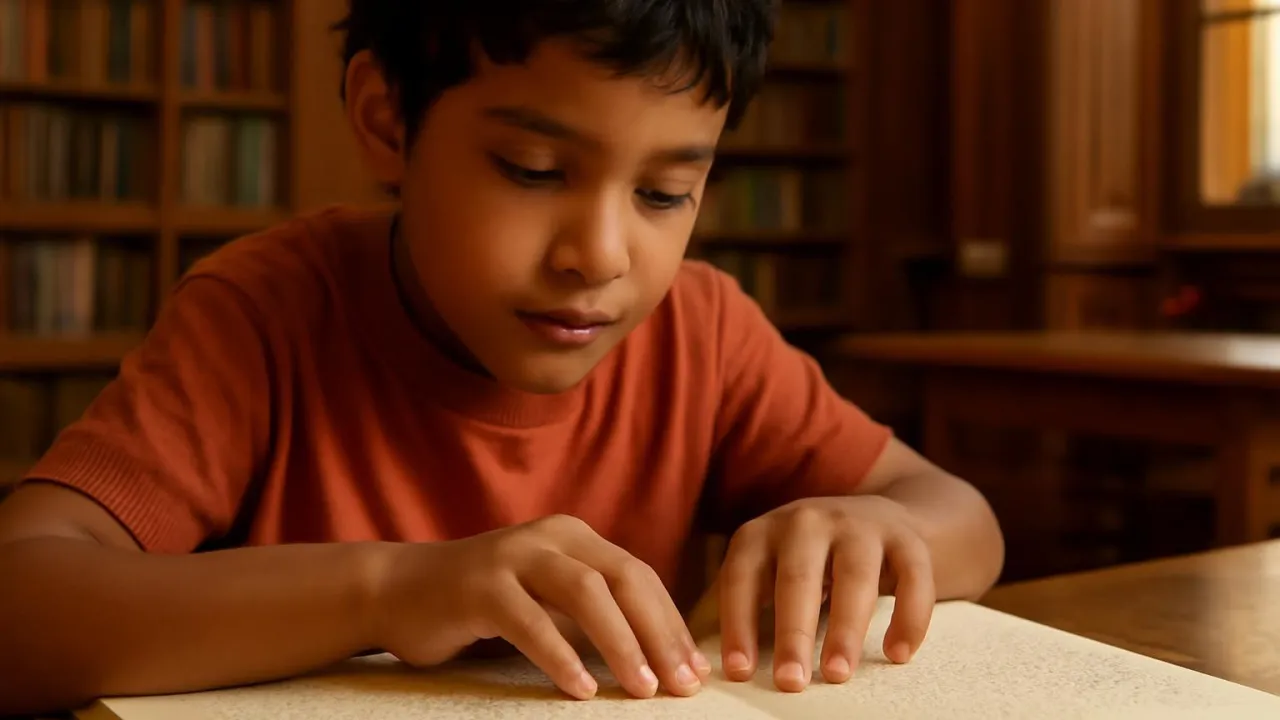
Some people can read Braille faster than most people can read printed words!
✨ Word Sparks (Grade 2 Glossary)
Tap 🔊 to hear
Pattern
A special way things are arranged
Blind
Someone who cannot see
Invent
To make something new
🪝
What would it be like to read by touch, not by sight?
1
Reading With Your Hands
Imagine closing your eyes and gliding your fingers over a page. You feel rows of little bumps called Braille dots. Each of dots stands for a letter or a number. People who are use these dots to read books and signs.
2
How Braille Works
Braille uses only six dots to make many letters and words. The dots are raised so fingers can feel them easily. People move their hands from left to right across the page. Braille lets them read stories, menus, and even music!
3
Louis Braille’s Big Idea
Louis Braille invented this system when he was just a teenager in France. He wanted to help people who could not see read and write. Today, Braille is used in schools, libraries, and elevators around the world.
1. How many dots are used to make each Braille letter?
2. Where can you find Braille today?
🤯 Mind-Blowing Fact • Grade 3
Braille music allows blind musicians to read and play complex songs by touch alone!
✨ Word Sparks (Grade 3 Glossary)
Tap 🔊 to hear
Tactile
Something you can feel with touch
Emboss
To press shapes into a surface
Cell
A small box for Braille dots
🪝
Can you imagine reading an entire story using only your sense of touch?
1
A World of Dots
Braille is a special system that lets people read and write using raised dots. Each Braille character is made from a of six dots arranged in two columns. By feeling different patterns of dots, readers can recognize letters, numbers, and even punctuation. This code opens up books and information for people who are blind or have low vision.
2
How Braille Is Made
Braille letters are created by pressing or embossing dots onto thick paper. The pattern of raised dots forms a code that fingers can sense easily. Braille can also be made with special machines called Braille writers. These tools help create pages quickly for schools, libraries, and even music sheets.
3
The Young Inventor
Louis Braille was just fifteen when he invented this reading system in France. He lost his sight as a child and wanted a better way to read. Inspired by a military code, he developed Braille so others could read with their fingertips. His invention changed education and daily life for millions of people.
4
Why Braille Matters
Braille gives people independence and access to information everywhere. It is used on signs, money, and even elevator buttons. Many libraries have books in Braille for children and adults. Thanks to Braille, everyone can enjoy reading and learning, no matter how they see the world.
1. What tool is often used to make Braille quickly?
2. Who inspired Louis Braille’s invention?
🤯 Mind-Blowing Fact • Grade 4
Modern Braille displays use tiny pins that move up and down, letting people read computer screens by touch!
✨ Word Sparks (Grade 4 Glossary)
Tap 🔊 to hear
Stylus
A tool for making Braille dots
Accessible
Easy for everyone to use
Impairment
A problem with a body sense or skill
🪝
What if you could decode secret messages just by feeling tiny bumps on a page?
1
The Ingenious Dot Code
Braille is a tactile writing system that uses patterns of raised dots to represent letters, numbers, and symbols. Each Braille character, or cell, is made up of six dots arranged in two columns of three. By moving their fingertips over these patterns, readers can quickly identify words and sentences. This system allows people who are blind or have low vision to access written information independently.
2
Engineering Braille
Braille is produced by embossing thick paper with a or a Braille typewriter, which creates durable, raised dots. The precise arrangement of dots in each cell forms a unique code for every letter or symbol. Braille can also be printed using advanced machines that create entire books or signs. This engineering makes it possible for Braille to be used in schools, public spaces, and even on currency.
3
Louis Braille’s Legacy
Louis Braille, who became blind as a child, invented this system in 1824 when he was only fifteen years old. He was inspired by 'night writing,' a code used by soldiers to communicate silently in the dark. Louis refined the idea, making it easier to learn and use for reading and writing. His invention revolutionized education for people with visual around the world.
4
Braille’s Global Impact
Today, Braille is used in over 130 countries and has been adapted for many languages. It appears on elevator buttons, medicine labels, and ATMs, making daily life more . Braille literacy opens doors to education, employment, and independence for millions of people. Thanks to this invention, everyone can enjoy books, music, and information, regardless of how they see.
Refreshable Braille displays can show an entire computer screen’s worth of text using moving pins and advanced software!
✨ Word Sparks (Grade 5 Glossary)
Tap 🔊 to hear
Embosser
A machine that presses Braille dots into paper
Matrix
A grid or pattern for arranging things
Inclusion
Making sure everyone can join in
🪝
Imagine a world where every book, sign, and screen could be read using only your sense of touch—how would that change your life?
1
A Revolutionary Tactile Code
Braille is a tactile reading and writing system that employs patterns of raised dots to encode letters, numerals, punctuation, and even music. Each Braille cell consists of six dots arranged in a 2-by-3 , allowing for 63 unique combinations. By gently gliding their fingertips over embossed pages, readers interpret these patterns as language, unlocking access to information without relying on sight. This system has transformed education, communication, and independence for people who are blind or have low vision.
2
Mechanics of Braille Production
Braille is created by embossing thick, durable paper with a stylus, slate, or specialized mechanical Braille writer. Modern production involves computerized and refreshable Braille displays, which use arrays of tiny pins that move up and down to form tactile characters. The precision engineering behind these devices ensures that each dot is evenly spaced and high enough to be read accurately by touch. Braille can be produced in over 130 languages, making it a truly global invention.
3
The Story of Louis Braille
Louis Braille, blinded as a child in early 19th-century France, was inspired by a military 'night writing' code designed for silent communication. At just fifteen, he refined this idea into a practical, efficient system for reading and writing, which he first introduced in 1824. Despite resistance from some educators, Braille’s method spread worldwide, eventually replacing less effective raised-letter systems. Today, his legacy endures in every tactile book, sign, and digital Braille device.
4
Braille’s Expanding Reach
Braille is now integrated into public infrastructure, including elevators, ATMs, and medication packaging, ensuring accessibility in daily life. Advances in technology have led to refreshable Braille displays, allowing users to read digital content from computers and smartphones by touch. Braille literacy is linked to higher employment rates and greater independence among blind individuals, highlighting its crucial role in social . Global organizations continue to promote Braille education and access as a human right.
5
The Future of Tactile Literacy
As digital technology evolves, new innovations like multi-line Braille e-readers and tactile graphics are broadening the possibilities for blind readers. Scientists are also exploring ways to make scientific diagrams, maps, and even art accessible through tactile printing. The Braille system’s adaptability ensures it will remain vital for communication, learning, and creativity for generations to come. Its impact demonstrates how inclusive design can empower millions and transform societies worldwide.