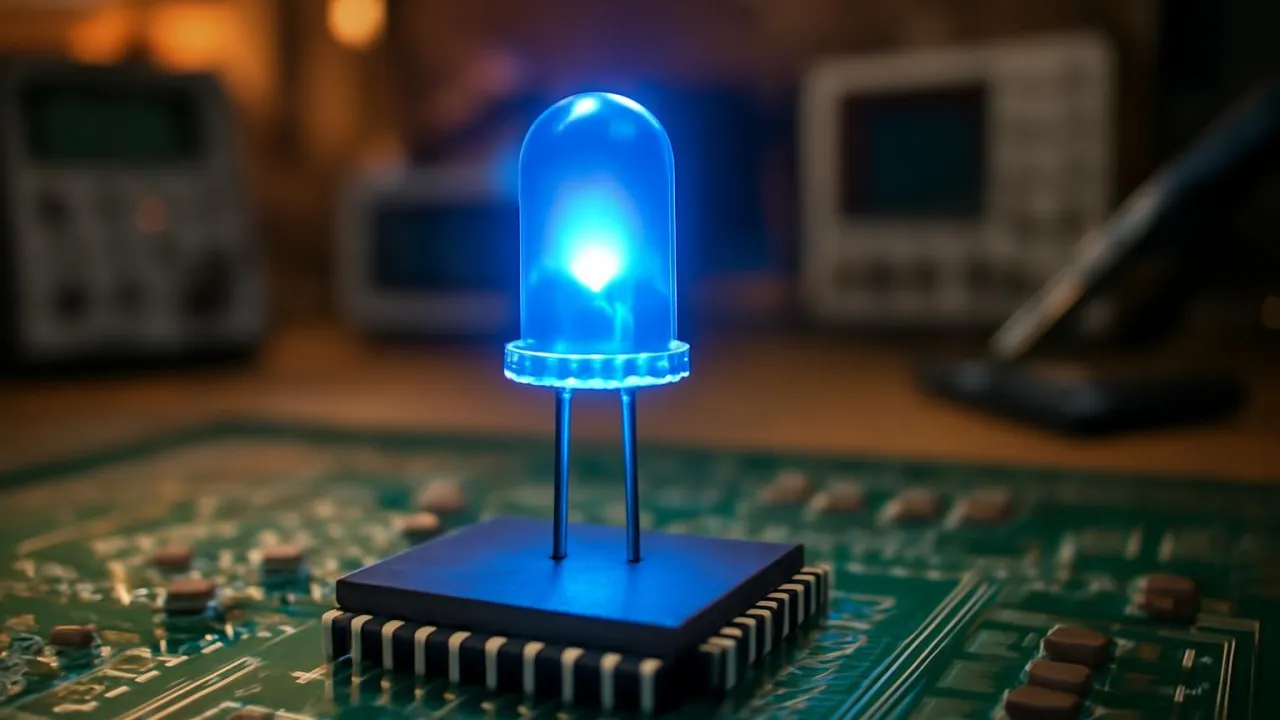
Blue LEDs helped make super-bright flashlights and colorful screens possible.
✨ Word Sparks (Grade 2 Glossary)
Tap 🔊 to hear
remote
A tool to control things far away
energy
Power that makes things work
bulb
A glass light that glows
🪝
Have you ever seen a tiny blue light shining on a toy?
1
The Magic of Blue Light
Blue LEDs are tiny lights that glow bright blue when turned on. They can be found in toys, nightlights, and even on your TV . These lights are small but very powerful.
2
How Blue LEDs Work
When electricity moves through a blue LED, it makes the light glow. Blue LEDs do not get hot, so they are safe to touch. They also use much less power than old light .
3
Why Blue LEDs Matter
Blue LEDs helped people make white LED lights for homes. With blue, red, and green LEDs, we can make any color we want. Blue LEDs help save and make bright screens.
1. Why are blue LEDs special compared to old bulbs?
2. What can blue LEDs help create when mixed with other colors?
🤯 Mind-Blowing Fact • Grade 3
Blue LEDs are so important, their inventors won a Nobel Prize in 2014.
✨ Word Sparks (Grade 3 Glossary)
Tap 🔊 to hear
gallium nitride
A special crystal that glows blue
electroluminescence
Light made by electricity in a material
Nobel Prize
A big award for great ideas
🪝
Imagine the world before bright blue lights—how did we make white light?
1
The Search for Blue
For many years, inventors could make red and green LEDs, but blue was missing. Without blue, it was impossible to create bright white LED light. Scientists in Japan worked hard to solve this glowing puzzle.
2
How Blue LEDs Work
A blue LED is made from a special material called . When electricity flows through it, the material vibrates and gives off blue light. This process is called , and it does not waste much energy.
3
Lighting Up the World
With blue LEDs, inventors could finally mix red, green, and blue to make white light. This breakthrough changed how we light homes, schools, and even car headlights. Blue LEDs also made phone and TV screens much brighter.
4
A Prize-Winning Invention
The scientists who invented the blue LED won the in Physics. Their work helped save energy all over the world. Blue LEDs are now used in signs, flashlights, and even in space! This tiny light truly shines everywhere.
Blue LEDs are so efficient, they can last over 20 years in some devices.
✨ Word Sparks (Grade 4 Glossary)
Tap 🔊 to hear
photon
A tiny particle of light
efficient
Using little energy to work well
pollution
Harmful stuff in air, water, or land
🪝
Can you picture a world where streetlights and screens glow only red and green?
1
Cracking the Blue Code
For decades, scientists could create red and green LEDs, but blue remained a stubborn mystery. Without blue, it was impossible to produce bright, energy-saving white LED light. In the early 1990s, Japanese researchers Isamu Akasaki, Hiroshi Amano, and Shuji Nakamura finally solved the puzzle by using gallium nitride, a tough crystal that could emit blue light when electrified.
2
The Science of Blue Glow
Blue LEDs work by sending electricity through gallium nitride, causing the atoms to vibrate and release energy as blue . This process, called electroluminescence, is highly because very little energy is wasted as heat. Unlike old light bulbs, blue LEDs stay cool and last for thousands of hours.
3
Changing the World’s Lights
The invention of blue LEDs allowed engineers to combine red, green, and blue light to create pure white LED lighting. This breakthrough led to energy-saving bulbs, bright phone and TV screens, and even powerful car headlights. Blue LEDs help reduce electricity use and lower worldwide.
4
A Nobel-Worthy Spark
In 2014, the inventors of the blue LED received the Nobel Prize in Physics for their groundbreaking work. Their discovery transformed lighting and electronics everywhere, making technology more and accessible. Today, blue LEDs shine in everything from traffic signals to spacecraft, proving that even tiny inventions can make a huge difference.
A single blue LED can shine for over 50,000 hours—more than five years of nonstop light.
✨ Word Sparks (Grade 5 Glossary)
Tap 🔊 to hear
semiconductor
A material that controls electricity flow
bandgap
The energy needed for electrons to jump and make light
phosphor
A substance that glows when hit by light
🪝
What if one tiny blue light could revolutionize the world’s energy use?
1
The Final Piece of the LED Puzzle
For decades, red and green LEDs illuminated electronics, but the blue LED remained elusive, blocking the path to efficient white light. In the early 1990s, Japanese scientists Isamu Akasaki, Hiroshi Amano, and Shuji Nakamura engineered a breakthrough using gallium nitride (GaN), a material with a wide capable of emitting high-energy blue photons. Their persistent research overcame immense technical hurdles, such as growing pure GaN crystals and creating reliable p-n junctions for stable light emission.
2
How Blue LEDs Work: The Science Behind the Glow
Blue LEDs function by passing an electric current through layers of gallium nitride and related compounds, causing electrons and holes to recombine at the junction. This recombination releases energy in the form of blue photons—a process known as electroluminescence. Unlike incandescent bulbs, which waste most energy as heat, blue LEDs convert electricity directly into light with remarkable efficiency, often exceeding 80% luminous efficacy.
3
Transforming Global Lighting and Technology
The invention of the blue LED enabled the creation of true white LED lighting by combining blue LEDs with yellow or mixing red, green, and blue LEDs. This innovation has revolutionized lighting, reducing global electricity consumption, lowering carbon emissions, and providing affordable, long-lasting illumination to communities worldwide. Blue LEDs also power the vibrant displays in smartphones, computers, and televisions, and are essential in medical devices and optical communications.
4
A Nobel-Winning Impact on Science and Society
In 2014, Akasaki, Amano, and Nakamura were awarded the Nobel Prize in Physics for their pioneering work. Their discovery not only transformed the lighting industry but also sparked new research in quantum optics, environmental science, and advanced manufacturing. Blue LEDs have become a cornerstone of sustainable technology, supporting everything from energy-efficient buildings to high-speed data transfer.
5
The Ongoing Evolution of Blue LED Technology
Today, engineers are developing even more advanced blue LEDs using nanotechnology and new materials to achieve higher brightness and lower energy use. Blue LEDs are now being used in water purification systems and innovative medical treatments, demonstrating their versatility and importance. The journey from a tiny blue spark to a global revolution shows how science and perseverance can light up the world, one photon at a time.