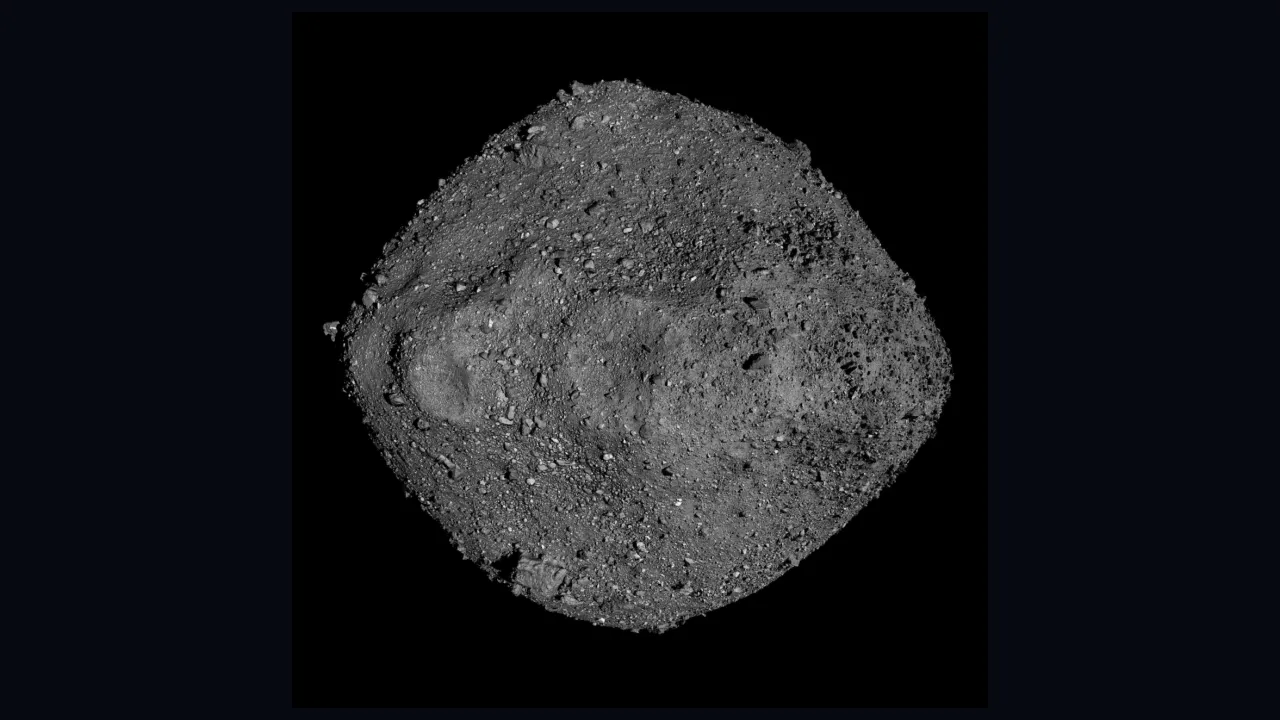
⚡ Cosmic SparkPreserves ancient carbon molecules and water-rich clays from before Earth was born
🤯 Mind-Blowing Fact • Grade 1
A third-grader named Michael Puzio won a contest to name Bennu after a mythical Egyptian heron bird because the spacecraft's arm looked like a bird's neck!
✨ Word Sparks (Grade 1 Glossary)
Tap 🔊 to hear
sample
A small piece collected for scientists to study
capsule
Protective container returning treasures safely to Earth
boulder
A large rock resting on the ground
🪝
Can a robot reach out in space, tag an asteroid, and bring rocks home?
1
Shaped Like a Toy Top
Meet Bennu, a dark rocky asteroid as tall as a giant skyscraper! It spins through space shaped just like a diamond toy top.
2
High-Five from a Robot
NASA sent a smart robot spacecraft named OSIRIS-REx to visit Bennu. Its long arm tapped the rocky ground and scooped up pebbles!
3
Parachuting Home to Earth
In 2023, a parachuted gently into the Utah desert carrying real space rocks from Bennu!
1. What everyday toy is Bennu Asteroid shaped like?
2. What did NASA's OSIRIS-REx spacecraft bring back from Bennu in 2023?
🤯 Mind-Blowing Fact • Grade 2
Bennu's pebbles were packed so loosely that had OSIRIS-REx not fired its backup thrusters, the spacecraft would have sunk right down into the asteroid like a plastic ball pit!
✨ Word Sparks (Grade 2 Glossary)
Tap 🔊 to hear
thruster
Small rocket engine steering a spacecraft gently
nitrogen
Clean, safe gas used to stir dust
skyscraper
A super-tall city building with many floors
🪝
Why did NASA's robot sink into Bennu like a ball pit when it tapped the surface?
1
Not One Solid Rock
Discovered in 1999, Bennu orbits the Sun near Earth's path every fourteen months. Measuring about 1,610 feet across, it isn't one solid boulder at all—it is a 'rubble pile' of loose rocks and dust held gently together by tiny gravity!
2
Surprise Boulders Everywhere
When NASA's OSIRIS-REx arrived in 2018, engineers expected smooth sandy beaches. Instead, rugged boulders covered Bennu from pole to pole, and tiny pebbles occasionally popped right off its surface into space!
3
Touch-and-Go at Nightingale
In October 2020, OSIRIS-REx steered into rocky Nightingale Crater, puffed gas to stir up gravel, and sank softly before backing away with a overflowing treasure of 4.3 ounces of space rock!
1. What happened when OSIRIS-REx tapped Bennu's surface in 2020?
2. Who chose the name 'Bennu' for this asteroid?
🤯 Mind-Blowing Fact • Grade 3
OSIRIS-REx scooped up so many pebbles at once that a rock jammed its collector flap slightly open, prompting engineers to stow the overflowing head early before precious dust drifted away!
✨ Word Sparks (Grade 3 Glossary)
Tap 🔊 to hear
amino acid
Tiny molecule living things use to build proteins
autonomous
Steering itself smartly without human remote control
phosphate
Mineral compound essential for DNA and cells
🪝
What ingredients of life did scientists discover hiding inside Bennu's jet-black pebbles?
1
Born in the Main Belt
Billions of years ago, Bennu belonged to a much larger wet, carbon-rich asteroid between Mars and Jupiter. A giant collision shattered that parent world, and loose fragments pulled back together into a 1,610-foot rubble pile before drifting into an orbit near Earth.
2
Active Asteroid Plumes
Orbiting Bennu in 2019, OSIRIS-REx caught a shocking sight: dozens of marble-sized pebbles shooting off the asteroid's surface like miniature meteor showers! Heating and cooling during Bennu's 4.3-hour spin cracks rocks apart and flicks pebbles into space.
3
Precision Tagging at Nightingale
Using vision navigation, OSIRIS-REx threaded between house-sized boulders to touch Nightingale Crater on October 20, 2020, gathering 121.6 grams—double its mission goal—and dropping the sealed capsule onto Utah on September 24, 2023.
4
Carbon, Water Clays, and Phosphates
Clean-room labs found Bennu's coal-dark grains brimming with carbon organics, , water-bearing clay minerals, and bright crusts from ancient salty water!
1. Why did OSIRIS-REx have to steer itself autonomously during its touchdown on Bennu?
2. What do the water-bearing clays and phosphate crusts inside Bennu's rocks prove?
🤯 Mind-Blowing Fact • Grade 4
After dropping off its Bennu sample capsule above Earth in September 2023, the healthy OSIRIS-REx spacecraft fired its engines for a brand-new bonus mission—renamed OSIRIS-APEX—to study asteroid Apophis in 2029!
✨ Word Sparks (Grade 4 Glossary)
Tap 🔊 to hear
YORP effect
Sunlight spin-up reshaping small uneven asteroids
contaminate
Spoil a pure sample with outside germs
evaporite
Salt mineral left behind when water dries
🪝
Why couldn't scientists simply wait for a piece of Bennu to fall to Earth as a meteorite?
1
Why Sample Return Beats Meteorite Hunting
Fragile, carbon-rich space rocks like 101955 Bennu crumble into dust balls when slamming into Earth's atmosphere at hyper-speed. Even if a tiny fragment survives, Earth rain and soil microbes its delicate chemistry within hours! Launching NASA's OSIRIS-REx mission in 2016 ensured scientists could bring back 121.6 grams of untouched, pre-Earth material sealed inside pure nitrogen.
2
How Sunlight Shapes a Spinning Top
Bennu's distinctive equatorial ridge comes from the : sunlight warming its uneven boulders and radiating away as heat slowly spun the asteroid faster and faster over millions of years. Centrifugal force caused loose gravel from its poles to landslide downhill toward the equator, sculpting a diamond spinning-top profile.
3
Tracking Orbit Shifts for Planetary Defense
Because Bennu crosses Earth's orbit every six years and makes close passes in 2135 and 2182, OSIRIS-REx measured its position and spin to within feet! Two years of close radio tracking gave astronomers ultra-precise measurements of the gentle thermal Yarkovsky push—where warm afternoon boulders radiate infrared heat like tiny thrusters—helping planetary defense teams predict Bennu's path for centuries.
4
Ancient Brines Inside Returned Grains
Microscopic analyses of the 2023 Utah capsule samples revealed fourteen of the twenty protein-building amino acids, all five chemical nucleobases of DNA and RNA, plus delicate salt minerals formed as ancient underground briny ponds slowly dried out 4.5 billion years ago!
1. How did Bennu get its bulging diamond or spinning-top shape around its equator?
2. Why was bringing back sealed Bennu samples directly from space far better than finding meteorites on the ground?
🤯 Mind-Blowing Fact • Grade 5
Finding an equal 50-50 mix of 'left-handed' and 'right-handed' amino acids inside Bennu's rocks proved zero Earth life contaminated the capsule—because biology on Earth uses almost exclusively left-handed amino acids!
✨ Word Sparks (Grade 5 Glossary)
Tap 🔊 to hear
regolith
Blanket of loose dust and broken rock
nucleobase
Chemical letter forming the code in DNA
presolar
Ancient stardust formed before our Sun existed
🪝
How did 121.6 grams of crumbly black gravel from 101955 Bennu preserve an evaporated extraterrestrial ocean world?
1
From Main-Belt Collision to Near-Earth Rubble Pile
Discovered in September 1999 by the Lincoln Near-Earth Asteroid Research (LINEAR) survey, 101955 Bennu is a 492-meter B-type carbonaceous asteroid with a bulk density of just 1,190 kilograms per cubic meter—barely denser than liquid water! Roughly 40 to 50 percent of Bennu's interior consists of empty pore spaces between boulders re-accumulated after a catastrophic collision shattered a 100-kilometer parent asteroid in the inner Main Belt roughly a billion years ago, before the Yarkovsky thermal drift nudged Bennu through the nu-6 secular resonance into a near-Earth Apollo orbit.
2
Microgravity Surprises: Particle Ejection and Zero Cohesion
During OSIRIS-REx's two-year orbital reconnaissance (2018–2020), navigation cameras caught an unexpected phenomenon: Bennu is an 'active asteroid' sporadically launching centimeter-scale pebbles into suborbital arcs or escape trajectories, driven by thermal fracturing across day-night swings of 250 kelvins and micrometeoroid strikes. When the Touch-And-Go Sample Acquisition Mechanism (TAGSAM) contacted Nightingale Crater on October 20, 2020, surface exhibited near-zero cohesion, behaving like a frictionless fluid under 6 micro-g gravity.
3
Precision Astrometry and the 2135 Gravitational Keyhole
Radio-science tracking during OSIRIS-REx's proximity operations measured the Yarkovsky acceleration to sub-millimeter-per-second-squared precision, constraining Bennu's September 2135 close flyby inside the Moon's orbit and pinning its cumulative impact probability through the year 2300 at a tiny 0.057 percent (roughly 1 in 1,750).
4
Prebiotic Chemistry and Evaporite Brines
Delivered to Utah's Dugway Proving Ground on September 24, 2023—the largest asteroid sample ever returned by NASA at 121.6 grams—Bennu's pristine stunned cosmochemists. Alongside silicon carbide stardust grains older than the Sun, laboratories identified hydrated magnesium-sodium phosphates, sodium carbonate ('trona'), halite, all five canonical DNA/RNA , and a racemic (50-50 left- and right-handed) suite of fourteen proteinogenic amino acids.
5
Blueprint for Early Earth Seed Delivery
That complete evaporite mineral sequence proves alkaline, salty brines once percolated and slowly evaporated inside Bennu's icy outer-Solar-System ancestor—demonstrating how carbonaceous asteroids seeded young terrestrial worlds with water, phosphorus, and prebiotic building blocks.