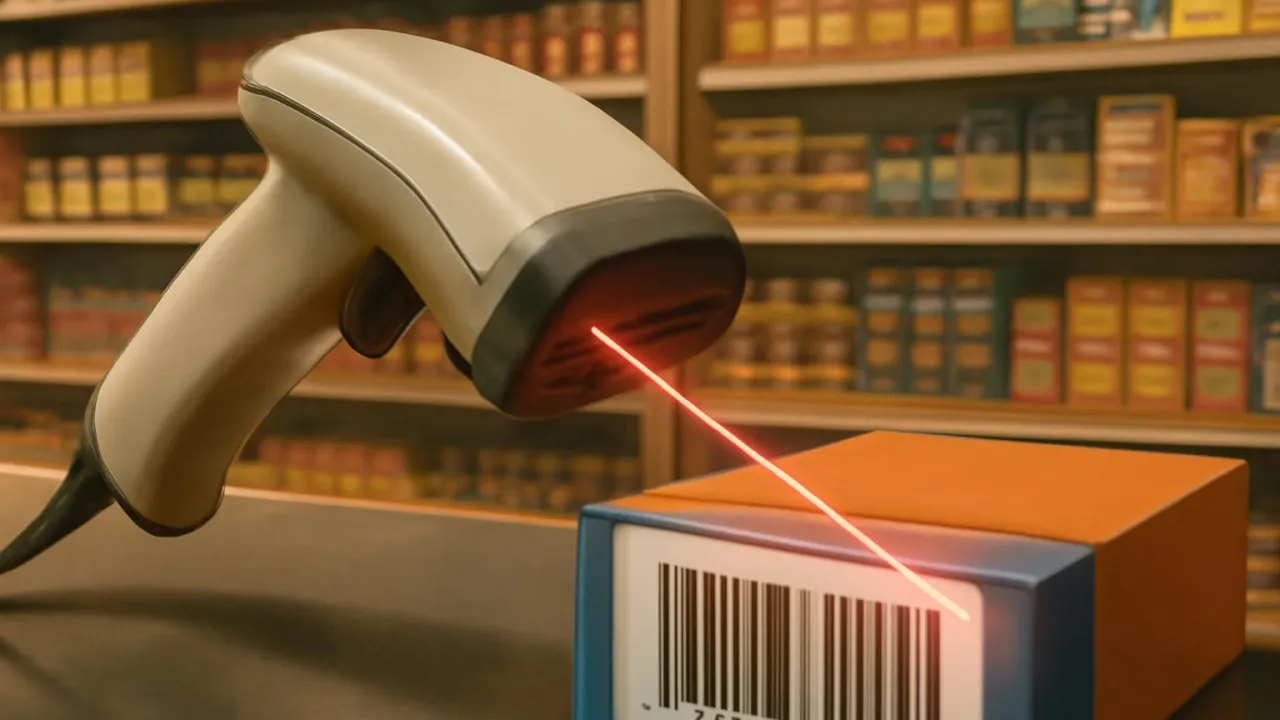
Barcodes can hold numbers, letters, and even website links!
✨ Word Sparks (Grade 2 Glossary)
Tap 🔊 to hear
reflect
To bounce light back
computer
A smart machine that stores information
cashier
A person who helps you pay
🪝
Have you ever heard the beep at checkout?
1
Stripe Codes Everywhere
Barcodes are black and white stripes on things you buy. Each barcode is a special code, and the scanner uses a red laser to read it. When you hear a beep, the scanner has found the code.
2
Fast and Easy Shopping
People use barcode scanners in stores to check prices quickly. The scanner reads the stripes and tells the what you are buying. This helps work faster and makes shopping easier for everyone.
3
How Does It Work?
The scanner shines a red laser on the barcode. The white and black lines light differently, so the scanner can understand the code. This helps find the price and name of the item right away.
1. What does a barcode scanner use to read stripes?
2. Why do stores like barcode scanners?
🤯 Mind-Blowing Fact • Grade 3
Some barcodes can be read from over a foot away!
✨ Word Sparks (Grade 3 Glossary)
Tap 🔊 to hear
optical
About how light is used
pattern
A repeated design or shape
absorb
To take in, not bounce back
🪝
What if every product could tell its story with stripes?
1
The Mystery of the Stripes
Barcodes look like simple black and white lines, but they hold secret information. Each barcode is made up of thick and thin lines arranged in a special . When a product passes over a scanner, a red laser shines on the barcode and creates a reflection. The scanner reads the pattern and turns it into numbers the computer understands.
2
How the Scanner Reads
The laser moves quickly over the barcode, sensing how the lines reflect light. White spaces reflect more light, while black lines it, creating a of light and dark. This pattern is called encoding, and it lets the scanner know exactly which product it sees. The computer then matches the code to the product’s name and price.
3
A Shopping Revolution
Before barcodes, cashiers had to type every price by hand. Barcodes and scanners made shopping much faster and more accurate. Stores could track products, update prices, and even reorder items automatically. This invention changed the way people shop all over the world.
4
From Gum to Groceries
The very first barcode was scanned on a pack of Wrigley’s gum in 1974. Today, you can find barcodes on almost everything, from books to toys and even zoo animals’ tags. Barcodes help people keep track of things quickly and easily.
1. Why do black lines absorb more light than white spaces?
2. What does the scanner turn the barcode pattern into?
🤯 Mind-Blowing Fact • Grade 4
The longest barcode ever used was over 2 feet long, on a giant shipping container!
✨ Word Sparks (Grade 4 Glossary)
Tap 🔊 to hear
inventory
A list of all the items in a store
database
A computer’s big list of information
revolutionized
Changed something in a big, new way
🪝
Imagine if every item in the world could be instantly recognized by a secret code.
1
The Birth of Barcodes
In the 1940s, Norman Joseph Woodland and Bernard Silver wanted to help grocery stores work faster. They created a system of black and white stripes that could hold information about products. Their idea was inspired by Morse code, and it took years for technology to catch up. Finally, in 1974, the first commercial barcode was scanned using a laser at a supermarket in Ohio.
2
How Barcode Scanners Work
Barcode scanners use a red laser beam to sweep across the barcode’s surface at checkout. The black lines absorb the laser’s light, while the white spaces reflect it back to a sensor. This creates a pattern of dark and light signals, which the scanner converts into digital data using optical encoding. The computer then matches this data to the product’s information in its .
3
Changing the World of Shopping
Before barcodes, cashiers had to enter prices by hand, which took time and led to mistakes. Barcodes and scanners shopping by making checkout faster and more accurate. Stores could now track , reorder products automatically, and even prevent theft more easily. This technology spread quickly to other industries, like libraries and hospitals.
4
Barcodes Everywhere
Today, barcodes come in many shapes, including QR codes that store website links. They are found on almost every product, as well as on tickets, books, and even hospital bracelets. Barcodes make it possible to organize, track, and share information quickly all around the world.
1. How does a barcode scanner turn stripes into data?
2. Why did stores want to use barcodes?
🤯 Mind-Blowing Fact • Grade 5
Over 5 billion barcode scans happen every day around the world—almost one million every second!
✨ Word Sparks (Grade 5 Glossary)
Tap 🔊 to hear
optical encoding
Turning information into light patterns
logistics
Moving things from one place to another
RFID
Radio waves used to track things
🪝
What if a simple pattern of stripes could unlock a world of information in a single blink?
1
Inventing the Universal Product Code
In the late 1940s, Norman Joseph Woodland and Bernard Silver set out to solve a big problem: how could stores quickly identify every product at checkout? Inspired by Morse code and drawing lines in the sand, Woodland sketched the first barcode concept. After years of development, the Universal Product Code (UPC) was introduced in 1974, marking the first time a laser scanner read a barcode on a pack of Wrigley’s gum in Ohio. This event launched a new era in retail and .
2
The Science Behind the Stripes
A barcode is a form of optical data encoding, where information is represented by a specific pattern of black and white lines. When a barcode scanner shines a laser beam across these stripes, the black lines absorb light while the white spaces reflect it. The sensor inside the scanner detects the changing pattern of reflected light, converting it into an electrical signal. This signal is then decoded into numbers and letters, which computers use to identify the product and retrieve its price and details from a database.
3
Engineering Precision and Efficiency
Barcode scanners use precise optics and moving mirrors to sweep the laser beam rapidly across the code. The width and spacing of each line are carefully engineered, allowing even small barcodes to carry up to 12 digits of information. Modern scanners can read barcodes from various angles and distances, and advanced models can even read damaged or partially obscured codes. This engineering ensures reliability and speed in busy environments like supermarkets and warehouses.
4
Transforming Global Commerce
The adoption of barcodes revolutionized not only shopping but also global supply chains, manufacturing, and medicine. Barcodes allow stores to track inventory in real time, automate reordering, and reduce human error at checkout. Hospitals use barcodes to match patients with medications, and airlines use them to track luggage worldwide. The technology has grown to include QR codes, which can store thousands of characters and link directly to digital content.
5
The Future of Barcodes
Today, barcodes are evolving with new technologies like chips and smartphone scanning apps. While the basic principle of remains, future systems may use invisible inks, color codes, or even DNA barcoding for biological samples. The simple idea of using patterns to store and share information continues to shape how people connect, shop, and learn in the digital age.