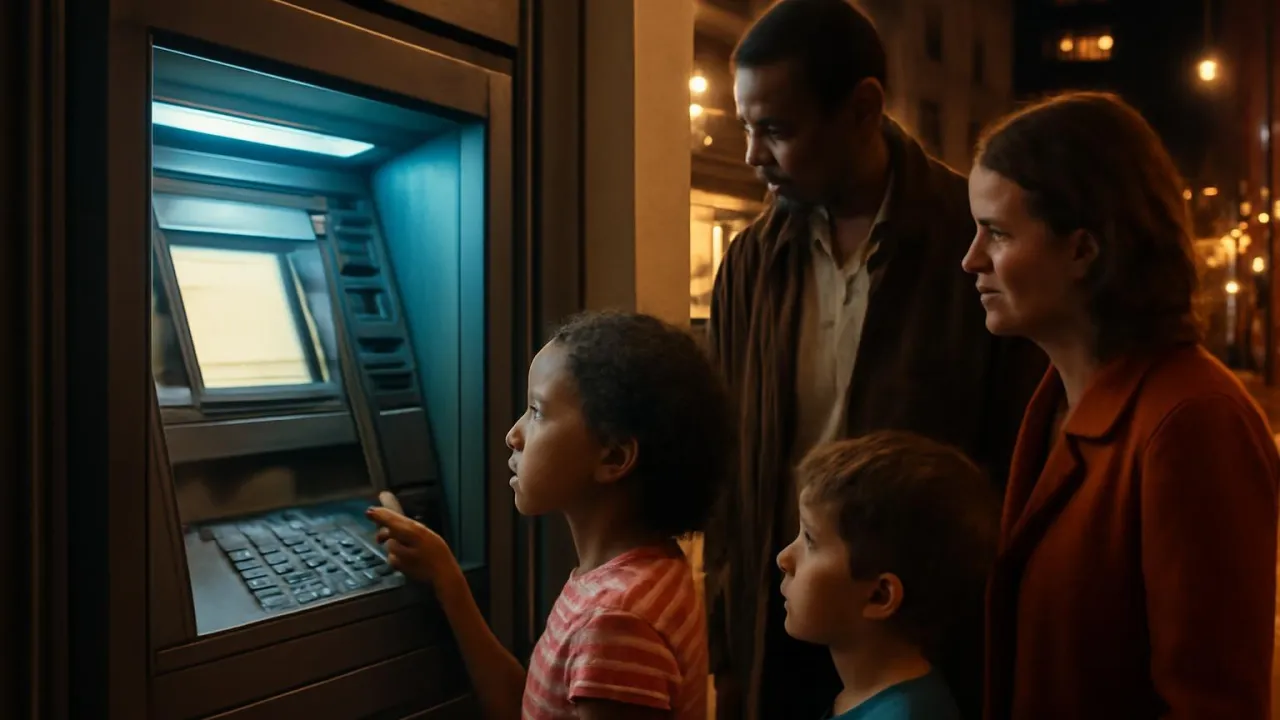
There are over 3 million ATMs in use around the world today!
✨ Word Sparks (Grade 3 Glossary)
Tap 🔊 to hear
PIN
A secret number for your card
magnetic stripe
A black strip that stores data
vault
A strong, locked box for money
🪝
Imagine hearing a soft whir and a click—could a machine really hand you cash?
1
A New Way to Get Money
Long ago, people had to visit banks during short hours to get money. In 1967, the first Automated Teller Machine, or ATM, changed everything. With a beep and a whir, it let people withdraw cash any time. This invention made banking faster and more convenient for everyone.
2
How the ATM Works
An ATM uses special technology to keep your money safe. When you insert your bank card, the machine reads the . You enter a , or secret code, to prove your identity. The ATM checks your account, then uses a secure to dispense cash.
3
Engineering and Security
The ATM is built with strong metal and special locks to prevent theft. Inside, it uses sensors and motors to count bills and deliver the right amount. The machine connects to banking computers using secure networks, keeping your information private. This engineering makes sure money is safe and only given to the right person.
4
A Worldwide Invention
Today, ATMs are found in nearly every country around the globe. They help travelers get local money and let people access their accounts anytime. The ATM’s invention made banking more accessible for millions. Its technology keeps improving to help people use money safely and easily.
The first ATMs used special paper vouchers instead of plastic cards for withdrawals.
✨ Word Sparks (Grade 4 Glossary)
Tap 🔊 to hear
encrypted
Coded to keep information secret
mechanism
A set of moving machine parts
fraud
Tricking a system to steal money
🪝
What if you could get cash at midnight, anywhere in the world, just by using a secret code?
1
The ATM Revolution
Before ATMs, people could only withdraw cash by visiting a bank during business hours and waiting in long lines. In 1967, John Shepherd-Barron invented the first ATM in London, forever changing how people accessed their money. The ATM, short for Automated Teller Machine, allowed customers to get cash instantly using a card and a personal identification number (PIN). This invention made banking more convenient and accessible for everyone.
2
How Does an ATM Work?
When you insert your bank card, the ATM reads the magnetic stripe or chip to identify your account. After you enter your PIN, the machine sends an message to your bank to check if you have enough funds. If approved, the ATM uses motors and sensors to count and dispense the correct bills from a secure vault. The entire process is designed to be quick, private, and highly secure.
3
Engineering and Security Features
ATMs are built with reinforced steel and advanced locking to protect the cash inside. They use computer networks to keep your account information safe from hackers. Many ATMs include cameras, alarm systems, and anti-skimming devices to prevent theft and . The engineering behind ATMs combines mechanics, electronics, and cybersecurity to ensure that only the right person can access the money.
4
Impact on Society and Banking
ATMs have made banking services available 24/7, helping people in cities and rural areas alike. They support millions of transactions every day, making it easier for people to travel, shop, and manage their money. The invention of the ATM inspired other self-service machines, like ticket kiosks and check-in stations. Today, ATMs continue to evolve, offering new features like touchscreens, multiple languages, and even video banking.
Some modern ATMs can recognize your face or fingerprint instead of needing a PIN.
✨ Word Sparks (Grade 5 Glossary)
Tap 🔊 to hear
biometric
Uses your body, like face or finger, for ID
encrypted
Turned into secret code for safety
inclusion
Making sure everyone can take part
🪝
Picture a humming machine on a city street—how does it instantly deliver cash, day or night, almost anywhere in the world?
1
A Banking Breakthrough: The Birth of the ATM
In 1967, John Shepherd-Barron unveiled the world’s first Automated Teller Machine (ATM) outside a London bank, forever transforming how people accessed their money. Before this invention, customers were limited to banking hours and often waited in long lines for a teller. The ATM’s introduction allowed people to withdraw cash using a card and a personal identification number (PIN), anytime and almost anywhere. This breakthrough marked the beginning of self-service banking, making financial services more accessible and convenient for millions worldwide. The ATM’s success quickly inspired banks across the globe to adopt similar technology.
2
Engineering Marvel: How the ATM Operates
When a user inserts a bank card, the ATM reads the magnetic stripe or embedded chip, extracting account data. After the user enters their PIN, the machine securely transmits this information to the bank’s central computer for verification. If the request is approved, the ATM’s internal mechanisms—comprising motors, rollers, and sensors—precisely count and dispense bills from a heavily armored vault. Each transaction is logged digitally, and the ATM prints a receipt or displays the balance on a screen. This complex process combines mechanical engineering, computer science, and secure networking to ensure speed, accuracy, and safety.
3
Security Innovations and Challenges
Security is a top priority in ATM design, as these machines hold large sums of cash and sensitive data. Modern ATMs use reinforced steel, time-locked vaults, and alarm systems to deter theft. They rely on data transmission, anti-skimming technology, and surveillance cameras to protect against fraud and hacking. authentication, such as fingerprint or facial recognition, is being introduced in some regions for even greater security. Despite these measures, criminals continually develop new methods to attack ATMs, so engineers must constantly update defenses. This ongoing battle drives innovation in both hardware and cybersecurity.
4
Global Impact: Changing How the World Banks
ATMs have revolutionized banking by providing 24/7 access to cash and account services in over 180 countries. There are now more than 3 million ATMs worldwide, serving billions of transactions each year. Their presence in remote villages and busy cities alike has increased financial , allowing people without nearby banks to access essential services. ATMs also paved the way for other self-service technologies, such as ticket machines and online banking. Their continued evolution—adding features like multi-currency dispensing, video chat, and mobile integration—shows how this invention keeps adapting to meet society’s needs.
5
The Future of ATMs: Beyond Cash Dispensing
Today’s ATMs offer much more than just cash withdrawals. Many machines now support deposits, bill payments, fund transfers, and even video calls with bank staff. As digital banking grows, some experts predict ATMs will become even smarter, integrating with smartphones and using artificial intelligence to personalize services. In some countries, authentication is replacing PINs for greater security and convenience. The ATM’s journey from a simple cash dispenser to a high-tech banking kiosk demonstrates how engineering, computer science, and user needs drive invention. Its story is a powerful example of how technology can make everyday life easier for people around the globe.