1. About how long does Altair take to spin around once?
2. What shape does fast spinning give Altair?
🤯 Mind-Blowing Fact • Grade 2
Astronomers linked six telescopes together in California to snap a real picture of Altair's squished shape!
✨ Word Sparks (Grade 2 Glossary)
Tap 🔊 to hear
neighbor
Something located close by in space
Aquila
Star pattern shaped like a flying eagle
flattened
Pressed down at the top and bottom
🪝
What happens to a giant ball of glowing gas when it whirls at 638,000 miles per hour?
1
A Close Summer Neighbor
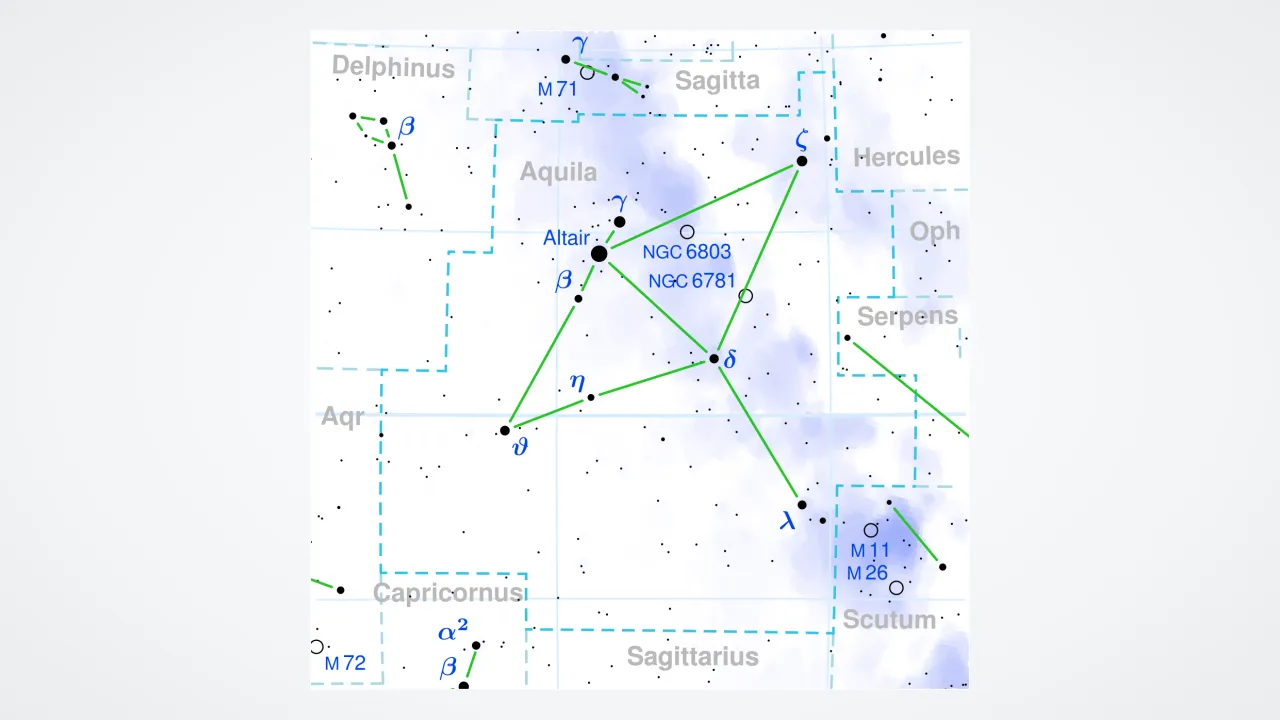
Tilt your head up on an August night to find the Summer Triangle. At its southern point shines Altair, the brightest star in the Eagle. Sitting less than 17 light-years from Earth, Altair is one of our closest bright .
2
A Speedy Twirl
Most stars like our Sun spin lazily, taking nearly four weeks for one turn. Altair races through a full spin in less than nine hours! Gas at its middle zips along at 177 miles every single second.
3
Wider Across the Middle
That dizzying spin flings hot gas outward around Altair's equator. As a result, Altair stretches twenty percent wider side-to-side than top-to-bottom, looking like a glowing white egg!
2. How much wider is Altair across its equator than from pole to pole?
🤯 Mind-Blowing Fact • Grade 3
Light leaving Altair today will reach Earth in less than 17 years—fast enough that a baby born tonight will be in high school when it arrives!
✨ Word Sparks (Grade 3 Glossary)
Tap 🔊 to hear
rotate
To spin around an imaginary center line
poles
Top and bottom ends of a spinning ball
core
Super-hot center where a star makes energy
🪝
Why are Altair's north and south poles much hotter and brighter than its equator?
1
Heart of the Flying Eagle
High in the summer sky soars the constellation Aquila, and at its bright neck shines Altair. Its name comes from an Arabic phrase meaning 'the flying eagle.' Anchoring the southern tip of the Summer Triangle, Altair sits a brisk 16.7 light-years from Earth.
2
Whirling Near Breakup Speed
Although Altair weighs nearly twice as much as our Sun, it roughly seventy times faster! Gas along its equator whips around at 177 miles per second, completing a full rotation every 8.9 hours—perilously close to the speed that would tear a star apart.
3
Hot Poles and a Cooler Waist
Because spinning puffs Altair's equator outward, that middle belt sits farther from the star's blazing . Meanwhile, the flattened sit closer to the core, making the poles roughly 1,500 kelvins hotter and noticeably brighter than the equator!
4
Photographed Directly
In 2007, scientists combined light from multiple telescopes to capture one of the first direct surface images of another sun-like star, proving Altair's squished shape.
1. Why are Altair's poles hotter and brighter than its bulging equator?
2. What does Altair's original Arabic name describe?
🤯 Mind-Blowing Fact • Grade 4
Altair spins at roughly seventy-five percent of its critical breakup velocity—any faster and gravity could barely hold its equator down!
✨ Word Sparks (Grade 4 Glossary)
Tap 🔊 to hear
oblate spheroid
Sphere flattened at poles and wide middle
centrifugal force
Outward pull felt on a spinning object
gravity darkening
Dimmer cooler equator on fast-spinning stars
🪝
How did astronomers take a sharp photograph of a flattened star over sixteen light-years away?
1
Speed Demon of the Local Neighborhood
Step outside on a warm summer night and trace the three bright corners of the Summer Triangle. While Deneb rules from thousands of light-years away, southern corner star Altair practically lives next door at just 16.7 light-years distant. Shining eleven times brighter than our Sun, this A7 V white main-sequence star hides a wild secret invisible to the naked eye: it spins like a cosmic centrifuge.
2
Centrifugal Force in Action
Our Sun rotates sedately at about 1.2 miles per second at its equator, taking roughly 25 days per spin. Altair hurtles around at 177 miles per second (286 kilometers per second), finishing each rotation in 8.9 hours! Outward stretches Altair into an —measuring 2.0 solar radii across its equator compared to only 1.63 solar radii from pole to pole.
3
Gravity Darkening
Nearly a century ago, Swedish astrophysicist Hugo von Zeipel predicted that rapid rotation would lower surface gravity at a star's bulging equator, cooling and dimming its middle belt while leaving its compressed poles blazing hot. On Altair, polar temperatures soar near 8,450 kelvins while the puffed-out equator cools down near 6,860 kelvins, making the star's top and bottom shine noticeably brighter than its waist.
4
Combining Telescopes on Mount Wilson
Ordinary single telescopes blur distant stars into tiny pinpricks of light. In 2007, astronomers linked four separated telescopes across California's Mount Wilson CHARA Array via fiber-optic beams, creating a virtual mirror over three hundred yards wide that directly imaged Altair's gleaming poles, darkened waist, and flattened oval outline!
1. What causes 'gravity darkening' along Altair's equator?
2. How did astronomers capture a direct surface image of Altair in 2007?
🤯 Mind-Blowing Fact • Grade 5
Resolving Altair's surface disk from Earth required telescopic sharpness equivalent to reading the date on a coin from nearly a thousand miles away!
✨ Word Sparks (Grade 5 Glossary)
Tap 🔊 to hear
interferometry
Combining telescopes for ultra-sharp cosmic images
angular momentum
Spinning motion conserved by rotating objects
magnetic braking
Slowing a star's spin via magnetic winds
🪝
How did an A-type star just 16.7 light-years away prove a century-old theory about stellar physics?
1
A Nearby Stellar Laboratory
Anchored in the constellation Aquila at a Hipparcos parallax distance of just 5.13 parsecs (16.7 light-years), Alpha Aquilae—Altair—is one of the closest and best-studied A7 V main-sequence stars in Earth's sky. Roughly 1.86 times as massive as our Sun and 10.6 times more luminous, this relatively young star—estimated through asteroseismology and evolutionary modeling at roughly 100 million to 1 billion years old—serves as nature's premier laboratory for extreme stellar rotation.
2
Why Hot Stars Spin Faster
Cooler yellow and red stars like our Sun possess deep convective outer envelopes whose boiling plasma generates powerful magnetic dynamos, shedding early in life through magnetized stellar winds. Hotter A-type stars like Altair possess stable radiative outer zones with far weaker , allowing Altair to preserve its primordial birth spin and whip around its axis every 8.9 hours at an equatorial speed near 286 kilometers per second.
3
Proving the Von Zeipel Effect
In 1924, Swedish theorist Hugo von Zeipel demonstrated mathematically that emergent radiative flux across a rotating star scales with local effective surface gravity. Because centrifugal acceleration stretches Altair's equatorial radius to roughly 2.0 solar radii while its polar radius stays compressed near 1.63 solar radii, Altair exhibits textbook gravity darkening: gleaming 8,450-kelvin polar caps contrasting sharply against a cooler 6,860-kelvin equatorial belt where shallow convection and weak X-ray emission even manage to form.
4
Optical Interferometry Triumph
Directly resolving Altair's tiny three-milliarcsecond angular diameter required Georgia State University's Center for High Angular Resolution Astronomy (CHARA) Array atop Mount Wilson, California. By combining near-infrared starlight with sub-micron precision across telescope baselines spanning up to 330 meters, astronomers reconstructed a landmark 2007 surface image confirming Altair's oblate geometry and tilted spin axis.
5
Across Cultures and Star Lore
Beyond stellar astrophysics, Altair shines across human heritage—from Arab navigators who named the flying eagle to East Asia's beloved Qixi and Tanabata sky festivals, where Altair represents the devoted cowherd Hikoboshi separated from Vega by the silvery Milky Way.