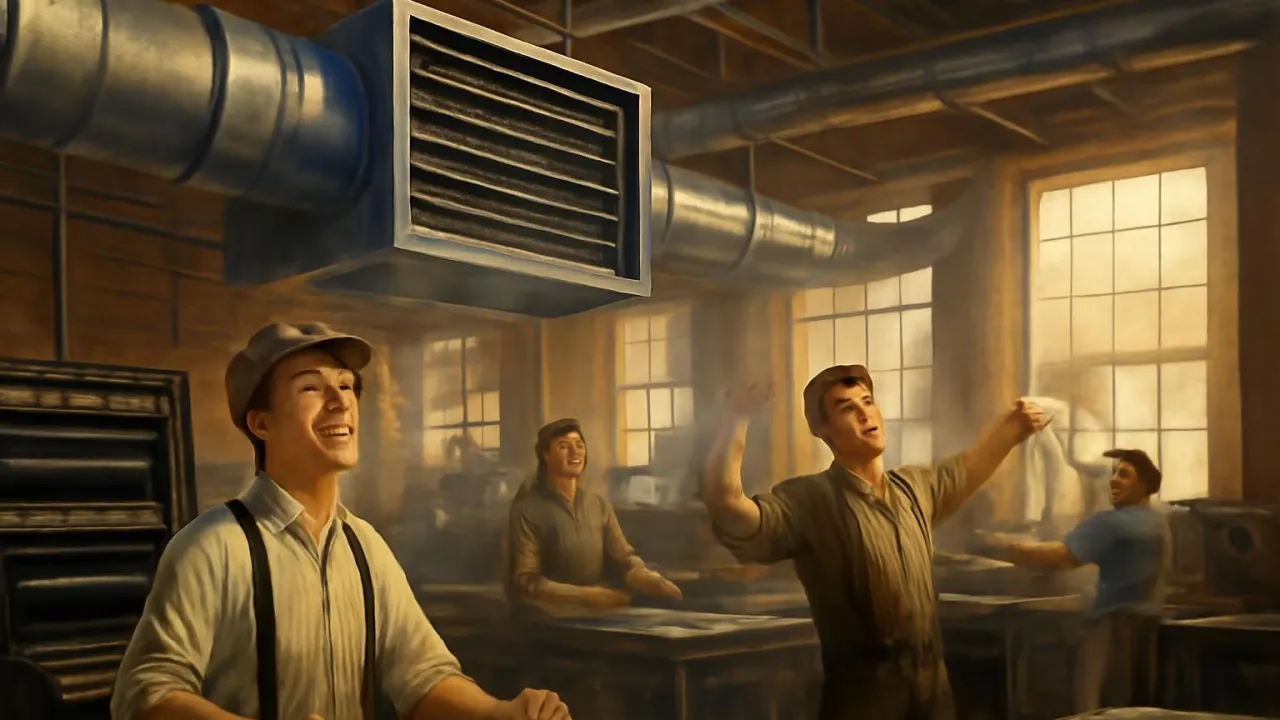
The first air conditioner was built to help a printing company make better paper!
✨ Word Sparks (Grade 2 Glossary)
Tap 🔊 to hear
vent
An opening that lets air out
fan
A spinning machine that moves air
cool
Not hot; feels nice and fresh
🪝
Have you ever felt a cold blast of air on a hot day indoors?
1
Making Rooms Cool
Air conditioning gives us cold air when it is hot outside. The machine blows air through , making rooms feel fresh. People can work, play, or rest without getting too sweaty. Even pets like the cool air inside!
2
How Does It Work?
A special machine pulls warm air in and it down. The cold air travels through pipes and comes out into rooms. help push the air everywhere, so the whole space feels nice. The machine keeps working until the room feels just right.
3
Why Is It Important?
Air conditioning helps people stay healthy and safe in the heat. It is used in schools, hospitals, and even big stores. Without it, some places would be too hot to visit or work in. It makes summer days much more fun for everyone.
Willis Carrier’s first air conditioner could cool a whole factory in 1902!
✨ Word Sparks (Grade 3 Glossary)
Tap 🔊 to hear
refrigerant
A liquid that makes things cold
coil
A looped metal tube for cooling
ventilation
How air moves in and out
🪝
Can you imagine how engineers make indoor air feel chilly, even when it’s blazing hot outside?
1
A Chilly Change Indoors
Air conditioning lets us enjoy cool air inside, even on the hottest days. When you walk into a store or a classroom and feel a sudden chill, that’s air conditioning at work. It helps people stay comfortable and safe from heat. Even animals in zoos sometimes need air conditioning to stay healthy.
2
How the System Works
Air conditioners use a process called refrigeration to cool air. Warm air from the room is pulled into the machine and blown over cold filled with special liquid. This liquid absorbs the heat, making the air much cooler. The cool air is then pushed back into the room by a fan.
3
Engineering Vocabulary
The cold are part of a system called a heat exchanger. Engineers use words like ‘’ for the cooling liquid and ‘’ for how air moves. The first air conditioner was invented by Willis Carrier to help control humidity for printing. Today, air conditioning is used in homes, cars, and huge buildings.
4
Why It Matters
Air conditioning helps people in very hot places live and work safely. It also protects computers and machines from overheating. Without air conditioning, many cities would be much harder to live in. This invention changed how we build and use buildings all over the world.
1. What does the refrigerant do in an air conditioner?
2. Why did Willis Carrier invent air conditioning?
🤯 Mind-Blowing Fact • Grade 4
The very first air-conditioned movie theaters became popular summer hangouts nearly 100 years ago!
✨ Word Sparks (Grade 4 Glossary)
Tap 🔊 to hear
thermodynamics
The science of heat and energy
humidity
How much water is in the air
efficient
Doing something with less waste
🪝
What if you stepped inside from a blazing summer street and felt a wave of cool air wrap around you?
1
A Cool Welcome Indoors
Imagine escaping the outdoor heat and being greeted by a gentle, chilly breeze as soon as you enter a building. That refreshing feeling is created by air conditioning, a clever invention that lets us control the temperature inside. With this technology, people can gather in movie theaters, shop in malls, or work in offices without worrying about the sweltering sun outside. Air conditioning has truly changed how we experience indoor spaces, especially during the hottest months.
2
How Air Conditioning Works
Deep inside the system, a closed loop of pipes holds a refrigerant, a special chemical that easily changes from liquid to gas. Warm air from inside is pulled over cold metal coils, where the refrigerant absorbs the heat and turns into a gas. The cooled air is then blown back into the room, while the heat is pushed outside. Fans and ventilation systems help spread the chill to every corner.
3
The Inventor’s Spark
In 1902, Willis Carrier invented the first modern air conditioner to solve a problem for a printing company that needed to control and temperature. Before air conditioning, factories and theaters often had to close during hot months because machines and people could not work safely. Carrier’s invention used scientific ideas from and mechanical engineering, and soon, air conditioning spread to homes, offices, and hospitals all over the world.
4
Changing the World
Air conditioning has made it possible for people to live and work comfortably in some of the hottest cities on Earth. It also protects computers and medical equipment from overheating and helps keep food fresh in stores. Today, engineers are inventing new systems that use less energy and are better for the environment. Air conditioning continues to shape our lives and the places we call home.
2. What challenge do modern engineers face with air conditioning?
🤯 Mind-Blowing Fact • Grade 5
One modern skyscraper’s air conditioning system can move over 10 million cubic feet of cooled air every hour!
✨ Word Sparks (Grade 5 Glossary)
Tap 🔊 to hear
refrigeration cycle
A repeating process that moves heat out
BTU (British Thermal Unit)
A measure of how much heat is removed
sustainability
Using resources in a way that protects the future
🪝
What if you could engineer a machine to control not just temperature, but also humidity and air quality in any building on Earth?
1
Revolutionizing Indoor Environments
Imagine stepping inside from a sweltering summer day and feeling a crisp, refreshing breeze wash over you. This everyday miracle is possible thanks to air conditioning, a breakthrough that has transformed how people live, work, and play. The invention of air conditioning made it possible to build skyscrapers, protect sensitive electronics, and even enable medical advances in climate-sensitive regions. Today, air conditioning is considered essential infrastructure in much of the world, especially as global temperatures rise.
2
Engineering the Cooling Cycle
Air conditioning systems rely on the principles of thermodynamics, particularly the , to transfer heat from inside a building to the outdoors. The process begins when warm indoor air is drawn into the unit and blown over evaporator coils containing a refrigerant fluid. As the refrigerant absorbs heat, it evaporates into a gas, which is then compressed and pumped to condenser coils outside the building. There, the heat is released into the environment, and the refrigerant returns to liquid form, ready to repeat the cycle. Fans and ventilation ducts ensure even distribution of cooled, dehumidified air throughout the building.
3
Inventor, Innovation, and Impact
Willis Carrier, an American engineer, invented the first modern air conditioner in 1902 to solve a humidity problem at a printing plant in New York. Carrier’s design not only cooled the air but also controlled moisture, which was crucial for preventing paper from warping and ink from smudging. The invention quickly spread to factories, theaters, and eventually homes, fundamentally changing architecture by allowing for sealed, glass-walled buildings in hot climates. Carrier’s company became a global leader in climate control technology, and his work is still honored as a turning point in engineering history.
4
Quantitative Specs and Modern Evolution
A typical residential air conditioner can cool a 2,000-square-foot home by removing up to 60,000 British Thermal Units (BTUs) of heat per hour. Large commercial systems can be hundreds of times more powerful, using advanced compressors, variable-speed fans, and smart thermostats for precise control. Modern air conditioners are designed to be far more energy-efficient than early models, using eco-friendly refrigerants and heat exchangers to reduce environmental impact. Engineers continue to innovate, developing solar-powered units and systems that recycle waste heat for other uses.
5
Global Challenges and the Future
While air conditioning has improved health, productivity, and comfort for billions, it also presents major environmental challenges. Air conditioning accounts for nearly 10% of global electricity use and contributes to greenhouse gas emissions through energy consumption and refrigerant leaks. Scientists and engineers are racing to design new cooling technologies that use less energy, rely on natural refrigerants, and integrate with renewable power sources. The future of air conditioning will depend on balancing human comfort with and environmental stewardship.