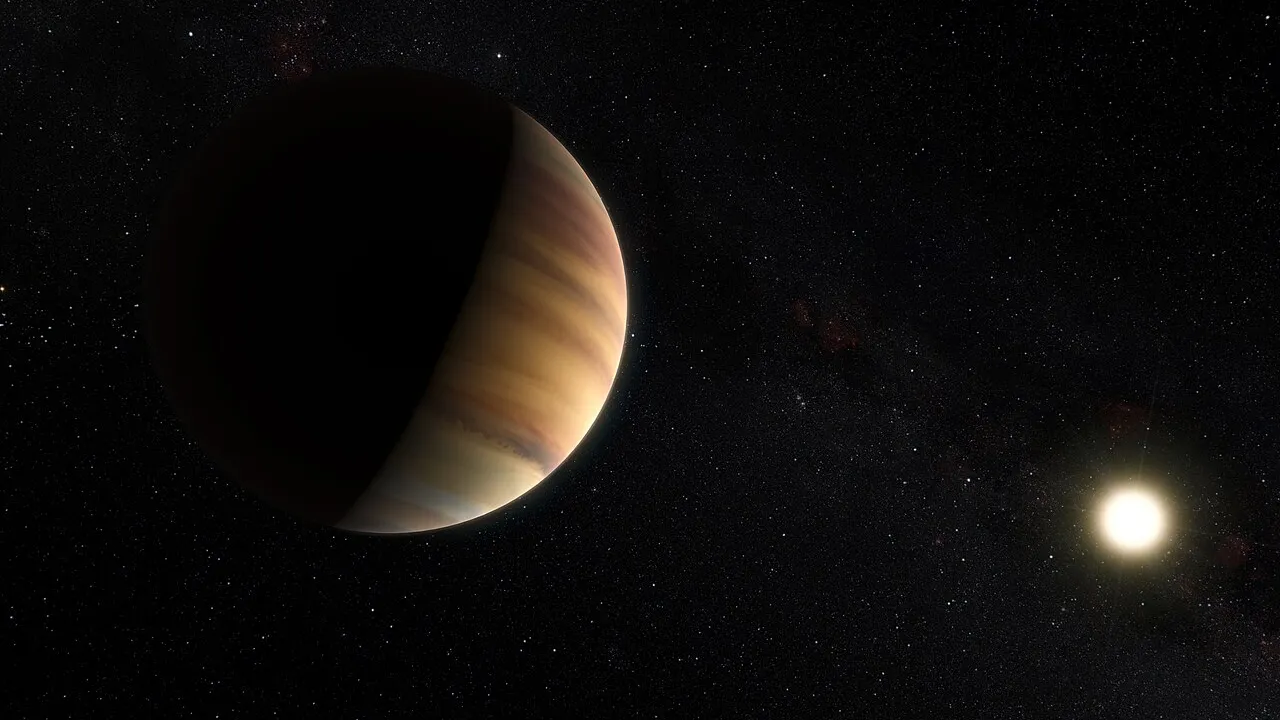
⚡ Cosmic SparkBecame the first planet ever discovered orbiting a Sun-like star beyond our own
🤯 Mind-Blowing Fact • Grade 1
Finding 51 Pegasi b was such an amazing breakthrough that its discoverers won the famous Nobel Prize!
✨ Word Sparks (Grade 1 Glossary)
Tap 🔊 to hear
gas giant
Huge planet made mostly of gas
discover
To find something for the first time
roasting
Super hot from strong star heat
🪝
Do you know the very first planet ever found around another Sun-like star?
1
A Huge First Discovery
For a long time, nobody knew if other Sun-like stars had planets. Then in 1995, two scientists spotted 51 Pegasi b! That changed space science forever.
2
A Roasting Gas Giant
This world is a huge ball of gas like Jupiter, only much hotter! It hugs so close to its star that it glows red-hot.
3
Four Days for a Year
Jupiter takes twelve Earth years to circle our Sun. Speedy 51 Pegasi b zooms around its star in just four days!
2. About how long does 51 Pegasi b take to orbit its star once?
🤯 Mind-Blowing Fact • Grade 2
51 Pegasi b gets so puffed up by intense starlight that it could float in a cosmic bathtub if one existed!
✨ Word Sparks (Grade 2 Glossary)
Tap 🔊 to hear
Hot Jupiter
Gas giant orbiting super close to star
Pegasus
Star pattern named for a winged horse
Dimidium
Official Latin name meaning one half
🪝
Why were astronomers completely shocked when a giant Jupiter-type planet zoomed around its star in four days?
1
Rewriting Every Science Book
Before 1995, every astronomy book taught that big gas planets like Jupiter only live far out in cold space. When Swiss scientists Michel Mayor and Didier Queloz looked toward , 50 light-years away, they found a giant surprise: 51 Pegasi b!
2
Meet the First Hot Jupiter
Weighing about half as much as Jupiter, 51 Pegasi b skims fewer than five million miles from its yellow star! Fierce heat bakes its gassy clouds to 1,800 degrees Fahrenheit and puffs the planet up wider than Jupiter itself.
3
A Special Official Name
Scientists also gave 51 Pegasi b the official name , which is Latin for 'half'—matching its half-Jupiter mass!
1. Why did 51 Pegasi b surprise astronomers so much in 1995?
2. What does 51 Pegasi b's official name, Dimidium, mean?
🤯 Mind-Blowing Fact • Grade 3
Before 51 Pegasi b was announced, astronomers searched mostly for slow ten-year wobbles like Jupiter's—missing fast four-day worlds hiding in plain sight!
✨ Word Sparks (Grade 3 Glossary)
Tap 🔊 to hear
migration
Planet spiraling inward or outward over time
Nobel Prize
World's highest award for scientific discovery
vaporize
Turn solid or liquid into hot gas
🪝
How could a giant gas planet form without burning up right beside a scorching star?
1
October 1995 Breakthrough
Working at Haute-Provence Observatory in France, astronomers Michel Mayor and Didier Queloz watched the Sun-like star 51 Pegasi wobble rapidly every 4.23 days. On October 6, 1995, they announced 51 Pegasi b—opening the modern age of exoplanet exploration and earning the 2019 in Physics!
2
Born Far Out, Moved Inward
Gas giants need icy building blocks to grow, which cannot freeze just five million miles from a hot star. Scientists realized 51 Pegasi b must have formed much farther out in cold space, then spiraled inward through swirling birth gas until it parked right beside its star!
3
Vaporized Rock Skies
Baking at roughly 1,800 degrees Fahrenheit, 51 Pegasi b has no solid ground. Instead, roaring winds whip vaporized iron and silicate minerals across its puffed-up atmosphere.
4
Opening the Floodgates
Once astronomers realized giant planets could orbit in days rather than decades, they quickly discovered thousands of exoplanets across our Milky Way galaxy!
1. How do scientists explain how gas giant 51 Pegasi b ended up so close to its star?
2. Which major award did Michel Mayor and Didier Queloz win in 2019 for discovering 51 Pegasi b?
🤯 Mind-Blowing Fact • Grade 4
Catching reflected visible light directly from 51 Pegasi b in 2015 allowed astronomers to pin down its orbital tilt and true mass of roughly 0.46 Jupiters!
✨ Word Sparks (Grade 4 Glossary)
Tap 🔊 to hear
spectrograph
Instrument splitting starlight into rainbow lines
protoplanetary disk
Swirling gas-and-dust disk building young planets
reflected light
Starlight bouncing off a planet's clouds
🪝
Why did skeptics at first struggle to believe that 51 Pegasi b could be a real planet?
1
A Signal Too Fast to Believe
When graduate student Didier Queloz and advisor Michel Mayor pointed the ELODIE at star 51 Pegasi in 1994, they expected any Jupiter-like planet to take years to orbit. Instead, the star's spectral lines swung back and forth at 56 meters per second every 4.23 days! They checked everything twice to make sure pulsating starspots were not tricking them before announcing 51 Pegasi b in October 1995.
2
Confirmed Across the Globe
Within just six days of the announcement, American planet hunters Geoff Marcy and Paul Butler pointed California's Lick Observatory telescope at Pegasus and confirmed the exact same four-day wobble. Humanity officially knew that other Sun-like stars build planetary systems!
3
Physics of Planetary Migration
Orbiting at just 0.0527 astronomical units—nearly eight times closer than Mercury orbits our Sun—51 Pegasi b inspired the modern theory of planetary disk migration. Gravitational torques and spiral density waves inside a young star's swirling protoplanetary gas disk drain a giant planet's orbital energy, guiding it gently inward until the inner edge of the disk halts its plunge.
4
Catching Direct Reflected Starlight
Even though 51 Pegasi b's tilted orbit means it never transits across its star's face from Earth, astronomers in 2015 used ESO's HARPS in Chile to isolate faint visible starlight reflecting directly off the planet's scorching cloud tops—pinning down both its orbital speed and true half-Jupiter mass!
1. How quickly did a second independent observatory confirm 51 Pegasi b after the October 1995 announcement?
2. What breakthrough observation of 51 Pegasi b did astronomers achieve in 2015 using the HARPS instrument?
🤯 Mind-Blowing Fact • Grade 5
Although 51 Pegasi b packs less than half of Jupiter's mass, intense stellar irradiation inflates its hydrogen-helium envelope to roughly fifty percent greater volume than Jupiter!
✨ Word Sparks (Grade 5 Glossary)
Tap 🔊 to hear
frost line
Cold orbital boundary where ices freeze solid
inclination
Tilt angle of an orbit toward Earth
accrete
Gather gas and dust through gravity
🪝
How did a fiber-fed spectrograph in southern France overturn two centuries of planetary formation theory?
1
Engineering Fiber-Optic Precision
Shining at apparent magnitude 5.49 just 15.5 parsecs (50.6 light-years) away in Pegasus, the metal-rich G2IV-V star HD 217014—51 Pegasi—became ground zero for an astronomical revolution. Using the newly commissioned fiber-fed ELODIE echelle spectrograph at Haute-Provence Observatory, Swiss astronomers Michel Mayor and Didier Queloz achieved 13-meter-per-second radial-velocity stability, immediately uncovering a clean sinusoidal 56-meter-per-second reflex wobble repeating every 4.2308 days.
2
Ruling Out Stellar Pulsations
Because classical Solar System nebular theory insisted gas giants could massive hydrogen envelopes only beyond the cold '' several astronomical units from a star, skeptics initially questioned whether non-radial stellar pulsations or rotating starspots mimicked an orbiting companion. However, rock-steady stellar photometry and unchanging spectral line bisector shapes clinched the case that a genuine planet—officially named Dimidium and informally nicknamed Bellerophon—orbited at 0.0527 AU.
3
Type II Disk Migration Paradigm
51 Pegasi b established the Hot Jupiter class and revitalized theoretical work on Type II orbital migration, demonstrating how a newly formed Jovian giant carves an annular gap in its viscous protoplanetary gas disk and spirals inward before magnetic cavities near the young star halt its journey.
4
High-Resolution Reflected-Light Spectroscopy
Because Dimidium's orbital plane is inclined roughly 80 degrees to the sky rather than edge-on, it never transits. Yet in 2015 and 2017, astronomers cross-correlated high-resolution optical and near-infrared spectra from ESO's HARPS and Hawaii's Keck Observatory, isolating the planet's 133-kilometer-per-second orbital Doppler signature directly in reflected starlight, pinning its true mass near 0.46–0.47 Jupiter masses, and detecting hot atmospheric water vapor!
5
Enduring Legacy Across Thousands of Worlds
Honored with half of the 2019 Nobel Prize in Physics, Mayor and Queloz's discovery of 51 Pegasi b expanded comparative planetology from a lonely sample of one Solar System into an ever-growing galactic census exceeding five thousand confirmed exoplanets.