The park’s glass bridge is so long, it can hold 800 people at once!
✨ Word Sparks (Grade 2 Glossary)
Tap 🔊 to hear
pillar
A tall, skinny stone tower
erosion
When wind or water wears rock away
bridge
A path that goes over something
🪝
Can you imagine walking through a forest of giant stone towers?
1
Stone Pillars Touch the Sky
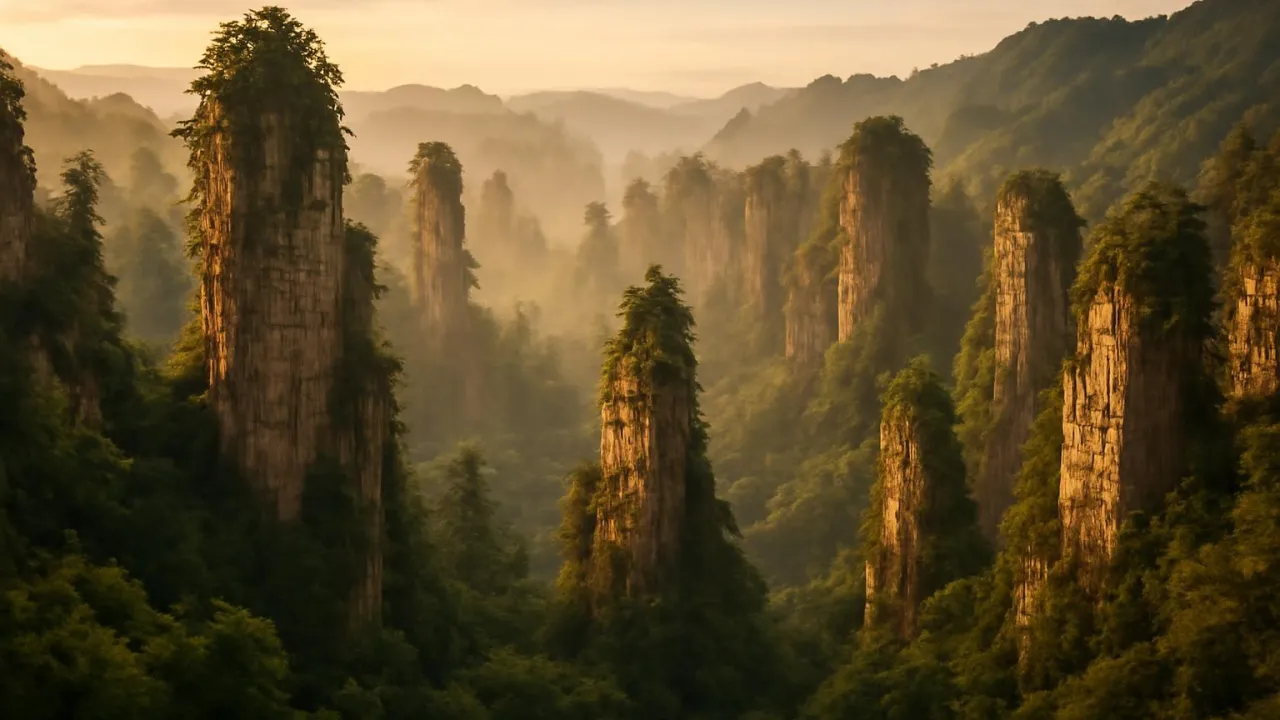
The Zhangjiajie peaks are tall stone towers. Some are as high as clouds, while others are hidden by mist. They stand close together, making a stone forest that looks magical. People feel amazed when they see so many reaching up.
2
Nature Shapes the Peaks
Rain and wind slowly shaped these for millions of years. Water wore away softer rock, leaving behind the hardest stone. Each pillar is a different shape, with some looking like fingers or castle towers. Nature worked like an artist to carve these giant rocks.
3
Exploring the Park
Visitors walk on winding paths and see glass high above the ground. They spot birds, green trees, and sometimes monkeys in the forest below. Many people take photos of the amazing views and ride the glass elevator up the cliffs. Everyone leaves with memories of this special place.
The Bailong Elevator is the world’s tallest outdoor glass elevator, rising 1,070 feet up a cliff!
✨ Word Sparks (Grade 3 Glossary)
Tap 🔊 to hear
karst
Land shaped by water and rock
quartz-sandstone
A very hard kind of rock
erosion
When wind or water wears down land
🪝
What would it feel like to stand on a glass bridge above towering stone pillars?
1
A Forest of Stone Giants
Zhangjiajie’s pillar peaks rise straight up from the green forest floor. Some pillars are taller than skyscrapers, with mist swirling around their tips. The area is filled with thousands of these narrow, rocky towers. Visitors say it feels like walking in a land of giants.
2
How Nature Built the Pillars
Over millions of years, rainwater and wind caused , wearing away the softer rock. Only the hardest was left standing as tall pillars. Each peak has a unique shape, some looking like fingers or castle spires. This process is called formation.
3
Exploring by Bridge and Elevator
People visit Zhangjiajie to hike, take photos, and explore the park’s glass bridges. The Bailong Elevator, made of glass, carries visitors up the side of a cliff. From the top, you can see endless pillar peaks stretching into the distance. Many birds and animals live in the lush forest below.
4
A Place of Inspiration
These peaks have inspired stories, movies, and art around the world. The park is a UNESCO World Heritage Site because of its rare geology and beauty. Scientists study the area to learn about and rock formations. The landscape changes with the seasons, making every visit unique.
2. Why is Zhangjiajie a UNESCO World Heritage Site?
🤯 Mind-Blowing Fact • Grade 4
Zhangjiajie’s glass bridge is 1,410 feet long and hangs 984 feet above the valley!
✨ Word Sparks (Grade 4 Glossary)
Tap 🔊 to hear
karst
Land shaped by water and rock dissolving
weathering
Breaking down rocks by wind or rain
preservation
Keeping something safe for the future
🪝
Have you ever wondered how thousands of stone towers could rise from a single forest?
1
A Landscape Like No Other
Zhangjiajie’s pillar peaks form a breathtaking stone forest, with more than 3,000 narrow towers rising above the lush green canopy. These pillars reach heights of over 3,500 feet, often shrouded in swirling mist that makes them seem to float in the sky. The landscape looks so unusual that it inspired the floating mountains in the movie 'Avatar.' Every year, millions of visitors come to witness this natural wonder in person.
2
The Science of Karst Formations
The peaks are made of quartz-sandstone, which is extremely resistant to . Over 300 million years, rainwater seeped into cracks and slowly dissolved softer rock, leaving behind the hardest stone as towering pillars. This process, called erosion, creates dramatic cliffs, spires, and deep ravines. Scientists study these formations to understand how water and wind shape our planet’s surface.
3
Exploring with Modern Engineering
Visitors explore Zhangjiajie using safe walkways, glass-bottom bridges, and the famous Bailong Elevator, which climbs 1,070 feet up a cliff face. These structures allow people to see the peaks from above and below, offering incredible views and thrilling experiences. The park is also home to rare plants and animals, protected by law to keep the ecosystem safe.
4
Cultural and Global Significance
Zhangjiajie is a UNESCO World Heritage Site because of its unique geology and cultural value. Local legends tell stories about the peaks, and artists have painted them for centuries. The area attracts scientists, photographers, and tourists from around the world, making it an important symbol of China’s natural beauty. Its helps people learn about geology, ecology, and sustainable tourism.
2. Why are glass walkways and elevators important in the park?
🤯 Mind-Blowing Fact • Grade 5
Zhangjiajie’s quartz-sandstone pillars formed during the Carboniferous period, long before the age of dinosaurs!
✨ Word Sparks (Grade 5 Glossary)
Tap 🔊 to hear
karstification
The process of water dissolving rock to shape land
tectonic uplift
Earth’s crust rising to form mountains
biodiversity
Many different living things in one place
🪝
What scientific secrets can we uncover by studying Zhangjiajie’s soaring stone pillars and their ancient origins?
1
A Geological Masterpiece in the Clouds
Imagine gazing across a valley where over 3,000 slender stone towers pierce the misty sky, each sculpted by nature’s patient hand. Zhangjiajie’s pillar peaks, located in Hunan Province, China, are among the world’s most spectacular quartz-sandstone karst formations. Some of these pillars soar to 3,544 feet (1,080 meters) above sea level, dwarfing even the tallest skyscrapers. The park’s dramatic scenery has inspired countless legends, artists, and even the floating mountains in the film 'Avatar.'
2
The Science Behind the Pillars’ Formation
These iconic peaks formed over 300 million years through a process called , where slightly acidic rainwater seeped into cracks, dissolving softer minerals and leaving behind vertical columns of hard quartz-sandstone. Erosion, weathering, and gravity further shaped the landscape, causing weaker rock to collapse and isolating the slender pillars. Scientists study the region to understand the interplay of chemical weathering, mechanical erosion, and that created such a unique environment.
3
Engineering Wonders Amid Natural Marvels
To allow safe exploration of this rugged terrain, engineers designed the Bailong Elevator, the world’s tallest outdoor glass elevator, which rises 1,070 feet (326 meters) up a sheer cliff. The Zhangjiajie Glass Bridge, stretching 1,410 feet (430 meters) across a deep canyon, offers breathtaking views through its transparent floor. These structures required advanced materials, seismic-resistant designs, and careful environmental planning to minimize their impact on the fragile ecosystem.
4
Ecological and Cultural Importance
Zhangjiajie National Forest Park is home to rare plant species, endangered animals like the Chinese giant salamander, and ancient trees that thrive in the humid, misty climate. Its designation as a UNESCO World Heritage Site highlights its global significance for geology, , and cultural heritage. Local Tujia and Miao communities share legends about the peaks, and their traditional practices help preserve the region’s natural balance.
5
Global Impact and Ongoing Discovery
Zhangjiajie’s pillar peaks attract millions of scientists, tourists, and artists each year, serving as a living laboratory for studying karst geology, erosion, and sustainable tourism. Ongoing research helps us learn how climate, water chemistry, and time shape our planet’s surface. The park’s preservation efforts ensure that future generations can continue to marvel at its beauty, while also inspiring new ideas in architecture, engineering, and environmental science.