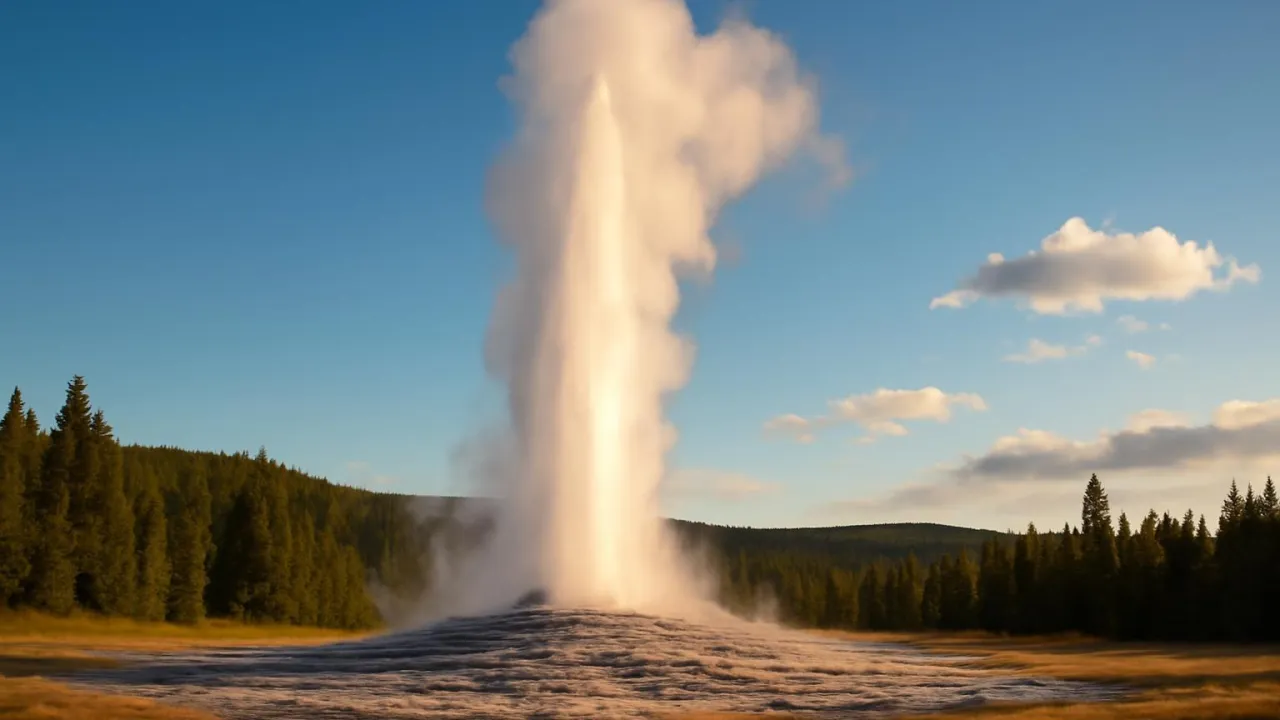
Old Faithful has erupted more than a million times since people started counting!
✨ Word Sparks (Grade 2 Glossary)
Tap 🔊 to hear
eruption
When water shoots out quickly
predictable
You can guess when it will happen
underground
Deep down below the ground
🪝
Have you ever heard a giant water fountain roar?
1
The Roaring Geyser
Old Faithful blasts hot water high into the sky. It makes a loud sound like a train whistle. People gather to watch the geyser’s amazing show.
2
How Does It Work?
Hot water deep heats up from Earth’s inside. When it gets too hot, the water bursts out in a big . This happens every 44 to 125 minutes.
3
A Famous Place to Visit
Many families visit Yellowstone to see Old Faithful. Some people take photos while others just watch in wonder. The geyser always puts on a special show.
Old Faithful’s water is heated by a giant magma chamber deep beneath Yellowstone!
✨ Word Sparks (Grade 3 Glossary)
Tap 🔊 to hear
vibration
A quick shaking or trembling movement
hydrothermal
Hot water and steam from inside Earth
geothermal
Heat that comes from deep underground
🪝
Can you imagine the ground rumbling before water blasts skyward?
1
The Geyser’s Grand Entrance
Before Old Faithful erupts, the ground vibrates and steam hisses out. Suddenly, a tall column of hot water shoots up, sparkling in the sunlight. Crowds gather, listening for the roaring sound and feeling the cool mist. Each eruption is a thrilling natural event in Yellowstone National Park.
2
How Does Old Faithful Work?
Deep underground, water seeps into cracks heated by hot rocks. As the water heats, it builds pressure until it erupts through the geyser’s vent. This process is called a eruption, and it repeats every 44 to 125 minutes. Old Faithful’s eruptions are so predictable that scientists can estimate the next show.
3
A Landmark of Science and Wonder
Old Faithful is a famous landmark visited by people from all over the world. Scientists study its eruptions to learn about energy and Earth’s inner heat. The geyser’s steady rhythm makes it special among thousands in Yellowstone. Visitors enjoy the spectacle and learn about Earth’s powerful forces.
4
Nature’s Water Clock
Old Faithful’s regular eruptions make it like a natural clock. Its water can reach up to 180 feet high, lasting up to five minutes. The geyser’s and steamy eruptions create excitement for everyone watching. Old Faithful reminds us how amazing our planet’s geology can be.
Old Faithful’s eruptions can spray over 8,000 gallons of boiling water each time!
✨ Word Sparks (Grade 4 Glossary)
Tap 🔊 to hear
magma chamber
A big pool of melted rock underground
seismic
Related to shaking or vibrations in the ground
ecosystem
All the living and nonliving things in a place
🪝
What would it feel like to stand beside a natural water cannon?
1
A Spectacular Eruption in the Wild
As the ground trembles and steam whistles from the earth, Old Faithful prepares its next eruption. In a sudden burst, boiling water and vapor rocket skyward, sometimes reaching 180 feet above the ground. The roaring sound echoes across the Upper Geyser Basin, thrilling visitors who eagerly gather for the show. Each eruption is a vivid reminder of the powerful forces shaping Yellowstone.
2
The Science of Geysers
Old Faithful’s eruptions begin deep underground, where rainwater seeps down to hot volcanic rocks. This water is heated by geothermal energy from a , causing pressure to build until it escapes through a narrow vent. The explosive release is called a hydrothermal eruption, and Old Faithful’s regular intervals make it a unique scientific phenomenon. Scientists use sensors to study the geyser’s vibrations and predict its next eruption.
3
A Landmark with Global Fame
Since its discovery by explorers in 1870, Old Faithful has become one of the world’s most recognized natural landmarks. Tourists from every continent travel to Yellowstone to witness its predictable eruptions and learn about Earth’s geothermal power. The geyser’s reliability has made it a symbol of nature’s clockwork precision and a favorite subject for researchers and photographers alike.
4
Protecting a Natural Wonder
Old Faithful is protected within Yellowstone National Park, America’s first national park, established in 1872. Park rangers and scientists work together to monitor the geyser and its delicate , ensuring it remains unspoiled for future generations. The study of Old Faithful helps us understand volcanic activity, groundwater systems, and the importance of preserving natural wonders. Every eruption inspires awe and curiosity about our dynamic planet.
1. How do scientists predict Old Faithful’s eruptions?
2. Why is Old Faithful important to protect?
🤯 Mind-Blowing Fact • Grade 5
Old Faithful’s largest recorded eruption blasted over 8,400 gallons (32,000 liters) of water into the air in just one event!
✨ Word Sparks (Grade 5 Glossary)
Tap 🔊 to hear
Yellowstone Caldera
A huge volcanic crater beneath Yellowstone
hydrothermal eruption
An explosion of hot water and steam
porous
Full of tiny holes that let water pass through
🪝
What secrets would you uncover if you could journey beneath Yellowstone’s surface?
1
A Natural Wonder’s Dramatic Display
Every eruption of Old Faithful begins with a low rumble, followed by a hissing surge of steam and a towering column of boiling water that can reach up to 180 feet into the sky. This spectacle, lasting between one and five minutes, is one of the most reliable geothermal events on Earth, captivating millions of visitors annually. The geyser’s eruptions are not only visually stunning but also serve as a powerful reminder of the dynamic geological forces at work beneath Yellowstone. The rhythmic cycle of Old Faithful has made it an icon of natural predictability and a symbol of the park itself.
2
Geothermal Mechanics Deep Underground
Old Faithful’s eruptions are driven by a complex interplay of groundwater, heat, and pressure deep within the Earth’s crust. Rain and snowmelt seep through rock layers until they encounter the immense heat of the ’s magma chamber, estimated to be only a few miles below the surface. As the water heats beyond its boiling point, pressure builds in underground chambers until it forces its way up through the geyser’s narrow vent in a violent . This process repeats every 44 to 125 minutes, depending on the volume and duration of the previous eruption.
3
Scientific Study and Global Impact
Since the Washburn-Langford-Doane Expedition first documented Old Faithful in 1870, scientists have intensely studied its eruptions to better understand geothermal activity and Earth’s interior. Modern researchers use seismic sensors, temperature probes, and even satellite data to monitor the geyser’s behavior and predict future eruptions with remarkable accuracy. Old Faithful’s regularity has made it a benchmark for studying hydrothermal systems worldwide, and its data helps scientists model volcanic risk and groundwater flow in similar environments.
4
Cultural and Environmental Significance
Old Faithful is more than just a geological marvel—it is a cultural icon, featured in art, literature, and conservation movements for over 150 years. Its presence helped inspire the creation of Yellowstone National Park, the world’s first national park, which set a global precedent for protecting natural wonders. The geyser’s ecosystem supports unique bacteria and plant life adapted to its hot, mineral-rich waters, making it a living laboratory for biologists and ecologists. Protecting Old Faithful ensures that future generations can witness its power and learn from its mysteries.
5
Preservation and the Future of Old Faithful
Today, park rangers, scientists, and visitors all play a role in safeguarding Old Faithful’s delicate environment. Climate change, human activity, and natural shifts in the Earth’s crust can all impact the geyser’s behavior and longevity. Ongoing research and careful management are essential to preserve Old Faithful and its surrounding ecosystem for centuries to come. By studying and respecting this remarkable geyser, we gain not only scientific knowledge but also a deeper appreciation for the forces that shape our planet.