🇺🇸 U.S. HISTORY
🏛️ 28th President of the United States (1913–1921)
VA History & Social Science SOL K.1, 1.2, 2.4, VS.1–VS.10, USI & USII
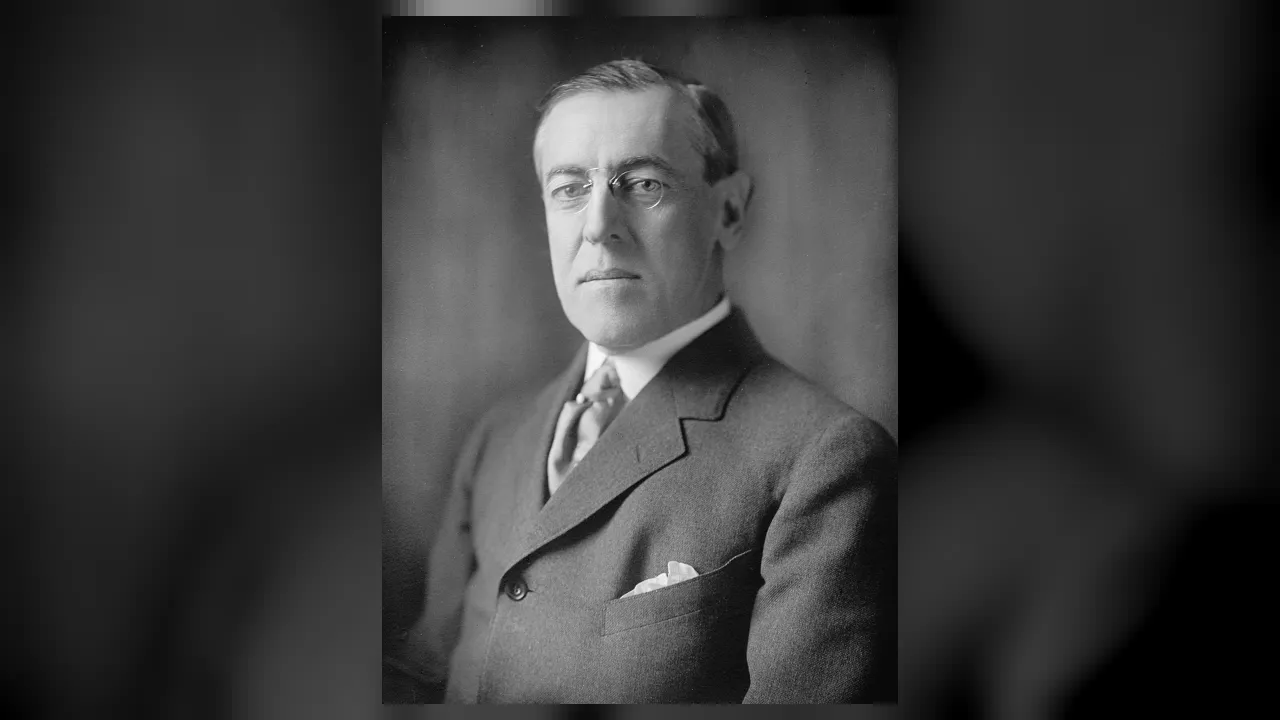
Woodrow Wilson
Virginia-Born Scholar Who Envisioned World Peace
Grade 1 • Early Reader • 82 words
⏳ Era / StatehoodPresidential Term: 1913–1921 (Eighth Virginia-Born President)
🗺️ Region / CapitalStaunton, Virginia; Princeton, New Jersey & Washington, D.C.
📜 Key MilestoneWorld War I Leadership, League of Nations Vision & National Park Service
⚡ Historical SparkOnly U.S. president to earn a Ph.D. doctorate and eighth president born in Virginia
🤯 Mind-Blowing Fact • Grade 1
During World War I, President Woodrow Wilson kept a flock of sheep grazing on the White House lawn to trim the grass and raise wool money for the Red Cross!
✨ Word Sparks (Grade 1 Glossary)
Tap 🔊 to hear
campus
The grounds and buildings of a college
overseas
Across the ocean in other faraway countries
flock
A group of sheep or birds together
🪝
What happens when a college teacher becomes president of the United States?
1
From Virginia to Classrooms
Ring, ring! School bells echoed on college where Tommy Wilson loved teaching history. Growing up after his start in Staunton, Virginia, he worked hard to read well.
2
Leading Through a Big War
Voters chose him as our twenty-eighth president! When World War I began , he tried to keep peace, then led American troops to help end the fighting.
3
A Club for Peaceful Nations
After the war ended, he sailed to Europe with a bold dream. He asked countries to join a peaceful group so nations could talk instead of fight!
1. In which Virginia town did Woodrow Wilson's life begin?
2. Why did sheep graze on the White House lawn when Wilson was president?
🤯 Mind-Blowing Fact • Grade 2
Woodrow Wilson was the eighth—and most recent—U.S. president born in the Commonwealth of Virginia, earning Virginia the nickname 'Mother of Presidents'!
✨ Word Sparks (Grade 2 Glossary)
Tap 🔊 to hear
patience
Staying calm and steady while learning something tricky
governor
The elected leader of a U.S. state
league
A partnership of groups working toward one goal
🪝
Did you know a boy who didn't learn his alphabet until age nine grew up to lead a famous university and our country?
1
The Eighth Virginia President
Scratch, tap! Young Tommy Wilson practiced reading slowly until words clicked, probably overcoming dyslexia through . Starting out in Staunton, Virginia, he studied history and law, becoming the only U.S. president ever to earn a Ph.D. degree.
2
Parks, Banks, and World War I
After leading Princeton University and serving as of New Jersey, Woodrow Wilson became our twenty-eighth president in 1913. He created the National Park Service in 1916 and guided the nation when America entered World War I in 1917.
3
Dreaming of Lasting Peace
When the war ended in 1918, Wilson proposed a ' of Nations' where countries could solve arguments peacefully. He won the 1919 Nobel Peace Prize, and women gained nationwide voting rights before his presidency ended!
1. What academic milestone makes Woodrow Wilson unique among all U.S. presidents?
2. Which agency did President Wilson sign into law in 1916 to care for America's national parks?
🤯 Mind-Blowing Fact • Grade 3
Woodrow Wilson's portrait once appeared on the biggest piece of U.S. paper money ever printed—the $100,000 gold certificate used solely between Federal Reserve banks!
✨ Word Sparks (Grade 3 Glossary)
Tap 🔊 to hear
neutral
Not taking either side during an argument or war
doctorate
The highest advanced degree earned at a university
armistice
An agreement by warring sides to stop fighting
🪝
How did a history professor from Staunton, Virginia, help design modern banking, protect national parks, and inspire today's United Nations?
1
From Shenandoah Valley Roots to Scholar
Imagine struggling to read letters at age nine and later writing whole books about how Congress works! Starting life in Staunton, Virginia, in 1856, Thomas Woodrow Wilson earned a in history and political science, led Princeton University, and served as governor of New Jersey.
2
Reforming Banks and Protecting Parks
Elected twenty-eighth president in 1912, Wilson worked with Congress on major domestic laws. He signed the Federal Reserve Act of 1913—which still manages America's money supply today—created the Federal Trade Commission, and established the National Park Service in 1916.
3
America Enters World War I
When World War I erupted in Europe in 1914, Wilson first kept the United States . However, after German submarines sank American ships in 1917, Congress declared war, and over two million American soldiers helped bring peace on November 11, 1918.
4
Fourteen Points and Women's Suffrage
Sailing to France for peace talks, Wilson presented his 'Fourteen Points,' including a League of Nations to prevent future wars. Though the U.S. Senate voted against joining the League, Wilson earned the 1919 Nobel Peace Prize and backed the Nineteenth Amendment securing women's right to vote.
1. What does the Federal Reserve System, created under President Wilson in 1913, still do today?
2. Which constitutional milestone expanding voting rights was ratified in 1920 near the end of Wilson's presidency?
🤯 Mind-Blowing Fact • Grade 4
November 11—the exact date in 1918 when President Woodrow Wilson announced to Americans that World War I fighting had stopped at the eleventh hour—is still celebrated nationwide today as Veterans Day!
✨ Word Sparks (Grade 4 Glossary)
Tap 🔊 to hear
mobilizing
Organizing people and supplies for a major effort
segregation
Unfairly separating people based on their race
ratify
To vote officially to approve a treaty or law
🪝
Why do Virginia history students study Woodrow Wilson both for Progressive reforms at home and for reshaping America's role in the world?
1
Virginia Birthplace and Academic Rise
Step inside the Greek Revival brick manse in Staunton, Virginia, and you visit the birthplace of the eighth Virginia-born U.S. president! Raised in Georgia and the Carolinas before studying at Princeton, the University of Virginia School of Law, and Johns Hopkins University, Woodrow Wilson earned a Ph.D. in political science in 1886. After serving as president of Princeton University and reform governor of New Jersey, he won the 1912 presidential election.
2
'New Freedom' Domestic Reforms
Wilson's 'New Freedom' agenda reshaped how the federal government regulated a growing industrial economy. He lowered tariffs, signed the Federal Reserve Act of 1913 creating twelve regional central banks to prevent financial panics, established the Federal Trade Commission to stop unfair business practices, backed eight-hour workdays for railroad workers, and created the National Park Service in 1916. At the same time, historians note that his administration permitted racial inside federal offices, a serious setback for Black civil servants.
3
World War I and the Fourteen Points
After maintaining American neutrality for nearly three years during World War I, unrestricted submarine warfare and the intercepted Zimmermann Telegram led Wilson to ask Congress to declare war in April 1917 so the world could 'be made safe for democracy.' industry and troops tipped the Allied balance toward the Armistice of November 11, 1918—now honored each year as Veterans Day.
4
The League of Nations and Constitutional Debate
Becoming the first sitting U.S. president to visit Europe, Wilson negotiated the 1919 Treaty of Versailles around his Fourteen Points, securing creation of the League of Nations. Under the Constitution, however, treaties require two-thirds Senate approval; concerned that League membership might commit U.S. troops abroad without Congress's consent, Senators declined to it. Still, Wilson's blueprint later inspired the United Nations in 1945.
1. Why did the United States never join the League of Nations even though President Wilson proposed it?
2. Which modern global organization built directly on Woodrow Wilson's earlier League of Nations idea after World War II?
🤯 Mind-Blowing Fact • Grade 5
By delivering his 1913 tariff address directly to a joint session of Congress in person, Woodrow Wilson revived a presidential tradition that no president had practiced since John Adams in 1800—creating the modern televised State of the Union speech we watch today!
✨ Word Sparks (Grade 5 Glossary)
Tap 🔊 to hear
decentralized
Spread across regional centers rather than one single office
impartiality
Treating rival sides fairly without favoring either one
self-determination
The right of peoples to choose their own government
🪝
How did Woodrow Wilson transform Progressive economic governance and pioneer twentieth-century collective security?
1
From Staunton Manse to Constitutional Scholar
Picture the first U.S. president in sixty-five years walking onto the House of Representatives floor in 1913 to deliver his State of the Union message in person rather than sending a written clerk's letter! Born in Staunton, Virginia, in December 1856—completing Virginia's historic roster of eight native-born presidents—Thomas Woodrow Wilson studied law at the University of Virginia and earned an 1886 Johns Hopkins doctorate analyzing congressional government before leading Princeton University and governing New Jersey.
2
Progressive Economic Architecture and Contradictions
Winning the four-way election of 1912 against William Howard Taft, Theodore Roosevelt, and Eugene V. Debs, Wilson enacted one of the most consequential legislative programs before the New Deal. The Underwood Tariff and Sixteenth Amendment federal income tax shifted revenue burdens; the Federal Reserve Act (1913) created a twelve-district central bank; and the Federal Trade Commission and Clayton Antitrust Acts (1914) curbed corporate monopolies. Yet historians equally examine his administration's contradiction in allowing cabinet departments to segregate federal workplaces, diminishing opportunities for African American employees.
3
Neutrality Tested and Wartime Mobilization
When European alliances plunged into World War I in August 1914, Wilson urged , winning narrow reelection in 1916. Early in 1917, however, Germany resumed unrestricted U-boat attacks against merchant shipping and dispatched the Zimmermann Telegram proposing a German-Mexican alliance. Addressing Congress on April 2, 1917, Wilson framed intervention as defending democratic self-government; the American Expeditionary Forces under General John J. Pershing deployed two million troops to France, decisively hastening the November 11, 1918 Armistice.
4
The Fourteen Points and Paris Peace Conference
In January 1918, Wilson articulated his Fourteen Points: open diplomacy, freedom of navigation, reduced trade barriers, national , and a 'general association of nations' to guarantee mutual peace. Spending six months at the 1919 Paris Peace Conference, he compromised on Allied reparation demands to secure the Covenant of the League of Nations inside the Treaty of Versailles, earning the 1919 Nobel Peace Prize.
5
Senate Stalemate, the Nineteenth Amendment, and Legacy
Back in Washington, Senate Foreign Relations Chairman Henry Cabot Lodge demanded reservations clarifying that Congress alone retained constitutional authority under Article I to commit U.S. forces under League Article X. Exhausted from a cross-country speaking tour, Wilson suffered a severe stroke in October 1919, and neither side compromised enough to reach a two-thirds Senate majority. Even so, Wilson's final years saw ratification of the Nineteenth Amendment (1920) securing women's suffrage, and his internationalist framework laid the intellectual cornerstone for the 1945 United Nations Charter.