1. Which river carved the deep rock walls of the Grand Canyon?
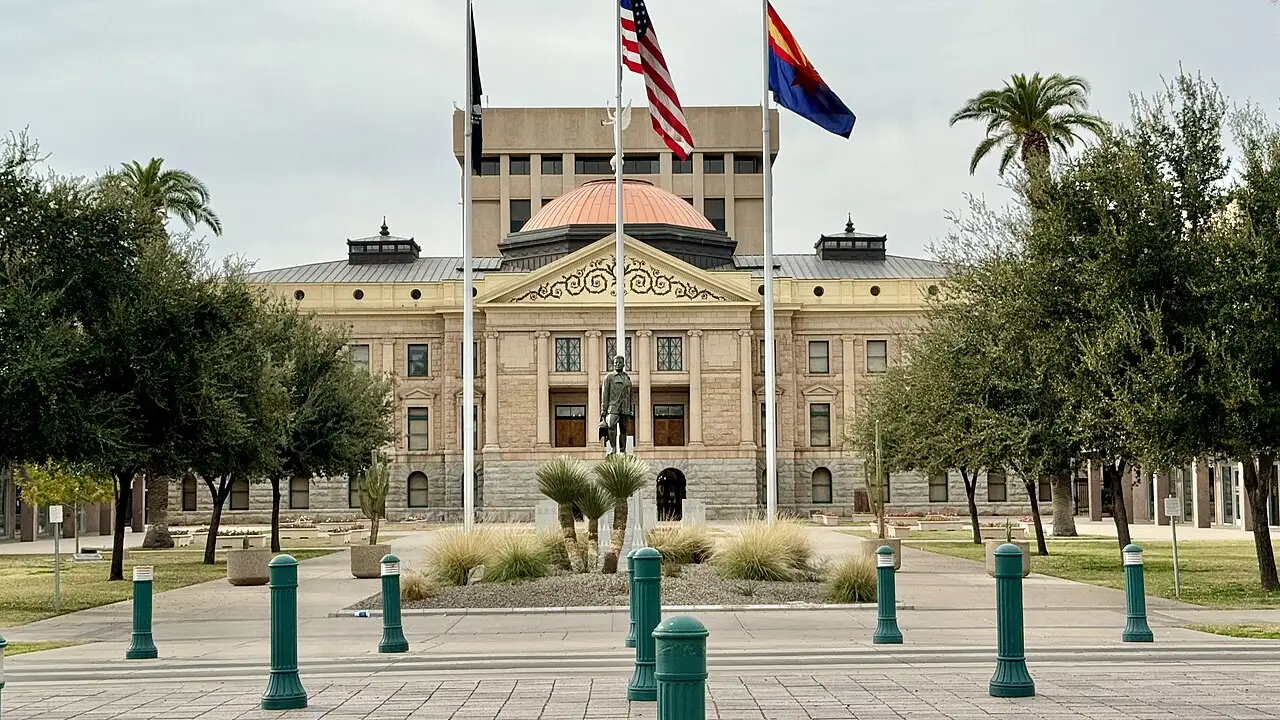
2. What is the capital city of the State of Arizona?
🤯 Mind-Blowing Fact • Grade 2
At Four Corners Monument on Arizona's northeastern border, you can put your hands and feet in four states—Arizona, Utah, Colorado, and New Mexico—all at once!
✨ Word Sparks (Grade 2 Glossary)
Tap 🔊 to hear
petrified
Ancient wood that slowly turned into stone
southwest
Region in the lower western United States
saguaro
A tall, tree-sized cactus with curving arms
🪝
Why is Arizona called the Valentine State as well as the Grand Canyon State?
1
A Valentine Birthday
Feel the warm dry air of the American ! On Valentine's Day, February 14, 1912, Arizona became the forty-eighth state. It was the very last of the connected lower forty-eight states to join our country.
2
Wonders of Rock and Wood
Northern Arizona holds the mile-deep Grand Canyon and snowy pine forests around Flagstaff. Nearby, Forest National Park sparkles with ancient fallen logs that turned into colorful rainbow stone!
3
Sonoran Desert Life
Around the capital city of Phoenix, the Sonoran Desert blooms with towering cacti. Jackrabbits, Gila monsters, and swift roadrunners rest in shady spots during hot afternoons.
1. On which special date in 1912 did Arizona become the forty-eighth state?
2. What happened to the ancient logs in Arizona's Petrified Forest?
🤯 Mind-Blowing Fact • Grade 3
Apollo astronauts practiced moonwalks inside Arizona's Meteor Crater and volcanic fields near Flagstaff before flying to the real Moon!
✨ Word Sparks (Grade 3 Glossary)
Tap 🔊 to hear
plateau
A wide area of high, flat land
irrigation
Bringing water to dry crops through canals
crater
A bowl-shaped pit made by an impact
🪝
Can one state hold sizzling cactus deserts, cool pine mountains, and a canyon visible from space?
1
A Giant Geological Storybook
Stand at Mather Point as morning sunlight paints two-billion-year-old rock layers in shades of crimson and gold! Winding 277 miles through northern Arizona, the Grand Canyon measures up to eighteen miles wide and over a mile deep, carved relentlessly by the Colorado River.
2
Surprising Pine Forests and Meteor Crater
Many travelers expect all of Arizona to be sandy desert, yet the high Colorado around Flagstaff receives heavy winter snow and grows the world's largest contiguous ponderosa pine forest. East of Flagstaff sits Meteor , a giant bowl blasted by an iron asteroid 50,000 years ago.
3
Ancient Canals and Native Nations
Centuries before Phoenix became the state capital, Ancestral Sonoran Desert people called the Hohokam dug hundreds of miles of canals by hand to water beans, corn, and squash. Today, twenty-two federally recognized Native American tribes—including the Navajo Nation and Hopi Tribe—call Arizona home.
4
Arizona's Famous Copper Star
Look closely at the copper-colored star on Arizona's state flag! Arizona mines more copper for electrical wires and motors than any other state.
1. Why is there a copper-colored star in the center of Arizona's state flag?
2. How did the ancient Hohokam people farm successfully in the dry desert around present-day Phoenix?
🤯 Mind-Blowing Fact • Grade 4
Astronomer Clyde Tombaugh discovered Pluto in 1930 using a telescope at Lowell Observatory in Flagstaff, Arizona, the world's first International Dark Sky City!
Sharing connected borders without ocean gaps between
🪝
How do uplift, river erosion, and clever desert adaptations allow life and cities to flourish across Arizona?
1
How the Grand Canyon Formed
Run your fingers over sandstone cliffs near the Grand Canyon and you are touching ancient sand dunes, shallow seas, and riverbeds stacked like pages in a history book. Millions of years ago, tectonic forces lifted the flat Colorado Plateau thousands of feet upward without tilting its horizontal layers. As the Colorado River rushed downhill toward the Gulf of California, sand and gravel scoured downward, slicing 277 miles of canyon over a mile deep.
2
Three Landscapes From Sky Islands to Basin Floors
Admitted on February 14, 1912, as the forty-eighth state, Arizona spans dramatic elevation zones. High mountains like Humphreys Peak—reaching 12,633 feet near Flagstaff—catch winter blizzards, while southern valleys sit in the Basin and Range province. In the Sonoran Desert, giant saguaro cacti expand pleated stems like accordions after summer thunderstorms, storing tons of water.
3
Indigenous Heritage and Navajo Code Talkers
Cliff dwellings tucked into Canyon de Chelly and Montezuma Castle show the architectural skill of Ancestral Puebloan and Sinagua builders. More than one-quarter of Arizona's land consists of sovereign tribal lands. During World War II, Navajo Code Talkers from Arizona and neighboring states created an unbreakable military code based on the Diné language, helping win vital battles in the Pacific.
4
From the Five C's to Clear Dark Skies
Historically, historians summed up Arizona's economy with 'Five C's': Copper, Cattle, Cotton, Citrus, and Climate. Today, Phoenix leads aerospace and semiconductor manufacturing, while Lowell Observatory in Flagstaff—where Pluto was discovered in 1930—continues exploring deep space.
1. How does a saguaro cactus soak up huge amounts of water quickly during brief summer monsoon storms?
2. Which solar system world was discovered in 1930 at Lowell Observatory in Flagstaff, Arizona?
🤯 Mind-Blowing Fact • Grade 5
London Bridge—originally built across the River Thames in England in the 1830s—was dismantled stone by stone, shipped to Arizona, and rebuilt in Lake Havasu City in 1971!
✨ Word Sparks (Grade 5 Glossary)
Tap 🔊 to hear
strata
Stacked horizontal layers of sedimentary rock
aqueduct
Engineered channel carrying water across long distances
arid
Extremely dry with very low yearly rainfall
🪝
What connects two-billion-year-old basement schists, pre-Columbian hydraulic engineering, and modern planetary astronomy in the forty-eighth state?
1
Deep Time Exposed in the Colorado Plateau
At the bottom of the Inner Gorge of the Grand Canyon, dark Vishnu Basement Rocks record mountain ranges forged nearly 1.8 billion years ago. Above them rise colorful Paleozoic of limestone, shale, and sandstone deposited as ancient oceans advanced and retreated. Beginning roughly five to six million years ago, epeirogenic uplift elevated the Colorado Plateau while the Colorado River incised downward, exposing an unmatched cross-section of Earth's crust.
2
Biomes Shaped by Elevation and Bi-Seasonal Rain
Although famous for vistas, Arizona encompasses striking ecological contrasts across its 113,990 square miles. Moving from the warm Sonoran Desert floor near Yuma to the 12,633-foot summit of Humphreys Peak replicates the climate shift of driving from Mexico to Canada. Unlike starker deserts, the Sonoran Desert receives both gentle winter Pacific rains and dramatic summer North American monsoon storms, supporting arboreal desert flora such as ironwood, palo verde, and Carnegiea gigantea—the iconic saguaro cactus.
3
Millennia of Indigenous Engineering and Statehood
Between roughly 300 and 1450 CE, Hohokam engineers in the Salt and Gila river valleys constructed over five hundred miles of graded earthen canals—the largest pre-industrial irrigation network in North America—laying the geographic foundation for modern Phoenix. Following Spanish colonial expeditions, Mexican governance, the 1848 Treaty of Guadalupe Hidalgo, and the 1853 Gadsden Purchase, Arizona entered the Union on February 14, 1912, completing the forty-eight contiguous states.
4
Water Stewardship, Copper, and Microelectronics
Twentieth-century reclamation projects, including Roosevelt Dam on the Salt River and Hoover Dam along the Nevada border, supplied hydroelectric power and municipal water through the Central Arizona Project . Arizona continues to produce roughly two-thirds of domestic U.S. copper, essential for clean-energy grids and electric motors, alongside advanced semiconductor fabrication around Phoenix and Tucson.
5
Window to the Solar System
Dry, transparent mountain air atop Kitt Peak, Mount Graham, and Flagstaff makes Arizona a global center for optical astronomy, planetary mapping, and spacecraft mission science.