🇺🇸 U.S. HISTORY
🏛️ 27th U.S. State • The Sunshine State
VA History & Social Science SOL K.1, 1.2, 2.4, VS.1–VS.10, USI & USII
State of Florida
Rocket Launches, Coral Keys, and Sunny Everglades
Grade 1 • Early Reader • 58 words
⏳ Era / StatehoodAdmitted March 3, 1845 (27th State)
🗺️ Region / CapitalSoutheastern U.S. • Capital: Tallahassee
📜 Key MilestoneKennedy Space Center, Everglades Wetlands, St. Augustine & Citrus
⚡ Historical SparkLaunchpad for America's historic Apollo Moon flights and home to the Everglades' one-of-a-kind River of Grass
🤯 Mind-Blowing Fact • Grade 1
Gentle West Indian manatees in Florida can weigh as much as a small car even though they only eat plants!
✨ Word Sparks (Grade 1 Glossary)
Tap 🔊 to hear
manatee
Gentle plant-eating marine mammal in warm waters
launchpad
Sturdy platform where space rockets lift off
marsh
Shallow wetland filled with tall green grasses
🪝
Where do gentle sea cows swim in warm springs while rockets blast into space?
1
Surrounded by Warm Seas
Feel golden sunshine warm your face along a sandy beach! Ocean water hugs Florida on three sides. Gentle gray munch sea grass in crystal-clear springs.
2
Three, Two, One—Liftoff!
Roaring flames light the sky at Cape Canaveral as space rockets zoom up past puffy white clouds!
3
Oranges and Tallahassee
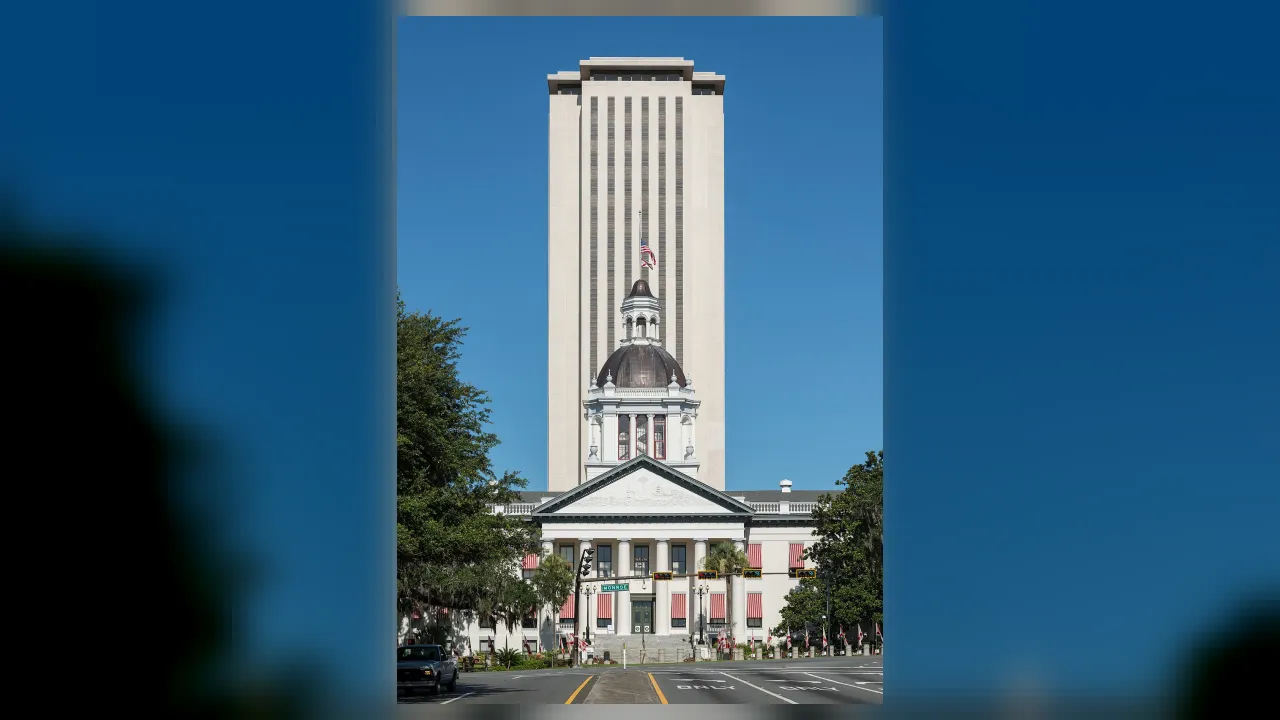
Sweet, juicy oranges ripen on green trees, and moss-draped oaks shade Tallahassee, the state capital.
2. What is the capital city of the State of Florida?
🤯 Mind-Blowing Fact • Grade 2
Southern Florida is the only place on Earth where American alligators and American crocodiles live side by side in the wild!
✨ Word Sparks (Grade 2 Glossary)
Tap 🔊 to hear
wetland
Land soaked with shallow water supporting wildlife
citrus
Juicy, tangy fruits like oranges and grapefruits
tropical
Warm, frost-free climate near Earth's equator
🪝
What is a 'River of Grass,' and where can you find America's oldest city?
1
A Slow-Moving River of Grass
Glide quietly across shallow water in southern Florida's Everglades! Instead of deep banks, fresh water flows slowly through miles of tall green sawgrass. Pink roseate spoonbills wade beside basking alligators.
2
Oldest City and Twenty-Seventh State
Way back in 1565, Spanish explorers founded St. Augustine on Florida's Atlantic coast—making it the oldest continuously lived-in European-founded city in the continental United States! Florida became our twenty-seventh state on March 3, 1845, with Tallahassee as its capital.
3
Islands Linked by Bridges
At Florida's southern tip, a chain of sunny islands called the Florida Keys stretches out into turquoise seas.
1. Which historic coastal town in Florida, founded in 1565, is the oldest continuously inhabited European-established settlement in the continental U.S.?
2. Which two big reptiles live together in the wild ONLY in southern Florida?
🤯 Mind-Blowing Fact • Grade 3
Every Apollo mission that carried astronauts to walk on the Moon blasted off from Launch Complex 39 at Florida's Kennedy Space Center!
✨ Word Sparks (Grade 3 Glossary)
Tap 🔊 to hear
porous
Full of tiny holes that hold water
equator
Imaginary line circling around Earth's middle
reef
Underwater ridge built by tiny coral animals
🪝
Why did NASA choose Florida's Atlantic coast as America's Spaceport to the Moon and Mars?
1
Earth's Spin Helps Rockets Launch!
Feel the ground rumble at Kennedy Space Center on Cape Canaveral as a giant rocket climbs eastward over the Atlantic Ocean! Engineers picked Florida for two smart reasons: being closer to Earth's gives rockets an extra eastward speed boost from Earth's spin, and launching over open ocean keeps people safe below.
2
Longest Coastline in the Lower Forty-Eight
Admitted on March 3, 1845, as the twenty-seventh state, Florida stretches between the Atlantic Ocean and the Gulf of Mexico. Counting bays and barrier islands, its 1,350-mile coastline is longer than any other state's except Alaska!
3
Limestone Springs and Coral Reefs
Beneath Florida's sandy soil sits limestone rock that acts like a giant sponge, feeding hundreds of clear freshwater springs. Offshore from the Florida Keys lies the continental United States' only living barrier coral .
4
Seminole Heritage and Tallahassee
Long home to Calusa, Timucua, Apalachee, and Seminole peoples, Florida chose Tallahassee—halfway between historic St. Augustine and Pensacola—as its capital in 1824.
1. Why does launching rockets eastward from Florida give spacecraft a helpful boost?
2. Why was Tallahassee originally selected as Florida's capital city in 1824?
🤯 Mind-Blowing Fact • Grade 4
Castillo de San Marcos in St. Augustine was built from coquina—a natural stone made of cemented seashells—whose spongy pockets absorbed cannonballs instead of shattering!
✨ Word Sparks (Grade 4 Glossary)
Tap 🔊 to hear
aquifer
Underground rock layer storing clean fresh water
coquina
Soft limestone formed from pressed ocean shells
mangrove
Coastal tree with tangled roots in saltwater
🪝
How does an underground sponge of ancient sea shells power crystal springs, sinkholes, and the Everglades ecosystem?
1
Built Upon an Ancient Limestone Platform
Millions of years ago, warm shallow seas covered the Florida Platform, piling up billions of seashells and coral skeletons that hardened into thick limestone. Rainwater absorbs a tiny bit of natural acid from soil, slowly dissolving underground tunnels and caves through that limestone—forming the Floridan , one of the world's most productive underground freshwater reservoirs! Over seven hundred crystal-clear springs bubble up at a steady 72 degrees year-round, sheltering manatees during chilly winter weeks.
2
How the Everglades Sheet Flow Works
From Lake Okeechobee southward, land slopes downward by less than two inches per mile! Instead of carving a narrow canyon, water spreads up to sixty miles wide and inches deep through sawgrass prairies, cypress domes, and coastal forests—a vital natural filter writer Marjory Stoneman Douglas famously named the 'River of Grass.'
3
Crossroads of Exploration and 1845 Statehood
After Juan Ponce de León sighted the blooming coast during the Easter season of 1513 and named it La Florida ('land of flowers'), Spain built the -shell fortress Castillo de San Marcos in St. Augustine. Acquired by the United States through the 1819 Adams-Onís Treaty, Florida became the twenty-seventh state on March 3, 1845.
4
Overseas Highway and Aerospace Frontiers
Along the Space Coast, Cape Canaveral launches satellites, planetary rovers, and crewed missions, while the 113-mile Overseas Highway leaps across forty-two bridges to connect the Florida Keys to Key West.
1. Why do manatees gather in Florida's inland limestone springs during cold winter spells?
2. What made coquina shell-stone walls at Castillo de San Marcos in St. Augustine surprisingly tough?
🤯 Mind-Blowing Fact • Grade 5
Lake Okeechobee in south-central Florida covers about 730 square miles—so wide you cannot see the far shore—yet its average depth is only about nine feet!
✨ Word Sparks (Grade 5 Glossary)
Tap 🔊 to hear
artesian
Underground water rising naturally under rock pressure
gradient
How steeply or gently land slopes downward
payload
Crew, satellites, or science gear carried upward
🪝
What connects carbonate karst geology, Gulf Stream currents, 1819 diplomacy, and orbital mechanics across America's southernmost mainland peninsula?
1
Carbonate Karst, the Floridan Aquifer, and Sheet Flow
Spanning 65,758 square miles, the Florida Peninsula is the emergent crest of a broad carbonate plateau underlain by thousands of feet of Eocene and Oligocene limestone. Karst dissolution sculpts sinkhole lakes across central Florida and feeds first-magnitude springs such as Wakulla and Silver Springs. South of the Kissimmee River and 730-square-mile Lake Okeechobee, a gentle of roughly three centimeters per kilometer drives laminar sheet flow across Everglades National Park—a UNESCO World Heritage wetland where temperate North American species meet Caribbean subtropical flora.
2
Ocean Currents, Coral Keys, and Subtropical Weather
Warm waters looping out of the Gulf of Mexico join the Florida Current through the Straits of Florida, feeding the mighty Atlantic Gulf Stream while nurturing the 350-mile Florida Reef Tract alongside ancient fossilized coral islands known as the Florida Keys. Afternoon sea breezes converging from both coasts make central Florida one of North America's most active thunderstorm zones.
3
Indigenous Ingenuity, Colonial Treaties, and Statehood
Centuries before Spanish explorer Juan Ponce de León arrived in 1513, Calusa mariners engineered shell-mound islands and canals along southwest estuaries, while Timucua and Apalachee communities farmed northern woodlands, later joined by Seminole communities who adapted chickee stilt architecture to the wetlands. Following Spanish and brief British rule, Secretary of State John Quincy Adams negotiated the 1819 Adams-Onís Treaty transferring Florida to the United States, leading to statehood as the twenty-seventh state on March 3, 1845.
4
Orbital Physics Along the Space Coast
Located near 28.5° N latitude on Merritt Island and Cape Canaveral, Kennedy Space Center imparts roughly 409 meters per second (over 910 mph) of eastward rotational velocity to rockets at liftoff—maximizing mass for Apollo lunar missions, thirty years of Space Shuttle flights, commercial crew capsules, and deep-space probes.
5
Ecological Restoration and Global Crossroads
Today, engineers and ecologists collaborate on the Comprehensive Everglades Restoration Plan to restore natural freshwater flow while Florida's seaports, aviation hubs, and agricultural groves connect North America with Latin America and the Caribbean.