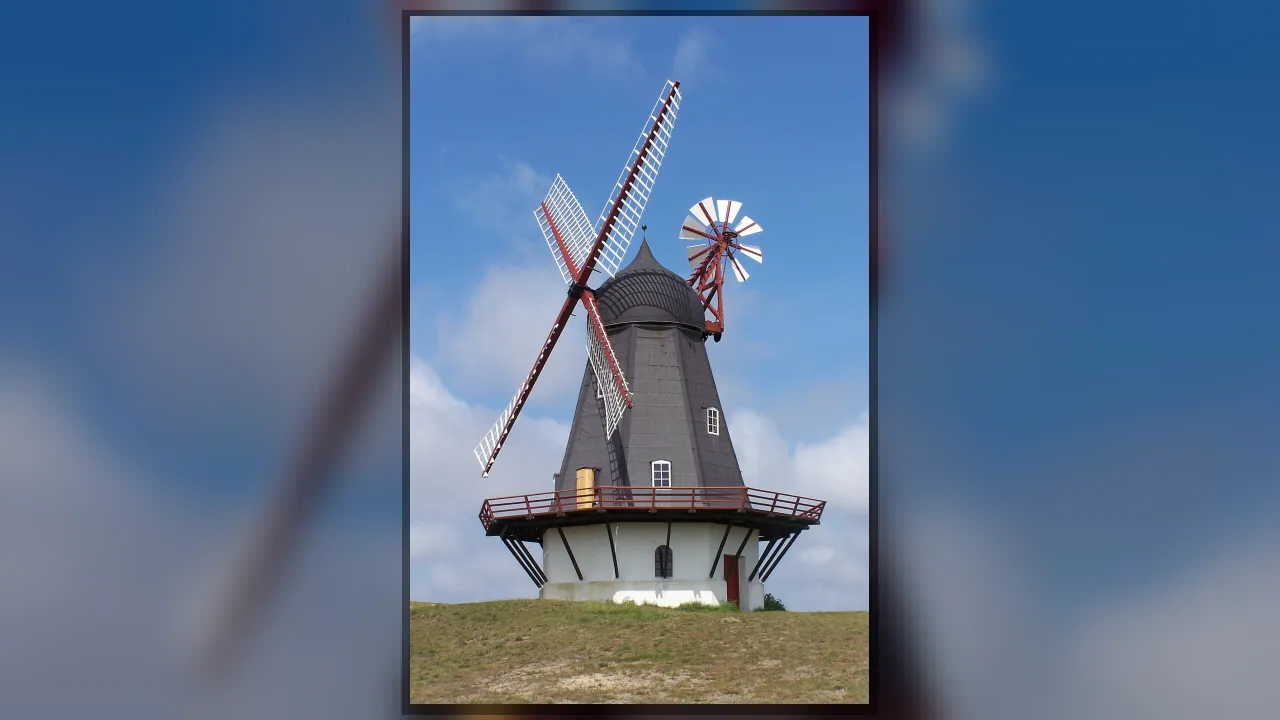
1. What pushes the giant arms on the outside of a windmill?
2. What do the heavy round stones inside a grain windmill make?
🤯 Mind-Blowing Fact • Grade 2
Dutch millers used the stopping positions of their giant sails like secret text messages—tilting them one way to celebrate a wedding and another way to warn neighbors!
✨ Word Sparks (Grade 2 Glossary)
Tap 🔊 to hear
millstone
Heavy grooved stone wheel that grinds grain
turbine
Modern bladed machine making wind electricity
prairie
Wide flat grassland with few trees
🪝
What did desert builders do for power where rivers dried up—yet strong winds roared every day?
1
Born in Windy Desert Lands
Over a thousand years ago in eastern Persia, rivers dried up in summer, while fierce desert winds blew for months! Clever builders stood woven reed sails upright around a post like a giant revolving door to grind grain.
2
Tilted Sails in Europe
By the 1180s, builders in England, France, and Holland placed four cloth-covered wooden sails on the front of tall towers. Because wind changes direction, millers turned the whole top cap so the sails always faced the breeze!
3
From Flour to Clean Lights
American farm windmills later pumped well water across dry , and sleek white wind today spin generators to light millions of homes.
1. How did the earliest ninth-century Persian windmills spin?
2. Why did European tower windmills have a rotating roof cap at the top?
🤯 Mind-Blowing Fact • Grade 3
At Amsterdam's historic industrial district in the 1600s, over a thousand windmills sawed ship timber, ground colorful paint pigments, pressed cocoa, and crushed mustard all at once!
✨ Word Sparks (Grade 3 Glossary)
Tap 🔊 to hear
pitch
Tilt angle of a blade catching wind
polder
Low land reclaimed from water by dikes
vane
Tail fin keeping blades facing the wind
🪝
If the wind blows straight at a windmill from the front, why do its sails spin sideways instead of just tipping backward?
1
Hold Your Hand Tilted in a Breeze!
Try tilting a flat piece of cardboard slightly next time a fan blows toward you! Instead of only pushing straight back, the air slides off the angled face and nudges your hand sideways. Windmill sails use that exact angled tilt—called —to turn straight wind into spinning motion!
2
Persia, Holland, and the American West
Ninth-century engineers in Sistan, Persia, built the first working wind-powered grain mills using vertical axles and woven reed mats. Three centuries later, European builders created horizontal-axle post mills and stone tower mills. In 1854, American inventor Daniel Halladay designed self-governing farm windmills with dozens of steel blades and a tail that aimed into prairie gusts automatically.
3
Pumping Back the Sea
Across the Netherlands, chains of windmills turned giant scoop wheels and Archimedes' screws to lift water out of soggy lowlands called , creating fertile farms below sea level!
4
Sparking Wind Electricity
In 1887, Scottish professor James Blyth connected wind sails to a dynamo to light his cottage—launching the clean wind-power era we use today.
1. What makes windmill sails spin around in a circle instead of simply bending straight backward?
2. Who built the first wind-powered machine that generated electricity to light a home in 1887?
🤯 Mind-Blowing Fact • Grade 4
The blade tips on a modern offshore wind turbine—descended from classic windmills—can slice through the air at over 290 kilometers per hour even in a moderate breeze!
✨ Word Sparks (Grade 4 Glossary)
Tap 🔊 to hear
torque
Twisting force that makes shafts rotate
fantail
Small rear wheel turning cap into wind
aerodynamic
Shaped to harness smooth air motion efficiently
🪝
How did timber gears and canvas sails power the world's very first factory boom centuries before coal or steam engines?
1
Step Inside a Breathing Timber Giant
Climb the creaking wooden ladder inside a seventeenth-century Dutch smock mill when a brisk North Sea gale hits! Overhead, a massive oak windshaft groans as twenty-meter sails slice the sky, transferring tremendous through wooden bevel gears to saw thick oak logs into ship planks in minutes.
2
Two Ingenious Designs
Reliable wind machinery began in ninth-century Sistan along the Persia-Afghanistan border, where fierce 120-day summer gales drove vertical-axis 'panemone' mills shielded on one side by mud-brick baffle walls. Around 1185 in Yorkshire and Normandy, European millwrights invented the horizontal-axis post mill, soon adding a miniature rear '' rotor patented by Edmund Lee in 1745 that automatically geared the heavy roof cap around whenever wind direction shifted!
3
Aerodynamic Lift Versus Simple Push
Early millers thought wind merely pushed flat sails, yet centuries of trial taught craftsmen to twist wooden sail bars slightly from hub to tip—just like an airplane wing or propeller! Moving air flows faster across the curved front surface, creating low-pressure lift that pulls the sail tips faster than the wind itself.
4
From Prairie Wells to Offshore Giants
Following Daniel Halladay's 1854 self-regulating water-pumping windmill and Charles Brush's 1888 12-kilowatt electric wind dynamo in Cleveland, Ohio, engineering evolved into sleek offshore wind turbines standing taller than skyscrapers.
1. What clever invention did Edmund Lee add behind windmill caps in 1745?
2. Why did skilled millwrights twist wooden sail frames from root to tip like a propeller?
🤯 Mind-Blowing Fact • Grade 5
Centrifugal flyball governors—famous for controlling James Watt's steam engines during the Industrial Revolution—were actually invented first by eighteenth-century windmill engineers to regulate spinning millstones!
✨ Word Sparks (Grade 5 Glossary)
Tap 🔊 to hear
Betz limit
Maximum 59.3% wind energy any rotor captures
solidity
Fraction of rotor circle filled by blades
governor
Spinning weights that automatically regulate machine speed
🪝
Why do the laws of physics forbid any windmill or wind turbine on Earth from capturing 100 percent of the wind's energy?
1
The Physics Riddle of Moving Air
Suppose a windmill extracted every last joule of kinetic energy from oncoming air: the air directly behind the blades would stop dead still, blocking fresh wind from flowing through! In 1919, German physicist Albert Betz proved mathematically that an ideal open rotor can capture at most 16/27—or 59.3 percent—of wind's kinetic energy, a ceiling celebrated as the .
2
From Sistan Panemones to Dutch Industrial Zones
Although Hero of Alexandria sketched a miniature wind-wheel organ in the first century CE, large-scale wind power emerged in ninth-century Sistan (eastern Iran), where vertical-axis drag-driven panemones milled grain and pumped irrigation water. By 1185, horizontal-axis post mills dotted England and Flanders, translating horizontal windshaft rotation downward through a wooden 'wallower' bevel gear to drive two-ton quartz runner stones. In the seventeenth-century Zaan region of the Netherlands, wind-powered crankshafts invented by Cornelis Corneliszoon van Uitgeest turned timber sawing thirty times faster, fueling global shipbuilding.
3
Lift-to-Drag Ratios, Solidity, and Mechanical Governors
Fluid dynamics distinguishes two regimes of wind machinery. Multi-bladed American farm windmills feature high '' (many wide blades filling the circle), producing massive starting torque at low speeds—ideal for lifting heavy piston water pumps deep underground. Conversely, Dutch grain mills with twisted 'weather' angles and modern three-bladed wind turbines use low solidity and airfoil cross-sections to maximize aerodynamic lift at high tip-speed ratios. To keep flour from scorching during sudden squalls, Scottish engineer Thomas Mead and Andrew Meikle paired spring-loaded shutter sails with centrifugal flyball that automatically adjusted millstone gap width!
4
Birth of Wind Electricity
Following James Blyth's 1887 Scottish cloth-sail generator and Charles Brush's 17-meter, 144-blade cedar rotor in Ohio (1888), Danish pioneer Poul la Cour combined wind tunnels with hydrogen electrolysis in the 1890s, laying the scientific foundation for modern aerodynamics.
5
Clean Megawatts Across Land and Sea
Today single offshore wind turbines sweep circles over 230 meters wide—generating 15 megawatts of emission-free electricity from the exact solar-driven atmospheric currents Persian millers tapped eleven centuries ago.