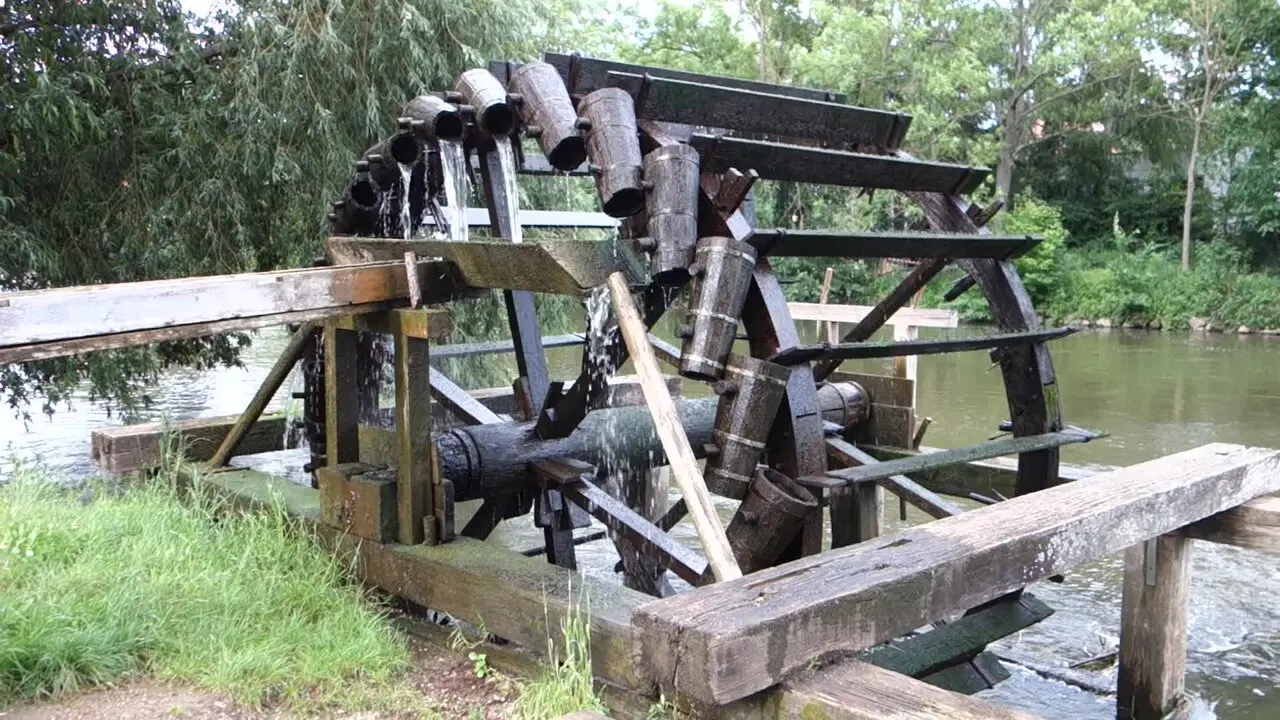
1. Why could a waterwheel work much longer than horses or oxen?
2. What pulls the top-fed bucket wheel downward to make it turn?
🤯 Mind-Blowing Fact • Grade 2
In ancient southern France, Roman engineers built sixteen waterwheels cascading down one single hillside at Barbegal—grinding enough flour each day to feed over ten thousand people!
✨ Word Sparks (Grade 2 Glossary)
Tap 🔊 to hear
undershot
Wheel pushed at bottom by flowing stream
overshot
Wheel turned by water pouring on top
trough
Long open channel guiding water forward
🪝
Before engines or wall outlets existed, how did towns saw giant logs, hammer iron, and grind tons of wheat?
1
Nature's First Mighty Engine
Long ago, grinding grain by rubbing two stones together by hand took hours of aching work! Around 250 BCE, inventors around the Mediterranean Sea and in China dipped giant paddled wheels into rushing streams so rivers did the heavy lifting.
2
Bottom Push or Top Pour?
Builders made two clever kinds of wheels. An wheel dips flat paddles into fast water at the bottom, while an wheel uses a wooden to pour water into buckets at the very top!
3
Powering Busy River Towns
Spinning axles soon ran bellows for hot iron furnaces, pounded rags into paper, sawed planks, and wove cloth.
1. How does an 'overshot' waterwheel get its spinning power?
2. Besides grinding flour, what other jobs did ancient waterwheels perform?
🤯 Mind-Blowing Fact • Grade 3
In Syria along the Orontes River stand the giant wooden Norias of Hama—creaking medieval waterwheels up to 20 meters tall that lift river water up into stone aqueducts all by themselves!
✨ Word Sparks (Grade 3 Glossary)
Tap 🔊 to hear
millrace
Narrow channel guiding swift water to wheel
bellows
Pump blowing strong air onto hot fires
hydroelectric
Making electricity from falling or flowing water
🪝
Why is pouring a small stream over the top of a waterwheel three times more powerful than letting a river push the bottom?
1
Speed Versus Gravity
Watch water splash against paddles at the bottom of an undershot wheel: most of the stream's energy slips right past! Now guide that same stream along a raised wooden channel called a and pour it into angled buckets at the top—gravity pulls every heavy liter of water all the way down, capturing up to triple the power!
2
Romans and Han Dynasty Innovators
Greek engineer Philo of Byzantium described waterwheels around 240 BCE, and Roman architect Vitruvius explained how right-angle gears turned horizontal axle spin into flat-spinning millstones. Meanwhile in 31 CE, Chinese engineer Du Shi hooked waterwheels to piston rods that pumped air blasts into iron furnaces, melting cast iron centuries ahead of Europe!
3
Over Five Thousand Mills in One Book
By 1086 CE, England's famous Domesday Book counted more than 5,600 watermills across English villages—roughly one waterwheel for every fifty families!
4
Grandparent of Hydroelectric Dams
In the 1800s, engineers enclosed curved metal waterwheels inside pipes to create modern water turbines that spin giant electric generators inside dams today.
1. What breakthrough did Han Dynasty engineer Du Shi achieve with waterwheels in 31 CE?
2. Why does an overshot bucket wheel capture so much more energy than a simple undershot paddle wheel?
🤯 Mind-Blowing Fact • Grade 4
Built in 1854 on the Isle of Man, the cast-iron 'Lady Isabella' Laxey Wheel measures 22.1 meters (72.5 feet) across and pumped 1,100 liters of water per minute out of deep lead mines!
✨ Word Sparks (Grade 4 Glossary)
Tap 🔊 to hear
hydraulic
Operated or powered by moving liquid water
noria
Waterwheel with rim pots lifting irrigation water
camshaft
Rotating bar with bumps lifting heavy hammers
🪝
Did you know the Industrial Revolution actually began beside rushing mountain rivers—decades before coal steam engines took over?
1
Why Factories Were Called 'Mills'
Ever wonder why textile factories, steelworks, and paper plants are still called 'mills' even when they grind zero grain? In the 1770s in Britain and New England, the very first giant cotton-spinning factories clustered along steep rivers so towering iron waterwheels could drive thousands of spinning spindles at once!
2
Ancient Roots Across Eurasia
power blossomed in the third century BCE around the eastern Mediterranean. Roman engineer Vitruvius documented geared vertical watermills in 'De Architectura' around 25 BCE, culminating in Rome's sixteen-wheel Barbegal complex in Gaul, which ground 4.5 metric tons of flour daily. Simultaneously in Han China, engineers coupled horizontal and vertical waterwheels to trip-hammers for hulling rice and piston-bellows for blast furnaces, while medieval Islamic engineers built floating bridge mills on the Tigris and giant 20-meter lifting wheels in Hama and Cordoba.
3
John Smeaton Tests Efficiency
For centuries, millwrights built wheels by guesswork. In 1759, English civil engineer John Smeaton built precision scale models and proved scientifically that kinetic undershot wheels converted only ~22 percent of water energy into work, whereas gravity-driven overshot wheels reached over 60 percent efficiency! Breastshot wheels—receiving water halfway up—balanced high flow with solid torque.
4
Evolving Into the Francis Turbine
In the nineteenth century, Benoit Fourneyron, Lester Pelton, and James Francis curled wheel blades inside pressurized steel casings, raising efficiency past 90 percent inside modern hydroelectric dams.
1. What surprising discovery did British engineer John Smeaton prove with his 1759 scale-model experiments?
2. Why are giant industrial cloth and paper factories still often called 'mills' in English today?
🤯 Mind-Blowing Fact • Grade 5
In 1682 at Marly-le-Roi in France, fourteen gigantic 12-meter waterwheels worked together in the Seine River—driving more than 250 pumps to lift water 150 meters uphill for the fountains of Versailles!
✨ Word Sparks (Grade 5 Glossary)
Tap 🔊 to hear
prime mover
Machine converting natural energy into mechanical motion
head
Vertical height difference falling water drops through
reciprocating
Moving straight back and forth repeatedly
🪝
How did harnessing the gravitational potential energy of falling water liberate civilization from muscle power—and birth modern turbine engineering?
1
Crossing the Prime-Mover Threshold
For tens of thousands of years, nearly every physical task—from crushing ore to lifting water—depended on metabolic energy from human or animal muscle, peaking around 75 watts per laborer or 750 watts per draft horse. Inventing the hydraulic waterwheel shattered that biological ceiling forever, tapping the solar-driven hydrologic cycle for continuous kilowatts of mechanical shaft power.
2
Parallel Triumphs in Rome, China, and the Islamic World
Emerging in Hellenistic Alexandria and Anatolia in the third century BCE, watermills took two classic forms: the gearless vertical-shaft 'Norse' or Greek turbine wheel, and the horizontal-shaft Vitruvian wheel (c. 25 BCE), which drove millstones via right-angle crown-and-lantern gears at up to five times axle speed. At second-century Barbegal in Roman Gaul, twin aqueducts fed sixteen overshot wheels arranged in two stepped cascades, generating ~30 kilowatts to feed nearby Arles. Independently in 31 CE, Han Dynasty prefect Du Shi linked horizontal waterwheels via cranks and connecting rods to metallurgical blast-furnace bellows, while medieval Islamic engineers mounted ship-mills midstream in fast river currents and dotted Iberia and Syria with self-powered norias.
3
Potential Energy, Head, and Smeaton's Mechanics
Available hydraulic power follows P equals rho times g times Q times H—the product of water density (1,000 kg/m³), gravity (9.81 m/s²), volumetric flow rate Q, and vertical drop ('') H. In his Royal Society experiments of 1759, John Smeaton demonstrated why inelastic turbulent impact limits flat-paddle undershot wheels to ~22% efficiency, whereas smooth entry into ventilated overshot buckets converts static gravitational weight across head H at 60–70% efficiency—later pushed to 75% by Jean-Victor Poncelet's curved undershot blades.
4
Cams, Cranks, and Industrial Mechanization
Studding wooden waterwheel shafts with iron cams transformed continuous rotation into rhythmic linear blows: Cistercian monasteries and Renaissance guilds mechanized fulling hammers for wool, trip-hammers for steel forgings, rag-pulp stampers for printing paper, mine-drainage pumps like the 22.1-meter Laxey Wheel (1854), and Richard Arkwright's 1771 water-frame cotton mills.
5
Metamorphosis Into Reaction and Impulse Turbines
Seeking higher rotational speeds for electric dynamos, nineteenth-century engineers Benoit Fourneyron, James Francis, and Lester Pelton enclosed guided water jets inside swirled metal runners—achieving over 92% efficiency in hydroelectric turbines that today generate roughly one-sixth of global electricity.