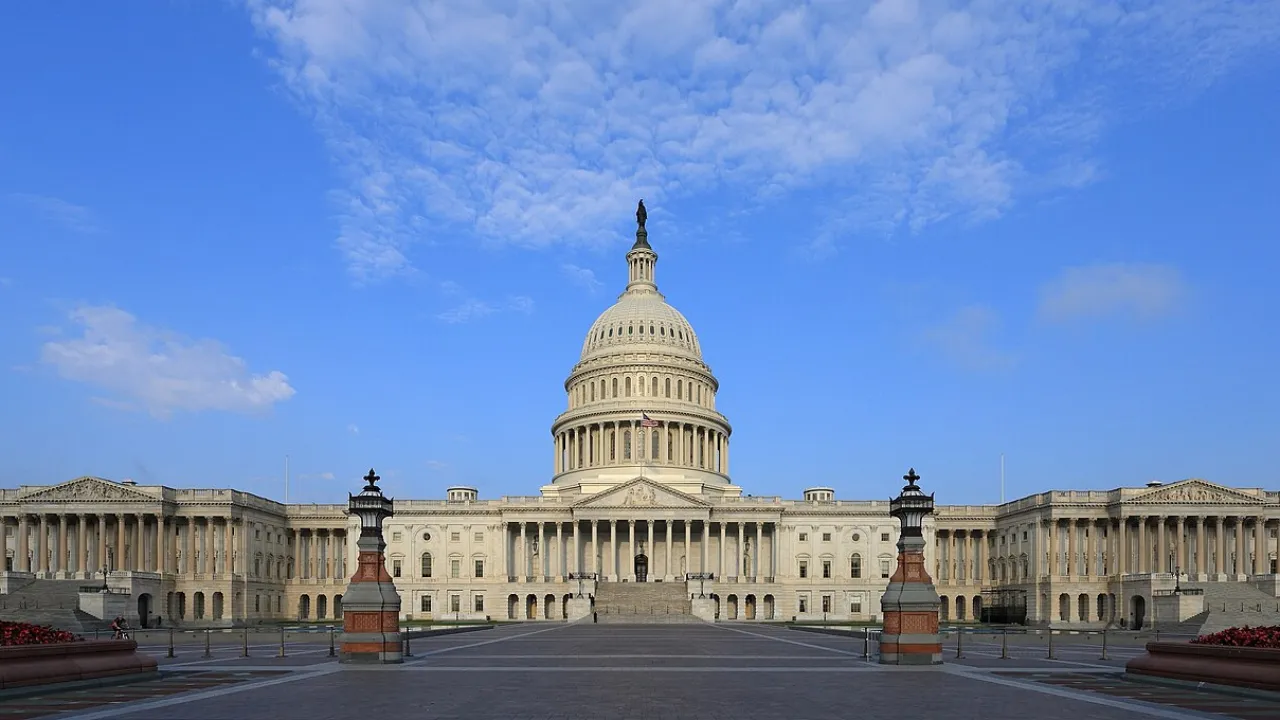
1. Where does the President of the United States live and work in Washington, D.C.?
2. Does Washington, D.C., belong inside one of the 50 U.S. states?
🤯 Mind-Blowing Fact • Grade 2
The Library of Congress in Washington, D.C., is the largest library on Earth, with over 800 miles of bookshelves holding more than 170 million items!
✨ Word Sparks (Grade 2 Glossary)
Tap 🔊 to hear
district
special area set aside for a purpose
Congress
elected lawmakers in the Senate and House
Supreme Court
highest court of judges in the nation
🪝
Why did America's Founders build a brand-new capital city instead of picking an older state city?
1
A Fair Home for Every State
Stand on the grassy National Mall and look east to the U.S. Capitol dome and west to the Lincoln Memorial! After winning independence, leaders decided no single state should have extra power by owning the national capital. So Maryland and Virginia gave land along the Potomac River to form the of Columbia—named for Christopher Columbus and President George Washington.
2
Three Branches Working Together
All three branches of national government work here: writes laws in the Capitol, the President leads in the White House, and justices decide cases in the .
3
Books and Blossoms
Three thousand cherry trees bloom each spring, and the Library of holds millions of books!
1. Why did the Founders create a separate federal district for the nation's capital?
2. Which two neighboring states border Washington, D.C., along the Potomac River?
🤯 Mind-Blowing Fact • Grade 3
You can still spot a color change partway up the 555-foot Washington Monument because builders paused during the Civil War and finished the top later with marble from a slightly different quarry!
✨ Word Sparks (Grade 3 Glossary)
Tap 🔊 to hear
surveyor
expert who measures exact land borders and maps
archives
safe place preserving original historic documents
avenue
wide tree-lined city street
🪝
How did an engineer and a self-taught astronomer map America's capital out of woods and farmland?
1
Choosing a Spot on the Potomac
Imagine riding on horseback beside George Washington in 1791 as mist rises off the Potomac and Anacostia rivers! Congress had just passed the Residence Act of 1790, letting President Washington pick the exact ten-mile-square site midway between Northern and Southern states.
2
L'Enfant and Benjamin Banneker
French-born engineer Pierre Charles L'Enfant designed grand diagonal radiating like sunbeams from Capitol Hill and the President's House. Alongside Andrew Ellicott worked Benjamin Banneker, a brilliant free African American mathematician and astronomer from Maryland who used star positions at night to mark the district's boundary stones!
3
Monuments of Memory
Along the National Mall rise the 555-foot stone Washington Monument, the Jefferson Memorial, the Lincoln Memorial, and the Martin Luther King Jr. Memorial.
4
America's Attic and Archives
Inside the National , visitors read the original handwritten Declaration of Independence, U.S. Constitution, and Bill of Rights.
1. How did astronomer and mathematician Benjamin Banneker help create Washington, D.C., in 1791?
2. Which building in Washington, D.C., displays the original handwritten Declaration of Independence and U.S. Constitution?
🤯 Mind-Blowing Fact • Grade 4
Contrary to an old myth, no law says buildings in Washington, D.C., can't top the Capitol—instead, the Height of Buildings Act of 1910 ties building heights to the width of the street out front!
✨ Word Sparks (Grade 4 Glossary)
Tap 🔊 to hear
compromise
agreement where each side gives a little
retrocession
returning land back to the state that gave it
Electoral College
constitutional group casting official votes for president
🪝
Why is Washington, D.C., shaped like a diamond missing one western slice—and why has it zero skyscrapers?
1
Constitutional Compromise of 1790
Before 1800, America's national Congress met in eight different towns, including Philadelphia and New York City. Under Article I, Section 8 of the U.S. Constitution, Congress received power to govern a federal capital district not exceeding ten miles square. Over dinner in 1790, Thomas Jefferson, James Madison, and Alexander Hamilton struck a famous : in exchange for federal management of Revolutionary War state debts, the permanent capital would rise along the Potomac River between Maryland and Virginia!
2
Why One Piece Returned to Virginia
Originally, forty sandstone markers outlined a neat 100-square-mile diamond straddling both banks of the Potomac. In 1846, Congress returned the 31-square-mile portion south of the river—today's Arlington County and part of Alexandria—back to Virginia, leaving modern Washington, D.C., at 68 square miles carved from former Maryland land.
3
Surviving 1814 and Voicing National Ideals
After John and Abigail Adams moved into the unfinished White House in November 1800, British troops burned both the Capitol and White House during the War of 1812—though First Lady Dolley Madison famously rescued Gilbert Stuart's portrait of George Washington! Rebuilt in stone, the Lincoln Memorial steps later echoed with Marian Anderson's 1939 concert and Dr. Martin Luther King Jr.'s 1963 'I Have a Dream' speech.
4
Height Limits and the Twenty-Third Amendment
A strict 1910 federal law caps building heights based on street widths, keeping the Capitol dome and monuments visible across a low, sunlit skyline. In 1961, the Twenty-Third Amendment granted D.C. residents three votes in presidential elections.
1. Why does Washington, D.C., cover 68 square miles on the Maryland side today instead of its original 100-square-mile diamond?
2. What constitutional change did the Twenty-Third Amendment bring for residents of Washington, D.C., in 1961?
🤯 Mind-Blowing Fact • Grade 5
English scientist James Smithson, whose bequest founded the world-famous Smithsonian Institution in Washington, D.C., never once visited the United States during his entire lifetime!
✨ Word Sparks (Grade 5 Glossary)
Tap 🔊 to hear
jurisdiction
official legal authority to govern an area
diffusion
spreading knowledge widely to everyone
bequest
gift left in a will for future good
🪝
How did a Fall Line river port planned on paper in 1791 evolve into the architectural and constitutional stage of the American republic?
1
Fall Line Geography and Nacotchtank Roots
Positioned precisely at the Atlantic Seaboard Fall Line where the Piedmont's crystalline rapids meet the tidal Potomac and Anacostia rivers, Washington, D.C., occupies 68.3 square miles bordered on three sides by Maryland and across the Potomac by Virginia. Centuries before colonial port towns of Georgetown (Maryland) and Alexandria (Virginia) shipped tobacco downriver, Algonquian-speaking Nacotchtank (Anacostan) villagers traded furs, maize, and freshwater pearls at this strategic river confluence.
2
Article I Enclave, the Compromise of 1790, and L'Enfant's Plan
Mindful of a 1783 incident in Philadelphia when unpaid soldiers surrounded Congress while state authorities hesitated, the Framers wrote the District Clause (Article I, Section 8, Clause 17) into the Constitution, authorizing exclusive federal over a national seat of government. Following the Compromise of 1790 negotiated by Jefferson, Madison, and Hamilton, the Residence Act empowered President George Washington—who never lived to govern from the city bearing his name—to select the Potomac site. Pierre Charles L'Enfant drafted a Baroque-meets-republican street grid intersected by state-named avenues, while Andrew Ellicott and free Black astronomer Benjamin Banneker surveyed the original boundary stones—many still standing inside protective iron cages today.
3
Resilience Through War, Emancipation, and the McMillan Plan
When federal clerks relocated from Philadelphia in 1800, muddy lanes connected Capitol Hill and the Executive Mansion. Burned by British regulars in August 1814 and rebuilt under architects Benjamin Henry Latrobe and Charles Bulfinch, the capital transformed during the Civil War into a fortified Union hub; on April 16, 1862—nearly nine months before the Emancipation Proclamation—President Abraham Lincoln signed the D.C. Compensated Emancipation Act freeing over 3,100 enslaved residents, still honored annually on April 16. In 1901–1902, the Senate's McMillan Commission revived L'Enfant's vision, clearing railway tracks to create today's monumental National Mall, Reflecting Pool, and Tidal Basin—graced since 1912 by Yoshino cherry trees gifted by Tokyo as an emblem of international friendship.
4
Smithsonian Scholarship and Civic Stage
Endowed unexpectedly by English chemist James Smithson—who never set foot in the United States yet left his fortune in 1829 to establish in Washington an institution 'for the increase and of knowledge'—the Smithsonian network joins the Library of Congress, National Gallery of Art, and National Archives in making public learning universally accessible. Meanwhile, the National Mall has served as the nation's peaceful civic forum, from suffragist parades in 1913 to the 1963 March on Washington.
5
Home Rule and Modern Governance
Under the Twenty-Third Amendment (1961) and the District of Columbia Home Rule Act (1973), D.C.'s roughly 700,000 residents elect a mayor, city council, and non-voting delegate to the U.S. House of Representatives while vibrant neighborhoods—from historic Shaw and U Street (home of Howard University and Duke Ellington's jazz legacy) to Capitol Hill—shape American culture and law.